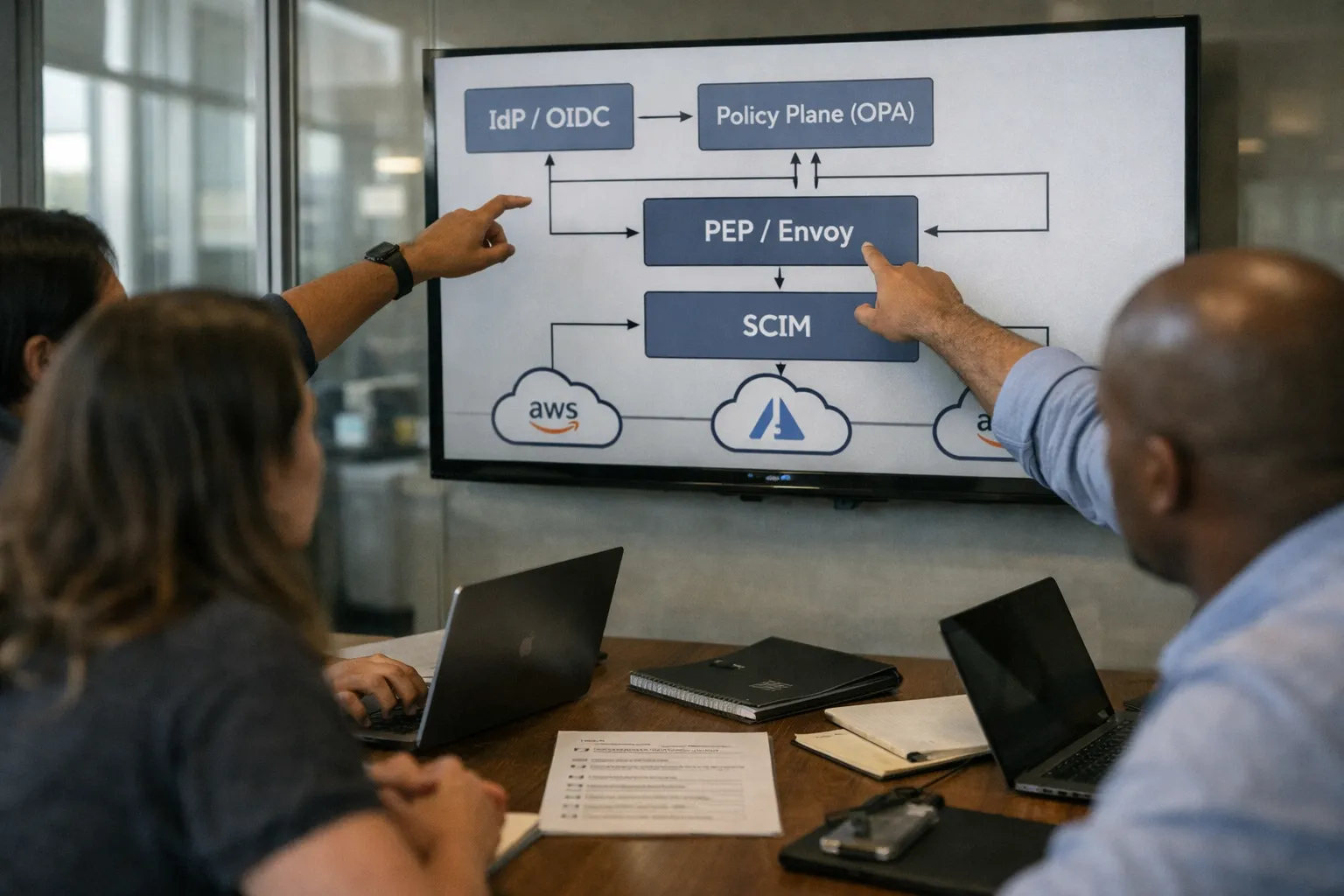
As enterprises finish the transition to distributed, hybrid-cloud estates in 2026, identity no longer sits at the edge — it is the fabric that connects apps, services, devices, and humans. This guide walks enterprise architects and platform engineers through designing and implementing an Identity and Access Management (IAM) Mesh: a decentralized, interoperable identity fabric that delivers secure integration, predictable scalability, and measurable ROI for modern enterprise solutions.
What an IAM Mesh Is (and Why It Matters in 2026)
An IAM Mesh is an architecture pattern that treats identity and authorization as a distributed, policy-driven fabric rather than a single monolithic service. It blends central control-plane capabilities (trust, policy, audit, federated identity) with distributed enforcement points (service-level policy agents, sidecars, cloud-native gateways) so enterprises can:
- Integrate workforce, customer, and machine identities consistently across SaaS, multi-cloud, and on-prem systems.
- Scale authentication and authorization independently of any one vendor or IdP.
- Reduce blast radius from compromised credentials through fine-grained, attribute-based controls and short-lived credentials.
- Measure and demonstrate ROI via reduced onboarding time, fewer security incidents, and lifecycle automation.
When to Choose an IAM Mesh
Consider an IAM Mesh when you face at least two of the following:
- Hybrid deployments across multiple clouds and on-prem clusters with divergent IdPs.
- Frequent cross-domain integrations (SaaS apps, partner APIs, B2B partners).
- Need for dynamic authorization (ABAC, risk-based access) rather than static roles everywhere.
- Regulatory or audit requirements demanding uniform logging and policy enforcement.
High-level Implementation Roadmap
Implementing an IAM Mesh is an organizational and technical program. Use a phased approach:
- Assess and design (0–2 months): inventory identity sources, apps, and integration points; define success metrics and ROI hypotheses.
- Pilot core mesh components (2–4 months): deploy central control plane, policy engine, and enforcement in a single domain.
- Integrate critical systems (4–8 months): connect HR/IDP, cloud accounts, key SaaS apps; automate provisioning via SCIM and SSO via OIDC/SAML.
- Scale and harden (8–12 months): add caching, rate limiting, multi-region replication, and secrets/key management.
- Optimize for operations (12+ months): tune SLA/SLOs, implement telemetry, and drive cross-organizational adoption.
Step-by-step: Design and Technical Decisions
1. Inventory: know your identity sources and integration points
Create a register that lists:
- Identity providers (IdPs): enterprise AD/Azure AD, Okta, ForgeRock, customer identity platforms.
- Applications: SaaS (Salesforce, Workday), cloud consoles (AWS, GCP, Azure), internal APIs, CI/CD tools.
- Provisioning connectors: HRIS, SCIM endpoints, LDAP, custom directories.
- Authorization models used: RBAC, ABAC, capability-based, sessions.
Goal: identify common attributes used for authorization (department, asset tags, device posture) and source-of-truth systems.
2. Choose the control plane and policy layer
The control plane manages trust, federated identity relationships, keys, auditing, and policy distribution. In 2026, most enterprises select a hybrid approach:
- Centralized control plane (could be vendor-managed or self-hosted) that stores policies, roles, and auditing streams.
- Open, standards-based policy language for interoperability (e.g., Open Policy Agent - OPA Rego, XACML for specific use-cases).
Design decision checklist:
- Does the control plane expose APIs for policy automation and CI integration?
- Does it support multi-tenant or per-business-unit policy scoping?
- Does it integrate with your SIEM and audit pipeline?
3. Enforcement: distributed PEPs and identity-aware proxies
Enforcement points (Policy Enforcement Points, PEPs) sit in front of services and evaluate policy decisions from the control plane (Policy Decision Point, PDP). Common enforcement mechanisms in 2026:
- Sidecar proxies (Envoy/Istio) for service mesh environments.
- API gateways with pluginable authz modules for SaaS integrations.
- Lightweight agents for legacy apps to offload token validation and attribute retrieval.
Pattern: keep decision logic centralized but cache decisions at PEPs to avoid latency and availability bottlenecks.
4. Federate identity and sync attributes
Integration tasks:
- SSO: standardize on OIDC for modern services; use SAML for legacy SaaS where required.
- Provisioning: adopt SCIM for lifecycle automation (onboard/offboard) across HRIS → IdP → apps.
- Attribute sync: build pipelines to normalize attributes (e.g., jobCode → accessTier) using ETL or identity transformation services.
Tip: assign attribute ownership (HR owns manager, IT owns device posture) and implement reconciliation rules.
5. Authorization model: adopt ABAC with a fall-back RBAC migration path
Most scalable enterprises use a hybrid model: continue RBAC for broad roles while migrating to Attribute-Based Access Control (ABAC) for fine-grained policies:
- Define canonical attributes (user, device, environment, resource).
- Store policies in the PDP (Rego/OPA recommended) and expose policy-as-code in CI.
- Implement policy change governance with staging and canary releases to avoid breaking access.
6. Token strategy and short-lived credentials
Use bearer tokens with short TTLs, rotate signing keys frequently, and prefer bound tokens where possible (proof-of-possession, DPoP). For machine-to-machine auth, use workload identity systems (e.g., Kubernetes service account tokens with projected credentials) and federated AWS/GCP/Azure access for cross-cloud roles.
Scalability Considerations
Design for both auth traffic scale and policy complexity:
- Horizontal scale for token issuers and introspection endpoints; use autoscaling groups and regional load balancing.
- Cache validated tokens and policy decisions at the PEP with TTLs aligned to risk profiles.
- Rate-limit policy evaluation at the control plane and add fallbacks (cached allow/deny) for degraded modes.
- Monitor and cap attribute enrichment calls (avoid synchronous calls to slow HR APIs during login).
Integration Patterns and Practical Examples
Three common integration patterns that produce high ROI:
- HR-driven workforce onboarding: HRIS -> SCIM -> IdP -> SSO provisioning -> IAM Mesh. Benefit: reduces new hire access time from days to hours.
- Partner B2B federation: establish short-lived trust with partner IdP using OIDC federation and token exchange. Benefit: eliminates shared accounts and manual ACLs.
- Cloud account consolidation: federated SSO across AWS/Azure/GCP using SAML or OIDC and centralized attribute-based role mapping. Benefit: reduces cross-account credential sprawl and audit gaps.
Measuring ROI: Metrics and a Sample Calculation
Track both security and business KPIs:
- Operational: mean time to onboard (MTTO), mean time to revoke access (MTTR), number of manual access requests.
- Security: number of privilege escalations, number of credential compromise incidents, time to detect and remediate.
- Financial: cost of manual provisioning (FTE hours), estimated cost avoided from reduced breaches, SaaS license savings from consolidation.
Sample conservative ROI model (annual):
- FTE savings: 2 admins @ $140k = $280k reduced manual provisioning burden
- Incident reduction: estimated avoidance of one medium breach @ $250k remediation
- License optimization: $60k consolidated SaaS licenses
- Total benefit: $590k
- Implementation & run cost (1st year): control plane + tooling + infra + staff = $300k
- Net benefit year 1: $290k (ROI ≈ 97%) — subsequent years improve as one-time implementation costs amortize.
Note: adjust inputs to your org; the key is tracking MTTO and incident cost assumptions to validate the business case.
Operations, Monitoring, and Compliance
Operationalize the mesh with unified telemetry:
- Collect auth metrics: token issuance/sec, auth latency, error rates, policy decision counts.
- Audit trails: centralize logs (immutable, WORM) for every auth and policy decision for compliance (SOC2, ISO, or industry regs).
- SLOs and incident playbooks: define acceptable auth latencies (e.g., 95th percentile 200ms) and degraded-mode behavior.
Common Pitfalls and How to Avoid Them
- Trying to rip-and-replace all IdPs at once — instead use a federated approach and incremental migration.
- Over-centralizing enforcement and causing latency — deploy PEPs with caching and asynchronous attribute enrichment.
- Undervaluing attribute hygiene — clean and normalize identity attributes before mapping to policies.
- Not automating policy lifecycle — manage policies as code with CI pipelines and tests to prevent outages.
Vendor and Open-source Tooling Considerations (2026)
In 2026 the market mixes platform vendors and specialized tools. Typical stacks combine:
- Enterprise IdPs: Azure AD, Okta, ForgeRock, Ping Identity (for workforce/customer identity).
- Policy engines: Open Policy Agent (OPA), cloud vendor policy services, or built-in PDPs in vendor platforms.
- Enforcement: Envoy/Istio sidecars, cloud-native API gateways, or vendor-provided enforcement agents.
- Provisioning and sync: SCIM connectors, MIM custom adapters, or identity orchestration products.
Pick vendors that support standards (OIDC, SAML, SCIM), expose APIs for automation, and integrate with existing SIEM/CMDB tooling.
12-month Implementation Checklist
- Complete identity inventory and attribute ownership matrix (month 1–2).
- Prototype control plane and deploy OPA as PDP in a non-prod environment (month 2–4).
- Integrate one IdP (workforce) and one critical SaaS via OIDC/SAML and SCIM (month 4–6).
- Deploy PEPs for one service mesh namespace and validate policy latencies (month 6–8).
- Expand to cross-cloud federation, automate provisioning, and roll out to three more applications (month 8–10).
- Finalize SLOs, audits, and hand over to platform operations (month 10–12).
Conclusion: Practical Identity as an Enterprise Fabric
Implementing an IAM Mesh transforms identity into a strategic enabler for enterprise solutions. When designed for interoperability, horizontal scalability, and policy automation, it reduces operational cost, shortens onboarding cycles, and reduces security risk — delivering measurable ROI. Start small with a focused pilot, instrument the right metrics, and evolve policies as code to achieve predictable, scalable identity at enterprise scale.