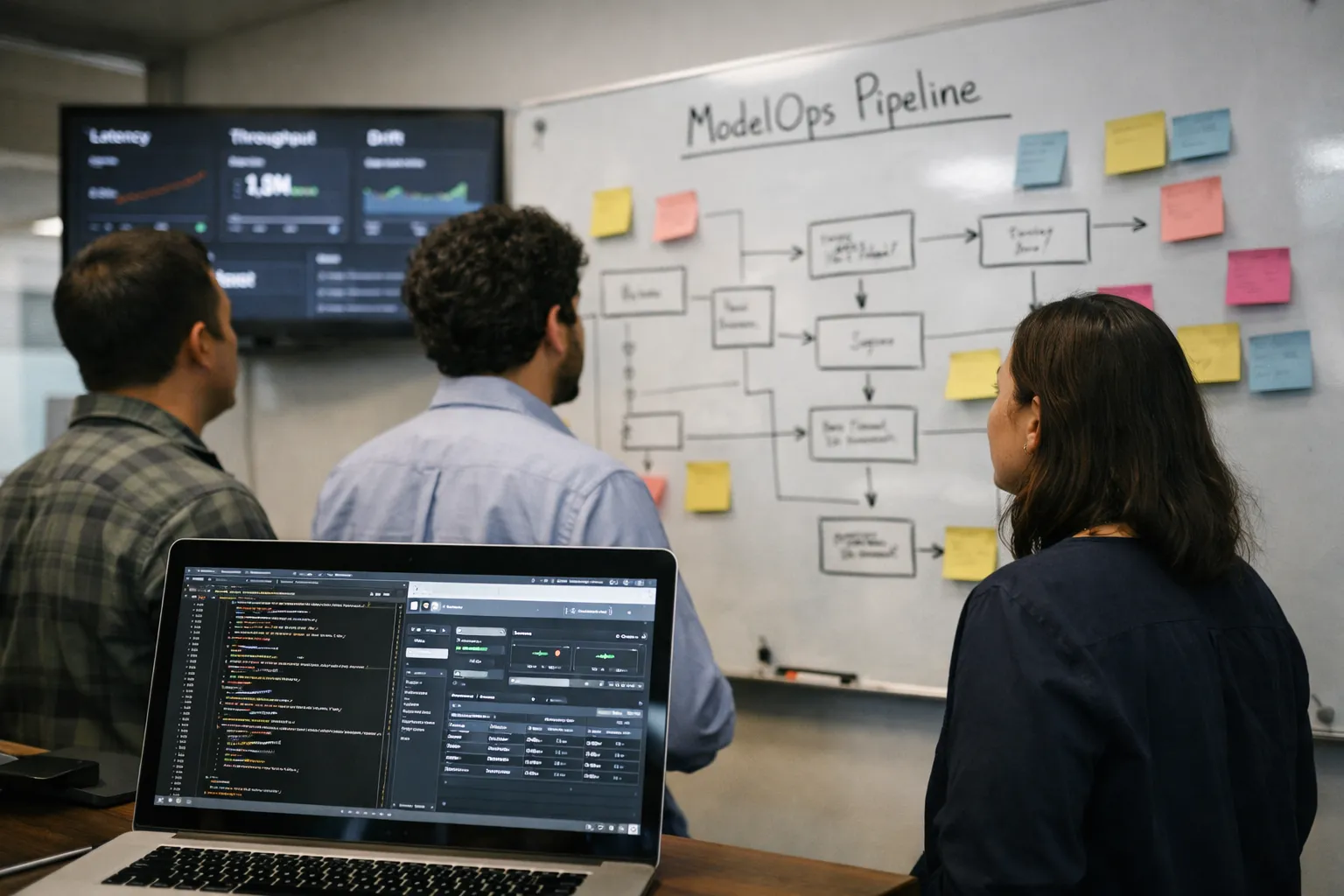
Overview
ModelOps—the practice of operationalizing machine learning and large language models—remains a strategic procurement and architecture decision in August 2026. The platform you choose shapes inference cost, compliance posture, integration effort and the speed at which your AI delivers business value. This update keeps the original framework from 2026 but adds fresh vendor context, operational patterns observed across enterprises through 2025–26, and updated best practices that reflect the maturation of LLM-driven production workloads.
Background: what changed since the first half of 2026
Two developments have made platform choice even more consequential:
- LLM-driven production is now mainstream: Conversational AI, RAG-powered search, and agent-style automation moved from pilots into revenue-bearing applications across retail, banking, and industrial sectors. That shift magnified inference cost as a first-order operational item.
- Supply-chain and governance expectations hardened: Regulators and procurement teams now demand model provenance, signed model artifacts, and auditable prompt handling. Enterprises also face more complex licensing choices for foundation models and third-party embeddings.
Data and evidence: what enterprises are seeing in 2026
Across dozens of enterprise engagements we tracked in 2025–26, these practical patterns recur:
- Inference dominates run costs — for LLM-heavy applications, infrastructure and API spend are the single largest ongoing expense and therefore the primary lever for ROI.
- Hybrid deployments are the default — a majority of production deployments combine managed cloud endpoints for burst capacity, self-hosted inference for baseline volume, and edge/embedded models for latency-sensitive use cases.
- Vector stores and RAG pipelines are standard components — commercial and open-source vector DBs (Pinecone, Milvus, Weaviate, and cloud equivalents) are now part of most deployment diagrams, which shifts integration work from models to index and retrieval pipelines.
- Observability broadened beyond metrics — teams instrument hallucination detection, retrieval relevance, prompt provenance and cost-per-inference with the same priority as latency and availability.
Three platform archetypes (revisited for 2026)
The three archetypes remain useful: managed cloud ModelOps, open-source/self-hosted stacks, and specialized LLMops platforms. Below we update examples, strengths and trade-offs observed through mid‑2026.
1. Managed cloud ModelOps
Examples: AWS SageMaker + Bedrock integrations, Google Vertex AI with managed foundation models, Azure Machine Learning with integrated Mistral/partner endpoints, and cloud vendor bundles that include model governance and cost controls.
- Scalability: Now includes model-mesh routing, per-model autoscaling and serverless LLM inference tiers; best for unpredictable bursts and global multi-region serving.
- Integration: Deep connectors to cloud storage, streaming (Kafka/PubSub), native vector services and identity providers accelerate proofs-of-concept.
- ROI: Shorter time-to-value for cloud-first teams; watch for egress and per-inference metering that can drive long-term TCO if baseline volume is high.
- Implementation: Fast pilots and integrated logging, but expect contractual work on SLAs, model ownership, and exportability of model artifacts for portability.
2. Open-source / self-hosted ModelOps
Examples: orchestration with Flyte or Kubeflow, serving via KServe or Ray Serve, registries with MLflow, feature stores like Feast or Tecton, and vector DBs self-hosted on Kubernetes.
- Scalability: Achievable at lower marginal cost for steady load—provided teams invest in GPU scheduling, queuing and cost-aware autoscaling. Emerging tools (model meshes, custom autoscalers) reduce friction but require platform engineering.
- Integration: Superior when data residency, bespoke identity systems or specialized hardware (on-prem GPU/AI accelerators) are required.
- ROI: Higher upfront engineering costs but lower variable inference costs for long-lived, high-throughput applications; also reduces dependency on vendor licensing terms.
- Implementation: Slower to production without experienced SRE/ML infra staff; best suited to regulated industries and organizations with large steady inference demands.
3. Specialized LLMops and lifecycle platforms
Examples: provider ecosystems and startups focused on LLM routing, prompt/version management and retrieval orchestration (platforms integrating features similar to LangChain frameworks, model routing, prompt stores, and observability tailored to LLMs).
- Scalability: Optimized for cost-aware inference routing, caching, and mixed-precision serving; many now support multi-model ensembles and automatic fallback policies to smaller, cheaper models.
- Integration: Plug into vector stores, knowledge bases, ticketing systems and messaging layers; usually provide SDKs to manage prompts and guardrails centrally.
- ROI: Can reduce inference spend materially through routing and caching and improve user experience through RAG and relevance tuning.
- Implementation: Faster than a custom self-hosted stack but still needs engineering around indexing, embeddings governance, and prompt sanitization.
Multiple perspectives: what vendors, platform engineers, and CIOs say
Platform vendors emphasize speed and integration. Cloud providers pitch managed ModelOps for low friction; specialized vendors highlight LLM-specific controls (prompt versioning, retrieval logging). Platform engineering teams prioritize portability and cost control, pushing for hybrid patterns and model artifact standards that prevent lock-in.
Procurement and legal teams focus on licensing and auditability: foundation-model licensing complexity (usage-based, fine-tuning restrictions and embeddings usage rights) now factors into architecture decisions as much as performance or price.
Implications: what this means for enterprise teams
Key operational implications for 2026:
- Architect for cost per useful response, not just latency: Measure business metrics (customer satisfaction, task success) per dollar and use model routing, caching and smaller specialist models where possible.
- Governance is operational: Implement signed model artifacts, model SBOMs, prompt change logs and role-based prompt/embedding access controls as standard platform features.
- Integration effort shifted to retrieval and indexing: Most production failures now trace to stale indices, mis-specified retrieval pipelines or data drift in the knowledge base rather than model serving bugs.
- Hybrid is the practical default: Use managed endpoints for burst and global presence, self-hosted for baseline volume or compliance, and specialized LLMops for conversational or RAG-heavy applications.
Updated implementation checklist (practical actions for August 2026)
- Define business-level SLAs (latency and "usefulness" metrics such as task completion rates) and map them to model/route-level objectives.
- Catalog models, embeddings, and data sources; implement artifact signing and maintain a model SBOM (software bill of materials) for each deployed model.
- Prototype a three-node architecture: managed burst endpoints, self-hosted baseline inference, and a specialized LLMops layer for routing/caching. Measure cost and accuracy for one representative workload.
- Instrument retrieval: log queries, hits, ranking scores and relevance feedback; include automated drift detection for both model outputs and indices.
- Implement role-based prompt stores, redaction rules for PII, and encryption-in-transit and at-rest for embeddings and indexes.
- Adopt CI/CD patterns for models: immutable artifacts, automated canary rollouts, continuous evaluation against held-out benchmarks and live feedback loops.
- Staffing: ensure a cross-functional team—platform engineers, MLOps engineers, data engineers (indexing/feature owners), and a compliance lead—allocated to the production lifecycle.
Outlook: what to watch for in the near term
Short-term indicators that will shift platform preference:
- Model licensing clarity: If standard commercial terms for foundation models converge, the friction of using managed endpoints will lessen for many enterprises.
- Standardization of model provenance and SBOMs: Wider adoption will make self-hosted architectures easier to manage and audit.
- Vector store consolidation: If a small number of vector DBs gain enterprise-grade features (multi-tenancy, compliance certs, multi-region replication), integration effort for RAG pipelines will fall.
Closing recommendations
In August 2026 the pragmatic enterprise approach remains hybrid. Start with managed or specialized LLMops to validate revenue and UX hypotheses quickly, simultaneously investing in portable artifacts (containerized models, signed registries, standardized index formats) so you can move workloads if cost or governance pressures require it. Prioritize observability that understands usefulness and retrieval relevance, not only latency and errors. Finally, treat model licensing and prompt governance as first-class architecture inputs—those decisions now shape both cost and legal risk.
FAQ
How should I decide between managed and self-hosted ModelOps in 2026?
Start with the constraints: if you need rapid time-to-market and are cloud-native, begin with managed ModelOps or an LLMops platform and measure cost and governance gaps. If data residency, sustained high-volume inference, or bespoke hardware are non-negotiable, plan a self-hosted path and budget for platform engineering. A two-track pilot (managed + self-hosted proof) is the lowest-risk way to decide.
What are the biggest hidden costs of ModelOps today?
Hidden costs include inference spend (API or cloud compute), index maintenance (re-indexing and storage growth), monitoring and annotator labor for feedback loops, and licensing or compliance remediation. Include those in your ROI model, not just engineering headcount or initial cloud credits.
Do I need a specialized LLMops platform if I already have MLOps tooling?
Probably: LLMs create new operational primitives—prompt/version management, retrieval logging, hallucination detection and cost-aware routing—that general-purpose MLOps tools typically don’t cover comprehensively. If your applications are RAG-heavy or conversational, a specialized LLMops layer will accelerate delivery and reduce inference spend.
Which integrations should be non-negotiable for enterprise ModelOps?
At minimum: secure identity and role-based access for model and prompt stores, connectors for your primary data stores and vector DBs, artifact signing and registry support, and observability hooks for both model-level metrics and retrieval-level relevance signals.
How long will it take to reach production readiness in 2026?
Expect 3–12 months for a first production service depending on scope. Small conversational features can launch in weeks on managed platforms; fully governed, regulated deployments with self-hosted inference and full audit trails may still require 9–18 months.