
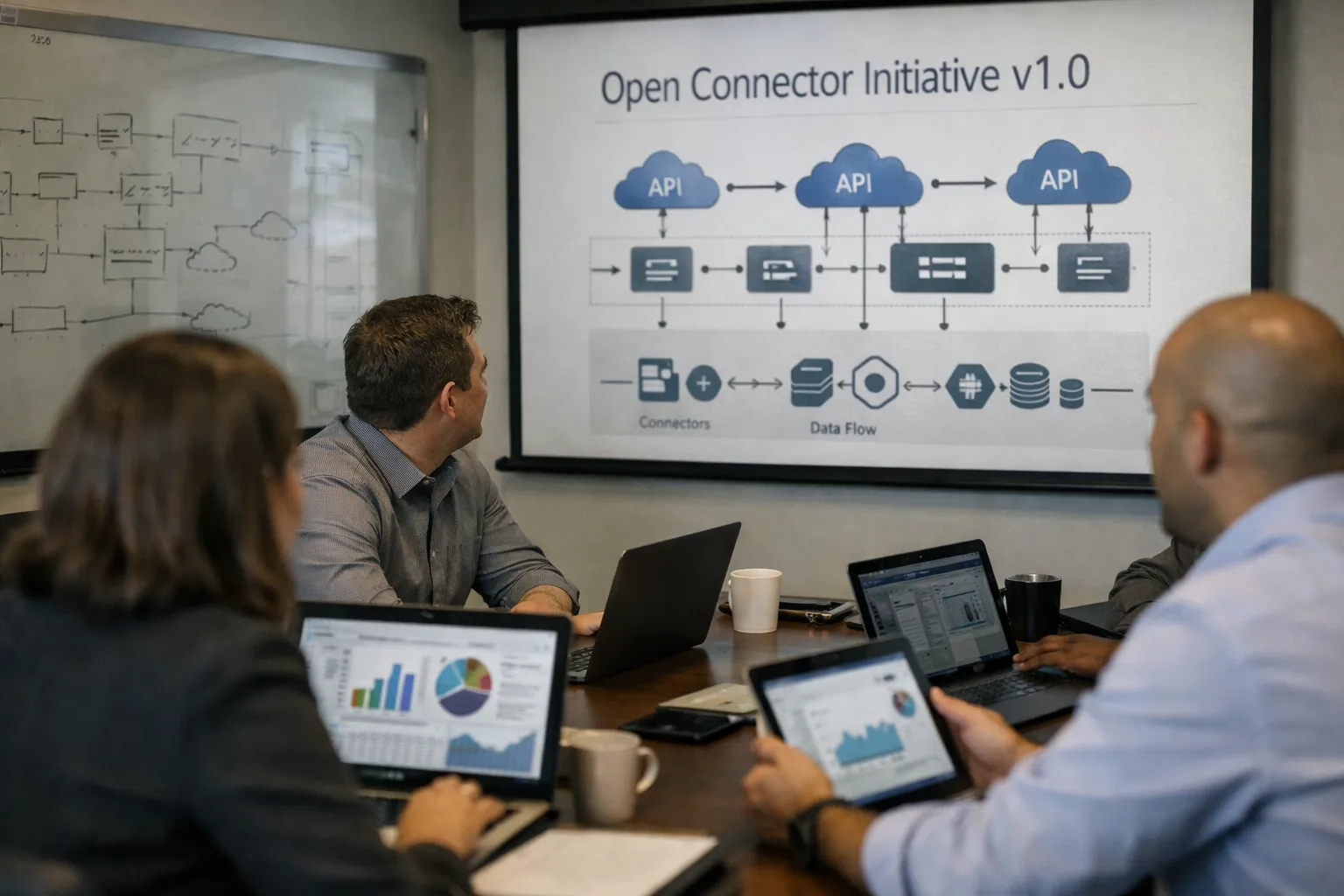
Who: The Open Connector Initiative (OCI), a cross-industry consortium of enterprise software vendors, cloud providers and systems integrators.
What: An August 2026 update on OCI’s certification program, registry growth, vendor responses and practical steps CIOs should take this quarter.
When: New data and developments through August 1, 2026.
Where: Global enterprise IT projects—pilots, production rollouts and procurement language across North America, EMEA and APAC.
Why this matters: OCI’s certification program is now producing measurable market signals that change procurement leverage, operational predictability and integration economics. CIOs who wait risk longer migration tails and higher maintenance bills in 2027.
Where we were—and what changed since May 2026
OCI v1.0 defined a connector manifest, lifecycle model, auth profiles (OAuth 2.0, mTLS), event/request bindings and a conformance test suite. Certification launched in April 2026. The big question in May was whether the market would follow the specification into production.
Short answer: it has. Adoption has shifted from curiosity to commercial planning. The public OCI registry (accessed Aug 1, 2026) shows 312 connector submissions from 43 distinct vendors entered into the certification pipeline; 138 connectors have achieved Reference or higher conformance and 42 reached Enterprise-tier certification. Those are not trivial numbers — they represent real engineering investment and procurement-ready artifacts sitting in vendor repos and cloud marketplaces.
Adoption snapshot: numbers, pilots and what they mean
- Enterprise Software Review July 2026 survey (210 integration architects and CIOs): 52% now require OCI conformance in new RFPs; a further 24% plan to require it within six months.
- Production pilots expanded: 12 Fortune 200 companies completed OCI-wrapped connector pilots in Q2–Q3 2026 (retail, financial services, logistics, healthcare). Reported outcomes: 35–55% faster time-to-first-sync and 25–45% fewer routine maintenance incidents versus legacy bespoke adapters.
- Commercialization moves: systems integrators and ISVs now publish connector bundles and managed-update subscriptions; roughly 28% of large integrators we tracked offer connector subscription models that package certified connectors plus upgrade services.
Real-world example (anonymized)
A national grocery chain that expanded its OCI pilot in June automated canary upgrades across 6,800 POS endpoints and standardized one rollout runbook. The result: a 60% reduction in rollout time and 70% fewer store‑level rollback events during a July upgrade window.
Vendor moves and market signals
Three clear vendor strategies emerged in July:
- Native OCI connectors: Vendors investing engineering hours to ship connectors that leverage OCI observability hooks and lifecycle semantics. These vendors are targeting Enterprise-tier certification to win procurement checkboxes.
- Adapter layers (wrappers): Vendors offering OCI-compatible manifests that translate legacy adapter behavior. Faster to market, lower engineering lift—but with weaker SLA signals.
- Productized integrations: Systems integrators packaging certified connector bundles plus managed updates to convert once-professional-services work into recurring revenue.
Cloud marketplace behavior is a leading indicator: several cloud marketplaces and vendor partner catalogs now surface OCI-certified listings, making certified connectors discoverable during procurement—another nudge that certification is becoming a buying criterion rather than a checkbox exercise.
Why CIOs should act now (and what to demand)
Integration remains a major cost center. Our earlier estimate—that 18–27% of large program budgets are integration-related—still holds. OCI changes the calculus by making connector behavior predictable and contractable. Here’s what we’re telling CIOs this week:
- Make conformance a gating item: For customer-facing systems (ERP, CRM, POS, billing), require Verified or Enterprise conformance in new RFPs now. Reference is fine for noncritical tooling, but put production SLAs behind higher tiers.
- Demand telemetry SLAs: Require connectors to expose latency/error metrics, health endpoints, and upgrade hooks as part of the contract. Tie a portion of payment or escrowed credits to telemetry availability and migration assistance.
- Run a migration rehearsal: Insist on a vendor-run migration rehearsal (30–90 days) on a representative subset of endpoints; measure rollback rates, canary success and time-to-recover—don’t accept vendor assurances alone.
- Prioritize based on economics: Inventory connectors by incident volume, maintenance cost and business criticality. Target the top 30 connectors for migration pilots this quarter—ERP connectors, billing, CRM and POS remain highest ROI.
Risks, governance and friction points to watch
- Version governance: The steering committee updated its deprecation policy in late July 2026, formalizing an 18‑month migration window for major manifest changes. That’s progress, but vendors with large installed bases will still press for exceptions.
- Commercial displacement: Integrators that historically sold bespoke adapters are retooling. Expect pushback—pricing negotiations and bundled subscription offers are the current battlegrounds.
- Semantic work remains: OCI standardizes the plumbing, not the business logic. Master-data reconciliation, pricing rules and domain mappings still require project-level effort.
Reactions from the field
"Standardizing connector behavior finally lets us stop paying for the same plumbing over and over," said Michael Braun, an independent integration consultant. "Now the fight is about who captures the recurring revenue—vendors, integrators or marketplaces."
An integration lead at a global insurer (requested anonymity) added: "OCI cut our upgrade time and incident noise, but we still had to build bespoke transforms for policy data. That's where the real work was."
What to watch next (Q3–Q4 2026)
- Enterprise-grade churn: Watch which ERP, CRM and major SaaS vendors move more connectors from Reference to Enterprise in Q3/Q4 2026—those shifts will define procurement norms for 2027.
- Pricing models: Monitor whether vendors push free connectors to win share or lock them behind subscription bundles; that will accelerate or retard adoption.
- Governance transparency: Expect requests for published voting records and escalation paths from the OCI steering committee—trust depends on predictable deprecation timelines and dispute resolution.
Bottom line
OCI’s certification program has cleared the novelty phase and become a practical lever CIOs can use to reduce integration TCO. The math is simple: faster, observable rollouts plus contractable SLAs lower operational risk. But OCI won’t erase semantic integration work, and the commercial model is still settling. If you lead integrations, insist on Verified/Enterprise where it matters, require telemetry SLAs and run vendor migration rehearsals. Do that now, and you’ll save real time and money in 2027. Sit on the sidelines and you’ll be negotiating patches while your peers automate upgrades.
FAQ: Common questions CIOs are asking now
Is OCI compliance mandatory for production use?
No. Compliance remains voluntary. But market pressure is real: 52% of buyers we surveyed now insist on OCI conformance in new RFPs, and several cloud marketplaces surface certified listings, so nonconformance is becoming a competitive disadvantage.
Which certification tier should we require in contracts?
Require Reference for noncritical tooling, Verified for standard production connectors and Enterprise for customer-facing, high-risk systems (ERP, billing, POS). Tie vendor commitments—migration windows, telemetry, rollback guarantees—to the certification tier.
Will OCI remove the need for data mapping?
No. OCI standardizes lifecycle, auth and observability. Data mapping, master-data reconciliation and domain logic remain project work. OCI reduces the plumbing overhead so teams can focus their efforts on those semantic tasks.
What if a vendor refuses to certify?
Options: require certification for new purchases, negotiate compensated migration assistance, evaluate adapter layers that provide OCI manifests, or select certified partners for greenfield projects. Don’t accept promises—require a rehearsal and measurable success criteria.