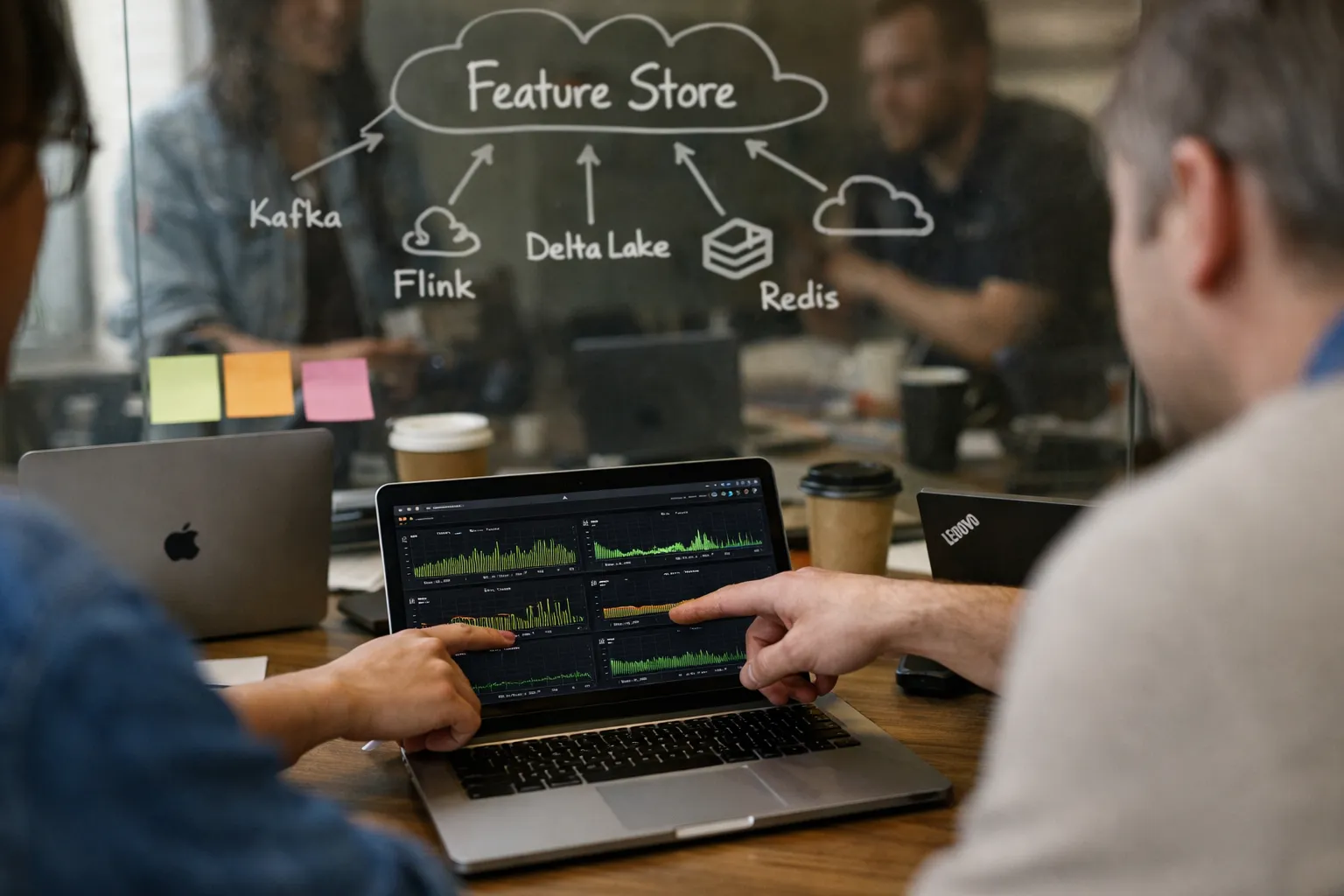
Enterprises deploying real‑time machine learning increasingly treat feature engineering as a reusable product rather than ad‑hoc code. A feature store centralizes feature definitions, storage, and serving to reduce time‑to‑production, improve model consistency, and improve governance. This guide walks engineering and ML teams through a concrete, actionable implementation plan for an enterprise feature store in 2026—covering architecture, integration, scalability, governance, and how to quantify ROI.
Why an enterprise feature store matters now
- Consistency: Ensures training and serving use identical feature calculations (reduces training/serving skew).
- Reusability: Teams reuse production‑grade features across models, reducing duplicated effort.
- Operationalization: Standardizes pipelines, materialization and serving APIs—improving deployment velocity.
- Governance & Compliance: Centralizes lineage, access controls and PII handling for enterprise solutions.
- Scalability: Supports low‑latency online lookups and high‑throughput offline joins required by modern ML services.
When to build vs. buy
By 2026 there are mature commercial and open‑source options (Tecton, Hopsworks, Feast, Databricks Feature Store, Vertex AI/SageMaker Feature Store). Choose 'buy' when you need rapid time‑to‑market, deep vendor integrations (cloud data lake, model hosting), and SLAs. Build when you have specific latency, cost or regulatory constraints and a core engineering capability in platform teams.
Decision factors:
- Integration: Does vendor integrate with your data lake, MLOps stack, streaming platform?
- Scalability: Can the product meet your online latency SLAs (e.g., ≤10ms) and offline throughput?
- ROI: Estimate time saved on feature engineering, faster model iterations, reduced MTTI (mean time to innovate).
- Implementation effort: Pilot velocity and operational burden for long‑term maintenance.
Core architecture patterns
Most enterprise feature stores implement a hybrid online/offline architecture. Key components:
- Feature Registry / Catalog: Stores canonical feature definitions, metadata, owners, and schemas. Integrate with metadata systems (OpenLineage, Amundsen, Data Catalog) for governance.
- Offline Store (Batch): Columnar data lake (Delta Lake, Iceberg, Parquet on S3/GCS/ADLS) for training and backfills.
- Online Store (Serving): Low‑latency key‑value stores such as Redis, DynamoDB, Bigtable, Cassandra, or RocksDB embedded in serving infra.
- Ingestion / Materialization Layer: Streaming (Kafka + Flink/Beam/ksqlDB) and batch (Spark, Dataflow) jobs that compute and write features to online/offline stores.
- Serving API: gRPC/HTTP endpoints that return features for model inference. Co‑located with model hosts for latency gains.
- Orchestration & CI/CD: Airflow, Dagster, or Argo for pipelines; GitOps and feature CI for tests and approvals.
Recommended stack example (2026)
- Metadata & registry: OpenLineage + Amundsen/Great Expectations for validation.
- Offline: Delta Lake on S3/ADLS with Iceberg tables for partition/compaction.
- Streaming: Kafka + Flink for event-time joins and late data handling.
- Online serving: Redis for sub‑10ms reads for high‑QPS features; DynamoDB or Bigtable for global distribution.
- Orchestration: Dagster for feature pipelines, GitOps for feature specs.
- Monitoring: Prometheus + Grafana + OpenTelemetry traces on serving paths.
Integration patterns for enterprise solutions
Feature stores must integrate horizontally with existing data platforms, identity, and MLOps. Key integrations:
- Data ingestion: CDC tools (Debezium) feed Kafka topics; batch ETL writes to lake tables. Ensure schemas and timestamps are carried end‑to‑end.
- Metadata & lineage: Emit OpenLineage events from pipelines to capture provenance and enable audits.
- Identity & access: Integrate with enterprise IAM (SAML/SCIM/Okta/Microsoft Entra) for role‑based access, PII masking and audit trails.
- MLOps: Connect with model registries (MLflow, Seldon, Vertex) so models reference feature specs and can request online lookups in runtime.
- Observability: Push metrics (lookup latency, QPS, miss rates, drift) to Prometheus/Grafana and traces to OpenTelemetry collectors.
Scalability considerations
Design for both throughput and global distribution:
- Partitioning: Partition feature data by entity key (customer_id) and time. Use time‑partitioned offline tables and hashed partitions for online stores.
- Sharding & replication: For global enterprises, replicate online stores across regions and implement deterministic routing to the nearest replica.
- Caching: Use multi‑layer caches (local LRU + global Redis) to lower latency and reduce pressure on persistent online stores.
- Materialization windows: Choose appropriate refresh cadence—streaming materialization for low latency features and micro‑batch for heavy aggregations.
- Backfills & compaction: Implement incremental backfills and table compaction to control resource spikes during large recomputes.
Performance targets (examples)
- Online lookup latency: target 10ms for critical features; 50ms acceptable for less critical ones.
- Throughput: design for peak QPS with headroom (e.g., 2–3x expected peak).
- Consistency: support event‑time joins with watermarking and late data policies to avoid skew.
Implementation roadmap: phases and checklist
Successful rollout typically follows five phases over 3–9 months for a pilot, longer for enterprise‑wide adoption.
Phase 1 — Discovery & design (2–4 weeks)
- Inventory high‑value features and owners.
- Define SLA targets (latency, freshness, availability).
- Choose build vs buy; select pilot tech stack (e.g., Feast + Flink + Redis or Tecton).
Phase 2 — Proof of Concept (4–8 weeks)
- Implement canonical definitions for 5–10 high‑value features.
- Build streaming pipeline from CDC (Debezium → Kafka → Flink) to online store.
- Expose serving API and validate latency and accuracy against baseline.
Phase 3 — Pilot & validation (6–12 weeks)
- Integrate with model training infra and run A/B tests.
- Establish monitoring dashboards: feature freshness, miss rates, drift.
- Implement access controls, PII masking and logging for audits.
Phase 4 — Production roll‑out (3–6 months)
- Onboard additional teams and features; migrate existing ETL to feature pipelines.
- Automate CI for features (unit tests, integration tests, data quality checks).
- Scale online serving, implement global replication if needed.
Phase 5 — Operationalize & optimize (ongoing)
- Measure ROI metrics and iterate on SLAs and cost tradeoffs.
- Establish feature lifecycle policies (deprecation, versioning).
- Refine governance and compliance workflows.
Quantifying ROI and success metrics
Frame ROI in business and engineering terms:
- Model quality uplift: Absolute lift in precision/recall, revenue per model, NRR impact from improved features.
- Velocity gains: Reduced feature development cycles (weeks → days) and quicker model retraining.
- Reuse & reduced cost: Percentage of features reused across teams, fewer duplicated pipelines, lower compute and storage cost from optimized materialization.
- Operational MTTR: Reduced incidents from consistent feature definitions and centralized monitoring.
Track KPIs: feature lookup latency, freshness (% of lookups within SLA window), miss rate, feature reuse count, time to onboard new feature, and cost per QPS.
Common implementation pitfalls and mitigations
- Training/serving skew: Mitigate with canonicalized feature definitions and end‑to‑end tests that compare offline join outputs with online lookups.
- Late or out‑of‑order events: Use event‑time processing with watermarks (Flink/Beam) and define late‑data policies.
- Schema drift: Version feature schemas and support backward compatibility; enforce schema evolution rules.
- Cold start & sparsity: Provide default values and fallbacks; use caching warm‑up strategies.
Governance, compliance and security
Enterprise feature stores must meet regulatory and internal controls:
- Implement RBAC/ABAC via enterprise IAM; log all accesses for audits.
- Manage PII: tokenization, reversible/irreversible masking depending on use case.
- Lineage: integrate OpenLineage and version all feature transforms for reproducibility.
- Data retention & deletion: support GDPR/CCPA deletion requests and retention windows for sensitive features.
Case examples (concise)
- Retail recommender: A retailer migrated session and user aggregates to a feature store (Feast + Redis + Flink). Result: 18% uplift in click‑through and reduced model rollout time by 40%.
- Fraud detection: A bank used Tecton + DynamoDB for online features; streaming materialization from Kafka reduced fraud detection latency from seconds to sub‑100ms, preventing larger losses.
Cost considerations
Key cost drivers: online store storage/replication (Redis/DynamoDB), compute for streaming jobs, offline compute for backfills, and engineering time. Tradeoffs:
- Replace always‑on expensive stores with TTL + cache layers to reduce DynamoDB/Redis costs.
- Balance micro‑batch vs streaming materialization based on business SLA and cost of stateful stream processing.
- Factor in decreased model development costs and increased revenue from improved models when calculating ROI.
Recommended next steps for platform teams
- Run a 6–8 week POC on 5–10 production features with clear SLA targets.
- Measure baseline model performance and operational metrics to quantify uplift.
- Create a cross‑functional steering group (data engineers, ML engineers, security, product) to govern adoption and prioritization.
- Invest in metadata and lineage early—this pays off for audits and debugging.
Conclusion
Implementing an enterprise feature store is a foundational step toward scalable, governed, and repeatable ML in the enterprise. With careful planning—selecting the right architecture, integrating into existing enterprise solutions, and focusing on measurable ROI—you can reduce duplicated effort, accelerate model deployments, and improve real‑time inference quality. Begin with a focused pilot, validate against concrete SLA and ROI targets, then scale iteratively while enforcing governance and cost controls.
Further reading: vendor docs (Feast, Tecton, Hopsworks, Databricks Feature Store, AWS SageMaker Feature Store, Vertex AI Feature Store), OpenLineage, and event‑time processing guides for Flink/Beam.