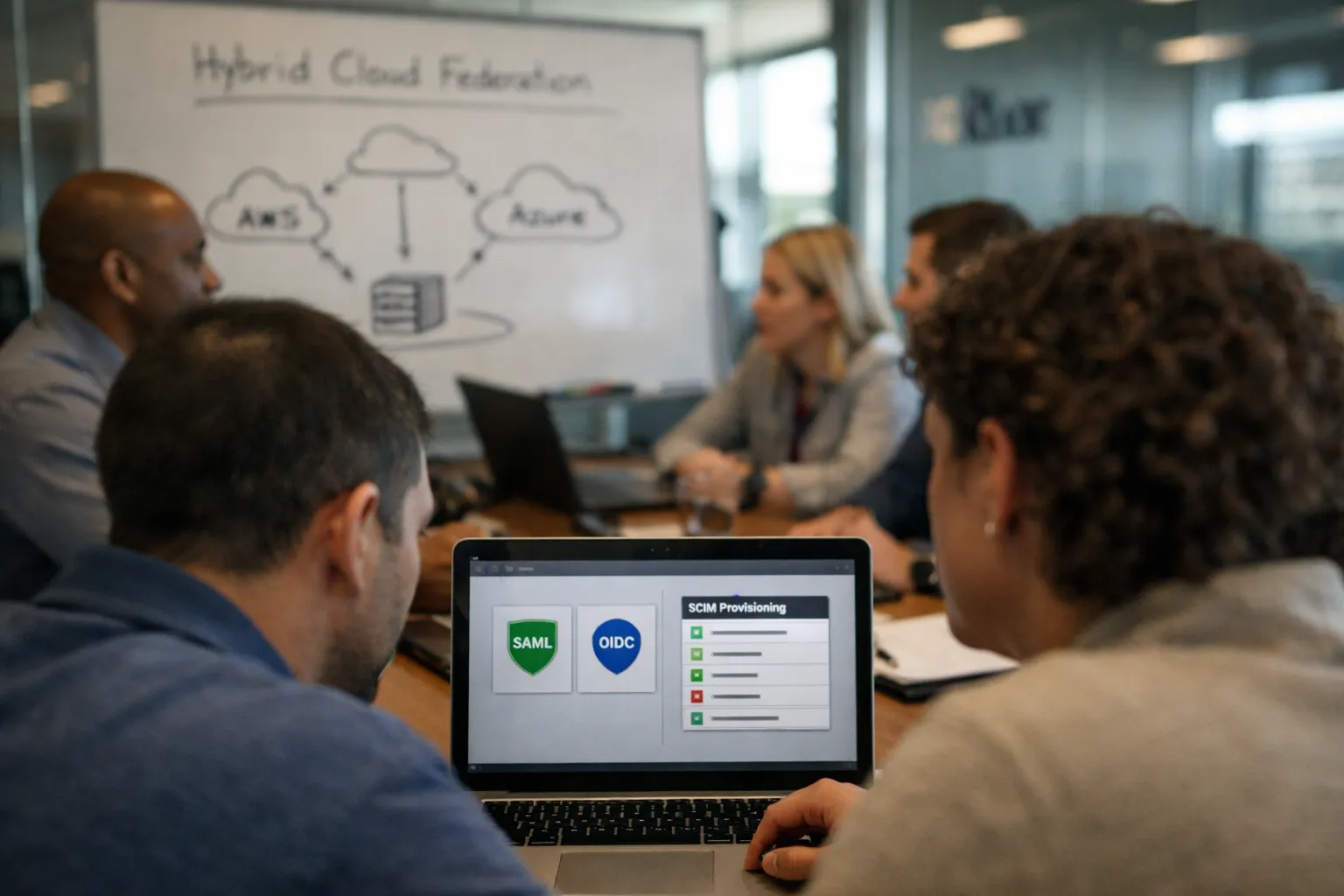
Enterprises in 2026 run applications across on-premises data centers, multiple public clouds, and an expanding catalog of SaaS services. Identity remains the primary control plane for access, audit, and compliance. This guide walks enterprise software teams through a practical, step-by-step implementation of identity federation for hybrid cloud environments — focused on scalable SSO, automated provisioning (SCIM), directory synchronization, integration patterns, and measurable ROI.
Why enterprise identity federation matters now
Identity federation ties together authentication and provisioning across heterogeneous systems so users get seamless single sign-on (SSO) while administrators retain centralized policy control. The benefits are clear for enterprise solutions facing:
- SaaS sprawl and accelerating app onboarding
- Hybrid and multi-cloud deployments with mixed identity providers
- Mergers & acquisitions that bring multiple directories and IdPs together
- Regulatory and audit requirements demanding unified logs and lifecycle controls
When correctly implemented, federation improves security posture, reduces help-desk overhead, and speeds time-to-productivity — outcomes that drive measurable ROI.
Scope and prerequisites
This guide assumes:
- You manage or influence identity and access for 1,000+ users across hybrid cloud
- Existing identity sources may include Active Directory (on-prem), Azure AD, and third-party IdPs (Okta, Ping, Keycloak)
- SaaS applications support at least SAML or OIDC; some support SCIM for provisioning
High-level implementation phases
- Assess and inventory
- Design architecture and flows
- Choose components (IdP, brokers, provisioning tooling)
- Integrate authentication (SSO) and provisioning (SCIM)
- Test, monitor, and scale
- Measure ROI and optimize
1. Assess and inventory (2–4 weeks)
Start with a disciplined inventory. Create a catalog of:
- Applications (SaaS, cloud native, legacy) and their supported protocols (SAML, OIDC, OAuth2, LDAP)
- Identity sources (on-prem AD forests, Azure AD tenants, external IdPs)
- Provisioning workflows — who creates accounts, approval paths
- Audit and compliance requirements (retention, event sources)
Key deliverables: application-protocol matrix, current onboarding SLA, help-desk ticket stats for account/password issues. Those figures feed your ROI calculations.
2. Design architecture and flows (2–6 weeks)
Decide how authentication and provisioning will flow across hybrid boundaries. Common patterns:
- Direct federation: Corporate IdP (Azure AD / Okta) connects directly to each app with SAML/OIDC.
- Brokered federation: A broker or gateway (AuthN gateway, API proxy, or IAM product) translates between protocols and centralizes integrations.
- Directory sync + cloud IdP: On-prem AD syncs to cloud directory (Azure AD Connect) and cloud IdP does the SSO/provisioning.
Consider zero-trust constraints: short-lived tokens, device posture checks, step-up authentication for sensitive actions. Diagram flows for login, token exchange, user provisioning (SCIM), deprovisioning, and audit log aggregation.
3. Choose components
Select enterprise solutions that align with your environment and integration needs:
- Primary IdP: Azure AD (enterprise SaaS integration), Okta (broad app catalog), Ping Identity (large enterprises), or open-source Keycloak (self-hosted control).
- Provisioning: Native SCIM support from IdP where possible; add a provisioning broker for apps with proprietary APIs.
- Directory sync: Azure AD Connect, AD Bridge tools, or AD Domain Services depending on on-prem constraints.
- Access gateway / broker: Use where apps lack native protocol support or to centralize policy enforcement (e.g., API gateway with OIDC translation).
- Observability: Centralized log/trace collection (SIEM integration), and metrics (SSO latency, provisioning success rate).
Evaluate vendors on enterprise criteria: SLA, integrations, support for SCIM 2.0, federation protocols (SAML 2.0, OIDC), SSO performance, and compliance certifications (ISO 27001, SOC 2).
4. Integrate authentication (SSO) and provisioning (SCIM)
Implement in incremental waves by app criticality.
Authentication (SSO)
- Map each app to a protocol (SAML or OIDC). For custom apps, implement OIDC where possible for modern flows.
- Standardize claims/attributes: decide canonical attributes (email, uid, groups) and mapping rules.
- Configure IdP trust: exchange metadata, certificates, and assertion endpoints. Test with a small pilot group.
- Enforce MFA and conditional access policies at the IdP for high-risk apps.
Provisioning (SCIM and lifecycle)
- Target SCIM 2.0 where supported. Prefer IdP-initiated provisioning for cleaner lifecycle management.
- Build a provisioning broker for apps without SCIM: use service accounts and the app’s REST APIs with audit logging.
- Automate deprovisioning: tie revocation to HR events or identity source changes to reduce orphaned accounts.
- Document reconciliation processes and implement scheduled reconciliations to catch drift.
5. Test, monitor, and scale
Testing checklist:
- Functional: SSO login/logout, attribute mappings, account creation, password resets, SCIM create/update/delete
- Security: MFA enforcement, token expiry, session revocation, replay protection
- Performance: SSO latency under peak loads; SCIM provisioning throughput
Scalability best practices:
- Make the authentication plane stateless where possible; use horizontally scalable IdP or clustered brokers.
- Cache tokens/metadata close to application edges, but honor token lifetimes for security.
- Implement rate limiting and backoff for provisioning calls to SaaS vendors.
- Use health checks and autoscaling policies for identity brokers and provisioning workers.
6. Measure ROI and optimize
Quantify gains to justify investment. Track metrics before and after:
- Help-desk tickets for password resets and account provisioning (expect sharp reductions)
- Mean time to onboard (employee provisioning) and offboard
- Time spent on audit and compliance evidence collection
- Access-related security incidents (reduction in orphaned accounts, unauthorized access)
Calculate ROI drivers: lower operational headcount for manual provisioning, faster employee productivity, and reduced risk exposure. Use these to prioritize future automation work.
Integration patterns and when to use them
- Direct IdP-to-app: Best for SaaS apps with robust SAML/OIDC and SCIM support.
- Broker/Gateway: Use when you need protocol translation, centralized policy, or when apps cannot natively integrate.
- Hybrid Sync: Sync on-prem AD to cloud directory (Azure AD Connect) where legacy apps require LDAP and cloud apps use OIDC.
Operational considerations
Runbooks and SLOs are essential:
- Define SSO availability SLOs and monitoring alerts for auth failures or latency spikes.
- Maintain a provisioning error dashboard: failed SCIM calls, reconciliation mismatches, API rate-limit hits.
- Establish incident playbooks for compromised accounts and emergency revocation workflows.
- Include identity components in change management and CI/CD pipelines for IaC-driven configurations.
Common pitfalls and how to avoid them
- Attribute sprawl: Inconsistent attribute names across apps. Mitigate with a canonical attribute registry and transformation rules.
- Ignoring provisioning: Only doing SSO without provisioning leads to orphaned accounts. Prioritize lifecycle automation.
- Poor scalability testing: Failing to simulate peak-auth loads. Include load tests for both auth and provisioning planes.
- Underestimating integrations: Legacy apps often have bespoke auth flows. Allocate engineering time for adapters or brokers.
Real-world examples
Example 1 — SaaS consolidation: A 5,000-seat enterprise reduced onboarding time from 48 hours to 2 hours by adopting a cloud IdP with SCIM provisioning and retiring manual workflows, cutting help-desk tickets by ~60% in 12 months.
Example 2 — M&A scenario: Post-acquisition, a manufacturing firm used a brokered federation pattern to bridge the acquired company’s Keycloak-based IdP to the parent’s Azure AD for a 90-day coexistence period, enabling a phased migration with no service disruption.
Checklist for launch
- Inventory completed and prioritized
- Architecture diagram and chosen components signed off
- Pilot apps integrated for SSO and SCIM
- Monitoring, logging, and incident playbooks in place
- Rollback plan and stakeholder communication prepared
- ROI baseline measured (tickets, onboarding time, incidents)
Conclusion
Identity federation is a foundational enterprise solution for hybrid cloud environments. A thoughtful implementation — balancing scalability, robust integration, and measurable ROI — reduces operational friction and strengthens security. Start with a small, high-value pilot, measure gains, then scale using the patterns and operational practices in this guide. The effort pays back through faster onboarding, fewer security incidents, and clearer auditability across your hybrid estate.
Next steps: run the inventory phase this quarter, select a single critical SaaS app as a pilot for SSO+SCIM, and capture baseline metrics for ROI analysis.