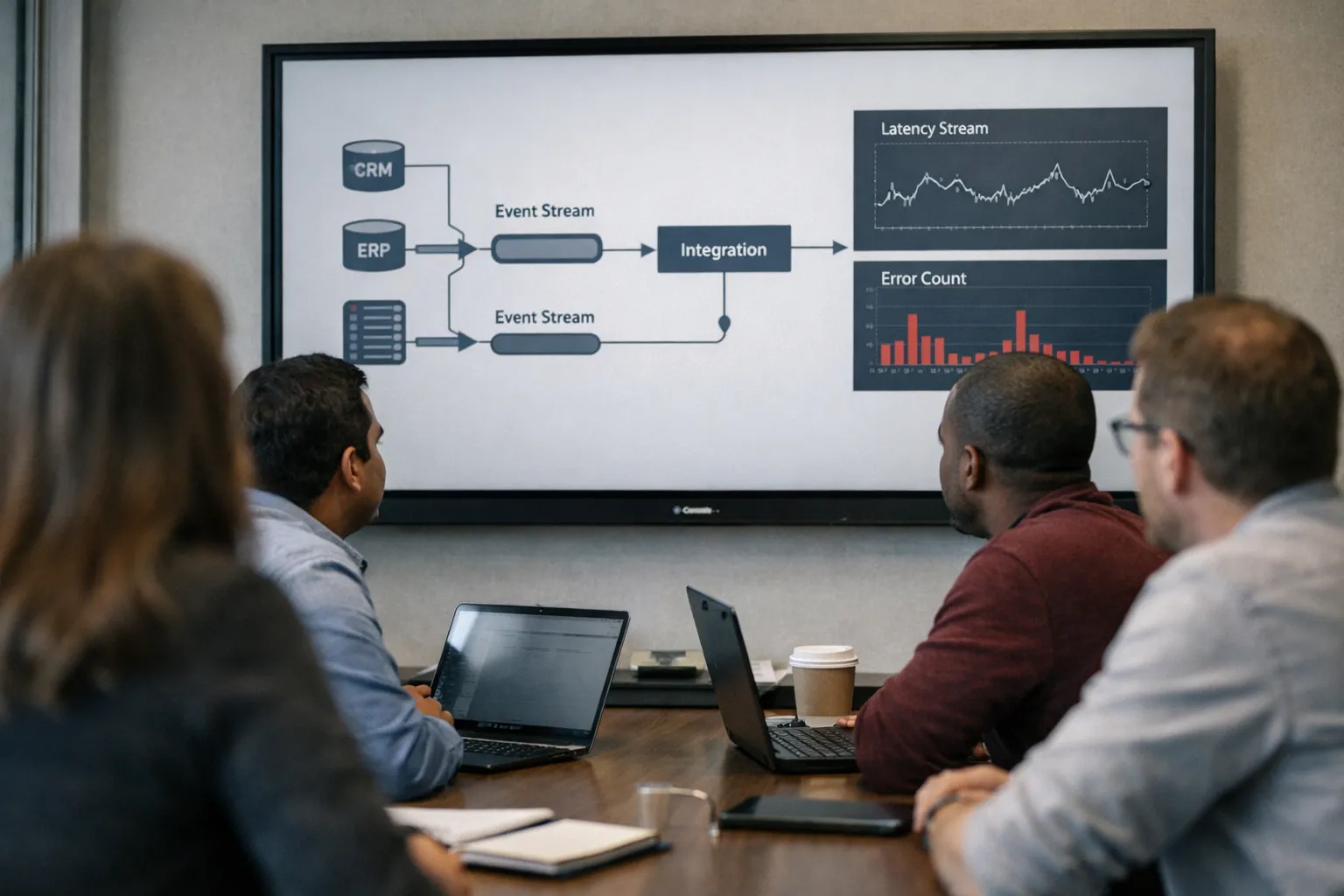
Enterprises still run hybrid fleets: modern SaaS and long‑lived on‑prem/mainframe systems. The integration platform as a service (iPaaS) remains the primary architecture for converting that heterogeneity into scalable, repeatable integration solutions. This June 2026 update keeps the original playbook’s pragmatic, vendor‑agnostic approach and layers in the most important changes of the last three years: widespread AI help for mappings and observability, edge WebAssembly connectors, event mesh adoption, and tighter supply‑chain and data‑governance requirements.
Who should read this and why it matters
This guide is for enterprise architects, integration leads, platform engineers and IT procurement teams evaluating or operating an iPaaS in 2026. You’ll get a phased implementation playbook, updated vendor‑selection criteria that reflect 2026 realities, operational best practices and a refreshed ROI lens. If your organization must move data reliably between multiple SaaS products and legacy systems while meeting stricter security and AI‑governance expectations, this is for you.
Prerequisites & context — what’s changed since 2023
- AI‑assisted integration: Leading iPaaS vendors now include LLM‑driven mapping assistants, auto‑generated transformations and natural‑language orchestration editors that reduce mapping time by a material margin. These features accelerate work but require AI governance, data minimization and prompt‑testing policies.
- Edge compute and WASM connectors: Edge connectors are increasingly implemented as WebAssembly modules to run securely near legacy systems with a small footprint and easier update paths.
- Event mesh mainstreaming: Event meshes (commercial and managed: Confluent, Redpanda, cloud eventing like AWS EventBridge / Azure Event Grid) are widely used as the messaging backbone for iPaaS choreography patterns.
- Security & supply chain: Expectations now include SBOMs for connectors, signed connector packages, and vulnerability scanning as part of the connector lifecycle.
Why an iPaaS — and when it’s the right fit (2026 view)
An enterprise iPaaS in 2026 remains a managed platform offering prebuilt connectors, orchestration, mapping/transformation, event handling and operational tooling. Choose iPaaS when you need:
- Rapid, repeatable integration across multiple SaaS apps (CRM, ERP, HR) and legacy systems without proliferating point‑to‑point code.
- Scalability across many flows with centralized governance, observability and versioning — including traceability into AI‑generated changes.
- Composable business automation that uses both synchronous APIs and asynchronous eventing (event mesh) while preserving data contracts.
- Developer productivity via templates, AI suggestions, and predictable runtimes (including WASM for edge agents).
iPaaS is still not the right answer for sub‑millisecond, in‑process access to a legacy in‑memory datastore or extremely bespoke transactional coupling; those use cases may require co‑located microservices or direct integration patterns.
Architectural patterns for SaaS–legacy integration
Match patterns to latency, resilience and governance requirements. The patterns below include 2026 best practices.
Hub‑and‑Spoke (Centralized)
- Central iPaaS runtime manages connectors, transformations and orchestration, with governance applied at the catalog level.
- 2026 update: Expect the hub to provide AI‑assisted policy enforcement (e.g., auto‑flagging risky transformations) and signed connector artifacts for supply‑chain traceability.
- Consider: ensure horizontal scale, multi‑region deployment and offline/limited‑connectivity modes for edge connectors.
Event‑Driven (Choreography with an Event Mesh)
- Systems emit domain events; an event mesh (Kafka/Confluent, Redpanda, EventBridge) transports them. iPaaS subscribes and reacts.
- 2026 update: Use schema registries with automated compatibility checks and integrate AI tools to suggest schema migrations. Plan for replay windows and tiered retention in the mesh.
- Consider: design idempotency, schema evolution and consumer‑driven contracts.
Hybrid (Edge WASM Connectors + Cloud Orchestration)
- Lightweight WebAssembly modules run near legacy systems for secure connectivity; orchestration and observability run in cloud iPaaS.
- 2026 update: WASM enables safer updates, smaller attack surface and standardized signing. Ensure mechanisms for automated connector updates and vulnerability patching.
Vendor selection: updated 2026 checklist
Evaluate offerings against enterprise requirements and 2026 expectations.
- Connector coverage & supply chain: Prebuilt connectors for critical SaaS and legacy protocols, plus signed connector packages, SBOMs and vendor vulnerability disclosure practices.
- AI capabilities (but governed): Mapping auto‑suggest, natural‑language orchestration, and AI‑assisted root‑cause insights. Confirm transparency (explainability), data handling policies and the ability to disable AI features for sensitive flows.
- Event & API models: Support for orchestration and choreography, native CDC (Debezium compatibility) and managed event mesh integrations (Kafka, cloud pub/sub).
- Security & compliance: RBAC and attribute‑based controls, short‑lived credentials, mutual TLS, enterprise SSO, signed connectors, connector SBOMs and attestations. Vendor compliance certifications (SOC 2, ISO 27001) remain baseline.
- Observability & SLOs: Distributed tracing across SaaS calls and WASM edge connectors, searchable traces/logs, metrics export, and AI‑assisted anomaly detection with audit trails for any AI actions.
- Governance & lifecycle: Environment promotion, versioned flows, schema registry integration, change approval workflows with auditability for AI‑proposed changes.
- Developer experience & CI/CD: Templates, SDKs, local emulators (WASM runtime), GitOps support and contract testing automation. LLM assist should integrate into CI checks, not replace them.
- TCO & pricing transparency: Clear consumption metrics, predictability for event retention and connector execution costs, and marketplace connector licensing clarity.
Implementation playbook: phases and activities (step‑by‑step)
Phase 0 — Define goals and KPIs
- List prioritized integration use cases (e.g., order sync, customer master, payroll feed) and map them to business owners.
- Set KPIs: time‑to‑integrate, message throughput, error rate, MTTR, cost per integration, and AI‑change acceptance rate.
- Define security/compliance: data residency, encryption, audit trails, connector SBOM requirements and AI governance rules.
Phase 1 — Discovery & inventory
Assemble a catalog of systems and flows:
- Systems of record and their APIs/protocols; current throughput and SLAs.
- Existing point‑to‑point integrations and pain points (maintenance cost, brittle transforms).
- Data formats, volumes, sensitivity classification and retention requirements.
Phase 2 — Architecture & pilot
- Select a pilot: pick 1–3 high‑value, mid‑complexity use cases crossing SaaS and legacy boundaries.
- Choose pattern: hub, event mesh + choreography, or hybrid with WASM edge agents.
- Implement pilot emphasizing:
- Contract‑first API or schema‑first event definitions (OpenAPI + AsyncAPI); publish to a registry with CI checks.
- Error handling, dead‑letter queues, idempotency, and compensating transactions for distributed updates.
- Performance and resilience testing: load tests at expected peak volumes plus fault injection. Include AI features in test plans (ensure deterministic outputs from mapping assistants).
Phase 3 — Scale & governance
- Formalize governance: naming conventions, connector approval, data classification, SBOM policy and access controls.
- Build reusable assets: templates, canonical models, transformation libraries, signed WASM connector registry and connector CI pipelines.
- Integrate CI/CD for flows, contract tests, and policy gates that block deployments if schema compatibility or security checks fail.
Phase 4 — Rollout & operations
- Phase rollout by business domain; measure KPIs, SLOs and AI change acceptance rates. Maintain a visible dashboard for business owners.
- Implement chargeback/showback and fine‑grained cost visibility for event retention, connector runtime, and AI usage.
- Create runbooks: incident response, connector updates, schema migration, and AI rollback procedures.
Integration patterns and technical considerations (practical details)
- Idempotency & deduplication: Use robust keys from sources or implement dedup state in iPaaS. With event meshes, use consumer group offsets and idempotency tokens.
- Schema evolution: Use a schema registry (Avro/Protobuf/JSON Schema) and enforce compatibility checks in CI. Use contract tests to detect consumer breaks before production.
- CDC vs polling: Prefer Change Data Capture (Debezium, vendor CDC) for near‑real‑time sync. Polling is acceptable only where CDC isn’t feasible and latency tolerance exists.
- Transactional boundaries: For cross‑system transactional consistency, design compensating transactions; avoid two‑phase commit spanning SaaS boundaries.
- Observability: Correlate traces across SaaS calls and WASM connectors. Capture sanitized payload samples for debugging and maintain an immutable audit trail for AI‑generated transformations.
Security, compliance and operational resilience (2026 expectations)
- Adopt least privilege with RBAC and attribute‑based controls across runtime and management planes.
- Use short‑lived credentials, token exchange (OAuth2), and automated rotation for connectors. Require signed connector artifacts and SBOMs.
- Network segmentation: prefer private connectivity (Direct Connect, ExpressRoute or cloud VPN) or WASM edge agents that avoid opening inbound public ports.
- Data masking and privacy: apply masking in transit/at rest where required; ensure AI features do not leak sensitive payloads to third‑party model providers.
Measuring ROI: updated metrics and sample calculation
ROI remains a mix of reduced integration time, lower maintenance costs and faster business outcomes. In 2026 include these additional metrics:
- AI‑assisted mapping reduction in mapping hours and number of review cycles.
- Connector lifecycle cost: patching, SBOM remediation and signed package management.
- Event retention cost and replay frequency (affects mesh cost).
Sample back‑of‑envelope annualized model (adapt to your org):
- Baseline: Average integration = 12 weeks; staff cost per project ≈ $120k (4 engineers share). Operational incidents = 6/year; MTTR 12 hours.
- Post‑iPaaS with AI-assisted mapping and reuse: Average = 4 weeks; staff cost per project ≈ $40k. Incidents = 2/year; MTTR 4 hours.
- Savings per project ≈ $80k. If 12 projects/year → $960k saved. Subtract iPaaS subscription + connector marketplace fees + operational staff + event mesh costs + AI usage fees (for model inference and prompt logging) — say $350k/year → net ≈ $610k.
Key point: include AI usage costs, event retention and connector lifecycle costs when modeling. Run sensitivity analysis for event volumes and AI inference per transaction.
Common pitfalls and mitigation (2026 additions)
- Pitfall: Blindly enabling LLM mapping on sensitive data. Mitigation: Enforce data classification gates, redact payloads and require model‑use approvals.
- Pitfall: Ignoring connector supply chain risk. Mitigation: Require SBOMs, signed packages and vulnerability scanning; include connector patching in SLAs.
- Pitfall: Underestimating event mesh cost. Mitigation: Model retention tiers, compress payloads and use tiered storage for older events.
- Pitfall: Over‑centralization causing a single choke point. Mitigation: Architect for horizontal scale, edge processing and degraded local modes.
Checklist before go‑live
- Completed inventory and prioritized use cases with business owners signed off.
- Pilot validated for performance, error handling, security and AI governance.
- Governance model, naming conventions and SBOM/connector policies documented.
- CI/CD pipelines, contract tests and policy gates in place (including AI‑change audit trails).
- Monitoring, alerting, runbooks and connector lifecycle procedures operational.
- Clear ROI tracking metrics defined, including AI and event mesh costs.
Conclusion
Implementing an enterprise iPaaS in 2026 is still a strategic investment in integration agility and scalability — but platform expectations have changed. Vendors now offer AI assistance, signed connector supply chains, WASM edge connectors and tighter integration with event meshes. Successful projects pair these capabilities with strong governance: connector SBOMs, AI governance, schema registries and CI policy gates. Follow the phased playbook here, measure both traditional and AI‑related KPIs, and build a connector lifecycle discipline to turn complex SaaS–legacy integration into reusable, secure enterprise capability.
FAQ
Do I need to use an event mesh with an iPaaS?
No — you can implement iPaaS using hub‑and‑spoke orchestration without an event mesh. However, an event mesh is recommended for high‑scale asynchronous architectures, improved decoupling, and replay capabilities. If you choose an event mesh, plan for schema registries, retention costs and consumer‑driven contract testing.
How should I govern AI features in my iPaaS?
Treat AI features as a controllable capability: require data classification gates, redact sensitive payloads before sending to models, log AI prompts and outputs for audit, and provide an option to opt out for regulated flows. Include AI‑suggested changes in the normal approval workflow and record who accepted them.
What is the role of WebAssembly (WASM) in modern iPaaS deployments?
WASM enables lightweight, portable edge connectors that run with small footprints and stronger sandboxing near legacy systems. Use WASM for connectors in constrained environments, and require signed WASM packages and automated update mechanisms as part of connector lifecycle management.
How do I control costs with consumption pricing and event retention?
Model event volumes and retention tiers up front. Use tiered retention (hot for recent events, cold for long‑term) and compress or truncate noncritical payloads. Track AI inference costs per transaction and set quotas or caching for repeated prompts. Implement chargeback/showback tied to business domains.
What’s the minimum team structure to run an enterprise iPaaS?
A small central platform team (3–6 engineers) for governance, connectors and platform ops, plus embedded integration engineers in domains. Scale the platform team as adoption grows, but prioritize automation (CI/CD, connector lifecycle, policy gates) to keep operational overhead predictable.