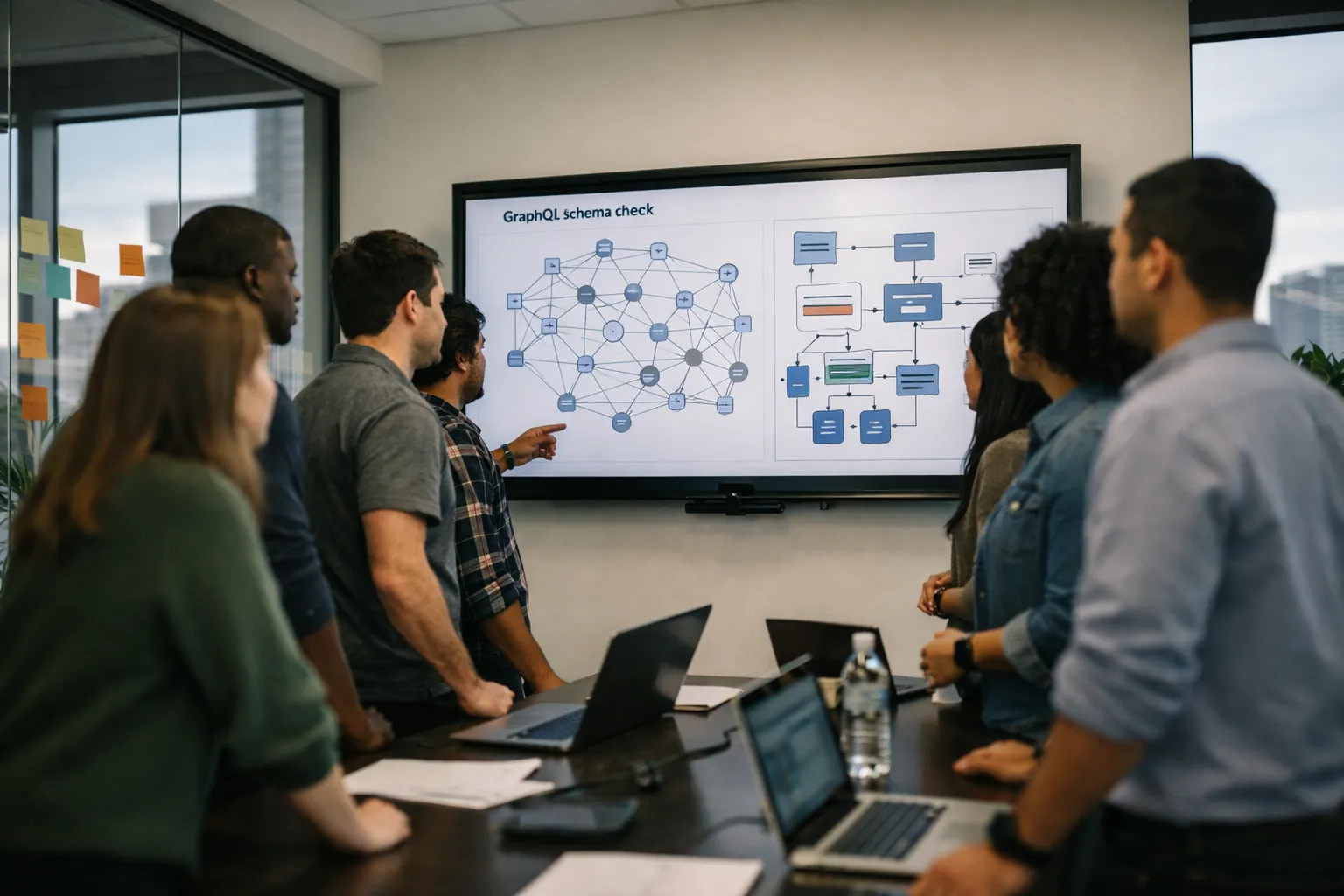
GraphQL Federation lets enterprises stitch many microservice-backed schemas into a single, queryable graph. For engineering leaders and architects, it promises faster integration, simpler client APIs and improved developer productivity — but only when implemented with enterprise-grade governance, observability and scalability. This guide walks through a concrete, practical implementation path for enterprise solutions that need robust integration, predictable scalability and measurable ROI.
Why choose GraphQL Federation in 2026?
Federation is a pattern that preserves service ownership while presenting a unified graph to clients. Compared with monolithic GraphQL gateways or client-side stitching, federation better supports:
- Service autonomy: Each team owns subgraphs and deployment cadence.
- Incremental integration: Add or refactor services without a single-shared schema repo.
- Consistent client APIs: Clients use one endpoint, simplifying SDKs and mobile/web client code.
- Operational scaling: Federated subgraphs can scale independently to manage resource demands.
For enterprise solutions, federation reduces integration friction between legacy systems and cloud-native microservices, while helping measure ROI through developer velocity and reduced integration maintenance.
When NOT to use federation
- Small teams with a single monolith: federation adds coordination overhead.
- When cross-service joins are rare: a simpler API gateway or BFF layer may suffice.
- If subgraph teams can't commit to schema contracts and CI controls — federation requires governance.
Prerequisites: organizational and technical readiness
Before a technical implementation, verify these organizational and technical prerequisites:
- Team ownership model: Clear ownership of domains/subgraphs and service SLAs.
- Contract-first culture: Treat schema changes as contracts, validated in CI pipelines.
- Observability platform: Central tracing, metrics and logs (OpenTelemetry-compatible recommended).
- Deployment automation: Kubernetes or other immutable-deploy platforms with GitOps or CI/CD.
- Security baseline: Centralized identity, per-request authn/authz tokens and network controls.
Step-by-step implementation plan
Phase 1 — Assess and design (2–6 weeks)
-
Inventory services and data ownership. Map domains, existing REST/GraphQL endpoints, and backend data stores. Identify natural ownership boundaries that will become subgraphs.
-
Choose a federation runtime and gateway strategy. Popular enterprise choices include Apollo Federation (runtime + router), open-source alternatives such as GraphQL Mesh for heterogeneous backends, and in-house gateway plus router setups for low-latency requirements. Consider performance profiles (e.g., native Rust-based routers vs Node.js) and vendor SLAs if adopting managed solutions.
-
Define SLA and scalability targets. Establish expected QPS, p95/p99 latency targets, and multi-region failover needs. Use these to size gateway nodes and subgraph instances.
-
Schema governance model. Decide on processes for schema reviews, breaking-change policies, versioning, and a registry for schema metadata. Plan for a contract-first, CI-validated workflow.
Phase 2 — Build foundational components (4–12 weeks)
-
Create per-domain subgraph projects. Convert endpoints into federated subgraphs with clear type ownership and resolvers. Prefer incremental migration: expose relevant types first, then expand.
-
Implement the gateway/router layer. Deploy a router that composes subgraphs at runtime (or compile-time if using schema composition). Configure caching at the gateway edge (response or persisted query caching) and at service side where applicable.
-
Establish CI/CD for schema validation. Each subgraph pipeline should run schema-linting, contract compatibility tests against a published schema registry and integration tests that exercise federated queries.
-
Integrate authn/authz. Implement token propagation and a centralized policy enforcement point. For enterprise solutions tie into existing identity providers and enforce least privilege at the gateway.
Phase 3 — Test, optimize, and secure (4–8 weeks)
- Load and integration testing: Run synthetic and recorded traffic through the composed graph. Measure downstream fan-out and hot fields that cause cascading load.
- Query cost analysis and rate limiting: Implement query complexity scoring or depth limits and protect downstream systems with circuit breakers.
- Caching and batching: Use persisted queries, CDN edge caching for read-heavy fields, and data loader patterns in subgraphs to mitigate N+1 resolution.
- Security hardening: Enforce input validation on resolvers, audit logs for sensitive fields, and encryption in transit. Periodically run threat-modeling exercises that consider federation-specific attack vectors (e.g., expensive composed queries).
Phase 4 — Gradual rollout and migration (6–12 weeks)
- Canary the gateway: Route a small percentage of traffic to the federated gateway and compare metrics against the incumbent gateway or direct calls.
- Incremental client migration: Update clients to use the federated endpoint where feasible. Support backward compatibility with temporary adapters for legacy clients.
- Monitor SLA impact: Track error budgets, latency, and backend load. Validate ROI hypotheses: reduced frontend-API mapping effort, fewer integration tickets, faster feature delivery.
- Full cutover and decommissioning: Once stable, deprecate older endpoints per your change policy, and tidy up unused data paths to reduce operational footprint.
Governance and lifecycle management
Federation succeeds or fails on governance. Implement these controls:
- Schema registry and change approvals: A central registry storing published composed schemas, owners, and change logs. Enforce automated compatibility checks in PR pipelines.
- Ownership and runbooks: Each subgraph should have a named owner, on-call rota and runbooks for recovery scenarios.
- Contracts and SLAs: Define per-subgraph SLAs (latency and availability) and backpressure contracts so downstream owners can manage expectations.
Scalability tactics for enterprise-grade workloads
To achieve predictable scalability:
- Horizontal scale subgraphs: Autoscale based on request rate and downstream queue metrics. Use vertical partitioning if a service has divergent workloads.
- Gateway clustering: Run stateless routers behind a global load balancer; use sticky routing only if necessary for debugging.
- Multi-region deployments: Deploy gateways near user populations and replicate read-only caches. For write operations, route to a global authority with conflict resolution strategies.
- Backpressure and throttling: Implement client and field-level limits that align with downstream capacity.
Observability, testing and maintenance
Instrumentation is essential. Ensure:
- Trace propagation across client → gateway → subgraphs with distributed tracing (OpenTelemetry).
- Field-level metrics for latency and error rates to spot hot resolvers causing downstream strain.
- Automated regression tests that validate the composed schema and representative federated queries.
- Synthetic monitoring of critical path queries from multiple regions.
Security and compliance considerations
Enterprises must secure the graph and ensure compliance:
- Data access controls: Implement attribute-based access control at the gateway or resolver level for sensitive fields.
- Audit trail: Log access to PII fields and maintain retention policies aligned with compliance requirements.
- Third-party subgraphs: Treat external schemas as untrusted; sanitize responses and restrict cross-subgraph references that expose sensitive data.
Measuring ROI and business value
To justify federation as an enterprise solution, quantify improvements in:
- Developer velocity: Measure time to deliver new fields or endpoints before and after federation.
- Integration cost: Track reduction in engineering time spent on client-specific adapters and break/fix tickets.
- Operational cost: Compare total cost of ownership: gateway and subgraph compute plus caching vs prior architecture. Factor in reduced maintenance overhead.
- Customer impact: Monitor client-side latency improvements and feature rollout frequency as upstream business KPIs.
Example ROI metric: if federation reduces average integration time per feature from 10 days to 4 days across five product teams, multiply saved engineering-days and translate to annualized cost savings; include accelerated time-to-revenue for new features.
Common pitfalls and how to avoid them
- Poor schema hygiene: Prevent by enforcing linting, documentation generation and compatibility checks in CI.
- Hidden downstream costs: Monitor fan-out and expensive resolver patterns; enforce caching and batching strategies.
- Insufficient testing: Invest early in integration tests that exercise composed queries end-to-end.
- Governance gaps: Create a lightweight review board and clear ownership to prevent schema churn and breaking changes.
Implementation checklist (quick)
- Map domains and select initial subgraphs
- Choose federation runtime and router strategy
- Establish schema registry and CI checks
- Instrument tracing, metrics, and field-level monitoring
- Implement authn/authz propagation and field-level controls
- Plan canary rollout and client migration path
- Define ROI measurement plan and report cadence
Conclusion
GraphQL Federation is a powerful enterprise solution for unifying microservice APIs while preserving team autonomy. The payoff — faster integration, simpler client APIs and potential cost savings — is real, but only when paired with strong schema governance, observability, and an operations plan that addresses scalability and security. Use a phased, metrics-driven implementation and validate ROI with concrete developer-productivity and operational-cost measures. With that discipline, federation becomes a stable foundation for next-generation enterprise integration.