
Overview
Low‑code orchestration remains the single most consequential abstraction in multi‑cloud integration. Since our May 2026 note, the conversation has shifted from “can this accelerate work?” to “will this survive audits, scale, and AI scrutiny?” In August 2026 the answers matter because organizations are moving production workloads onto these platforms — and when they do, failures are not just annoying; they’re expensive and visible.
Background: what changed since mid‑2026 and why it matters
Three developments since May 2026 reshaped practical buying and delivery decisions.
- LLM governance moved from checkbox to contract item. Vendors have gone beyond gimmicks: built‑in model registries, prompt‑sandboxes, and usage logging are now baseline in enterprise plans. That matters because procurement and risk teams will demand proof that LLM prompts and responses are auditable and that enterprises control which base models are used for production transformations.
- Portability became an economic lever. Procurement teams increasingly refuse to accept opaque vendor state custody. Buyers want exportable state snapshots, documented restore procedures and supported “bring‑your‑own‑runtime” options; without them, migration costs and business continuity risk make deals hard to justify.
- Standards and observability expectations hardened. OpenTelemetry, CloudEvents and AsyncAPI are now treated as table stakes for integration metadata; platforms that don't emit structured traces and lineage metadata are effectively invisible in large SRE stacks.
Data and evidence: market signals and platform capabilities in August 2026
Adoption is still accelerating — not because low‑code is a fad, but because teams that standardize governance and test rigor are seeing measurable velocity and lower maintenance overhead. The difference between successful programs and pilot sprawl is operational discipline, and you can measure that.
Here are the practical capability signals you should demand and how to validate them:
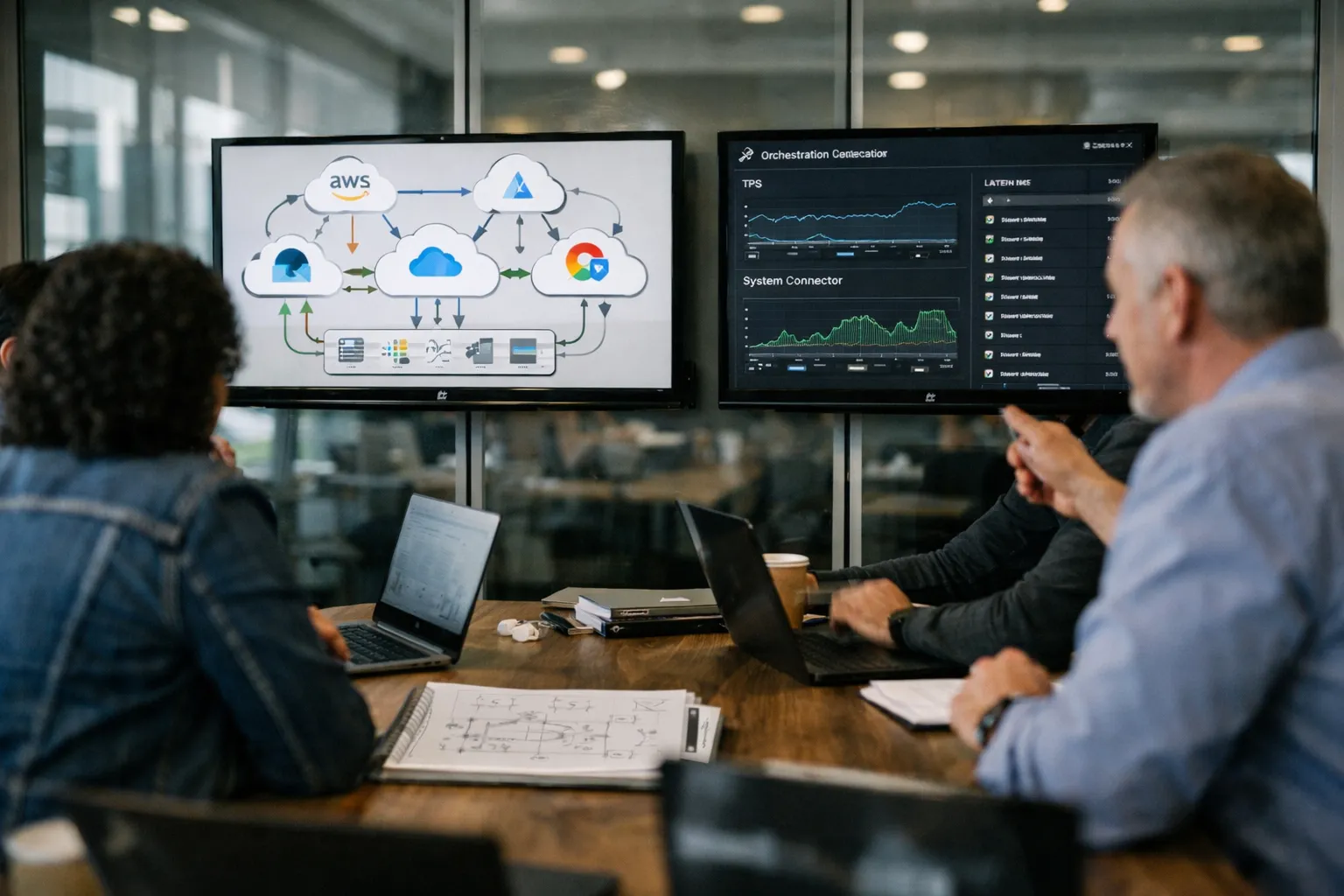
- Performance disclosures — Ask for TPS, median/p95/p99 latencies and MTTR for realistic flows (parallel fan‑outs, long‑wait human approvals, flaky third‑party APIs). Don't accept canned numbers; insist on a vendor‑supported 48–72 hour load run against a sanitized copy of one critical flow.
- State portability and custody — Require documented export/import procedures, export time (GB/min), and a tested restore into a non‑vendor runtime. Prefer vendors that support customer‑managed state (cloud storage, DBs, or object stores) as an option.
- Observability and lineage — Expect native OpenTelemetry traces, event lineage metadata, structured logs and the ability to push those into your central APM, SIEM and data lineage tools without vendor‑only portals.
- AI controls — Verify model provenance (which base model was used), prompt logging, a non‑production training mode, and the ability to choose or block third‑party models at the tenant level.
Feature patterns we see in the market today:
- LLM‑assisted mapping with a safety layer: auto‑generated transformations plus unit tests and hallucination detection hooks.
- “Runner” or BYOR (bring‑your‑own‑runtime) options that let customers deploy lightweight workers in VPCs or on‑prem while keeping a cloud control plane.
- Policy‑as‑code integrations (OPA/Rego or equivalent) so authorization, data residency rules and connector usage can be checked in CI/CD.
Multiple perspectives: the tradeoffs different stakeholders are making
Vendors paint the picture in broad strokes: faster time to value and democratized automation. That's true — but only if architecture and governance teams treat low‑code as infrastructure, not as a departmental sandbox.
- CIOs & Integration Architects — Their bottom line is predictability. They're now asking for artifact export formats that drop into CI/CD, documented upgrade paths and supported BYOR options. If a platform can't show you how it behaves under your ops playbook, it's a demo tool, not infrastructure.
- Security & Compliance — Security teams demand more than SOC 2. They want model logs, proof that LLM features do not leak PII, geo‑fenced state, and contractual SLAs for incident response. In regulated sectors, vendors are being required to demonstrate end‑to‑end evidence for change control and data residency.
- Developers & SREs — Dev teams will embrace low‑code if the platform isn't a black box. They favor SDKs, unit test hooks, local emulators, and the ability to export flows into code artifacts (YAML/JSON that a workflow engine can run) for debugging and migration.
- Procurement — Procurement teams have started to treat state portability and AI governance as priced line items. Expect negotiations around egress costs, connector premiums and support for long‑term data retention for audit evidence.
Implications: what this means for procurement, delivery teams, and executives
If you want low‑code orchestration to be a long‑term piece of your integration fabric, stop treating it like a point solution. Instead, align technical validation with contractual and organizational controls. Here’s what to do now.
- Run production‑like POCs — 60–90 days is fine, but make sure the POC includes: peak concurrency, flaky downstream APIs, long‑running states, and an outage/recovery test. Measure TPS, p95/p99 latency, error budget consumption, MTTR and SRE hours required per 1,000 flows/month.
- Contract for state portability — Put export SLAs and restore tests in the contract. Require sample exports and a dry‑run restore to a sandbox you operate. If a vendor balks, price that risk into the deal or walk away.
- Govern LLM features as production‑grade tools — Treat LLM outputs like generated code: require review gates, synthetic test suites, hallucination detectors, and prompt logging that’s retained for audits.
- Model total cost realistically — Look beyond license fees. Include agent licensing, connector charges, egress, storage for exported state, SRE ops time, and the legal cost of negotiation for data residency clauses.
- Create a lightweight CoE with teeth — Templates, naming conventions, connector libraries, lifecycle/deprecation policies and a flow review board. Without this, we will see the same automation sprawl we've fixed before — only faster.
Updated best practices — August 2026
- Validate with realistic chaos tests — Simulate API throttling, node failures, and region failovers. Observe how state is preserved and restored.
- Externalize and version critical state — For regulated or critical workflows, require customer‑managed state stores or guaranteed export/restore features with tested recovery times.
- Embed policy‑as‑code into CI/CD — Use OPA/Rego or equivalent to assert data residency, connector usage, and permission boundaries during pipeline runs.
- Use LLM features with a safety pipeline — Auto‑generate mappings and tests, but gate them with human review and automated validation against edge cases and synthetic negative tests.
- Measure operational economics monthly — Track cost per 1M executions, average SRE hours per 100 flows, and time to export state. Use these metrics to decide when to standardize a pattern or refactor to code.
Outlook: what to watch for in the next 12–18 months
Three pressure points will determine who wins:
- Portability and open standards — Platforms that embrace standard workflow descriptors, CloudEvents, and easy export will be easier to justify at scale. Expect more bilateral migration toolkits and community‑built exporters for popular workflow engines.
- Enterprise AI governance — Model registries, certified non‑production modes, and contractual obligations around model provenance will become negotiation points. Vendors who ignore this will lose regulated customers.
- Composable runtimes — The architectures that win will be modular: thin control planes, customer‑controlled runners, and connectors that expose transactional semantics. Monolithic, opaque stacks will be relegated to low‑risk automation.
Practical procurement checklist (updated Aug 2026)
- Can the vendor demonstrate TPS and tail latency under a realistic workload that mirrors our worst case, including failover and long‑running states?
- Does the platform permit exporting process definitions and state, and can the vendor document export SLAs and perform a restore into a customer‑controlled environment?
- Are connectors full‑featured (pagination, streaming, transactional semantics) and is a custom connector SDK available with CI support?
- What is the total pricing model including runtime transactions, connector tiers, agent fees, cloud egress, and cost for storing exported state for auditability?
- Does the platform emit OpenTelemetry traces, lineage metadata, and structured logs that integrate with our APM/SIEM? Is RBAC available at process and connector granularity?
- Do LLM features exist, and what governance controls are provided (model registry, prompt logging, sandboxing, hallucination detection)? Can model selection be restricted at tenant level?
- Can our SREs run the platform in staged CI/CD with unit tests, mocks, policy‑as‑code checks, and rollback playbooks?
FAQ — common questions right now
Is low‑code orchestration safe to use for regulated workloads in 2026?
Yes — but only if you validate state custody, observability, and AI controls. Prefer vendors that allow customer‑managed state or provide documented, tested export/restore procedures. Require SOC 2/ISO 27001 and insist on contractual evidence for data residency and incident response times for regulated workloads.
Will LLM features replace developer work in low‑code platforms?
No. LLMs speed repetitive tasks (mappings, draft flows, unit tests) but they require review, testing and policy controls. Treat LLM outputs as accelerants, not authoritative production code, and put human and automated validation in the deployment pipeline.
How do we avoid vendor lock‑in with low‑code orchestration?
Design for portability from day one: insist on exportable, versioned definitions; prefer platforms that support open standards or provide clean SDKs; and implement a small core of critical connectors as customer‑owned services to lower migration cost.
What workloads are still poor fits for low‑code orchestration?
Ultra‑low latency trading systems, extremely bespoke heavy‑compute logic, and workflows where the vendor must keep opaque state for regulatory reasons are poor fits. For regulated disaster‑recovery critical state, prefer customer‑owned stores or verified export/restore guarantees.
Conclusion
We believe low‑code orchestration is now infrastructure — but like any infrastructure, it demands discipline. In August 2026 the winners will be the teams and vendors that treat AI features as governed tools, make state portability contractual, and integrate with standard observability and policy pipelines. Skip those steps and what looked like instant velocity will become technical debt and a compliance headache. Do the work up front, run the right tests, and low‑code can be the fastest, most maintainable path to multi‑cloud integration. Ignore it, and we'll all be rewriting the same automations next year.