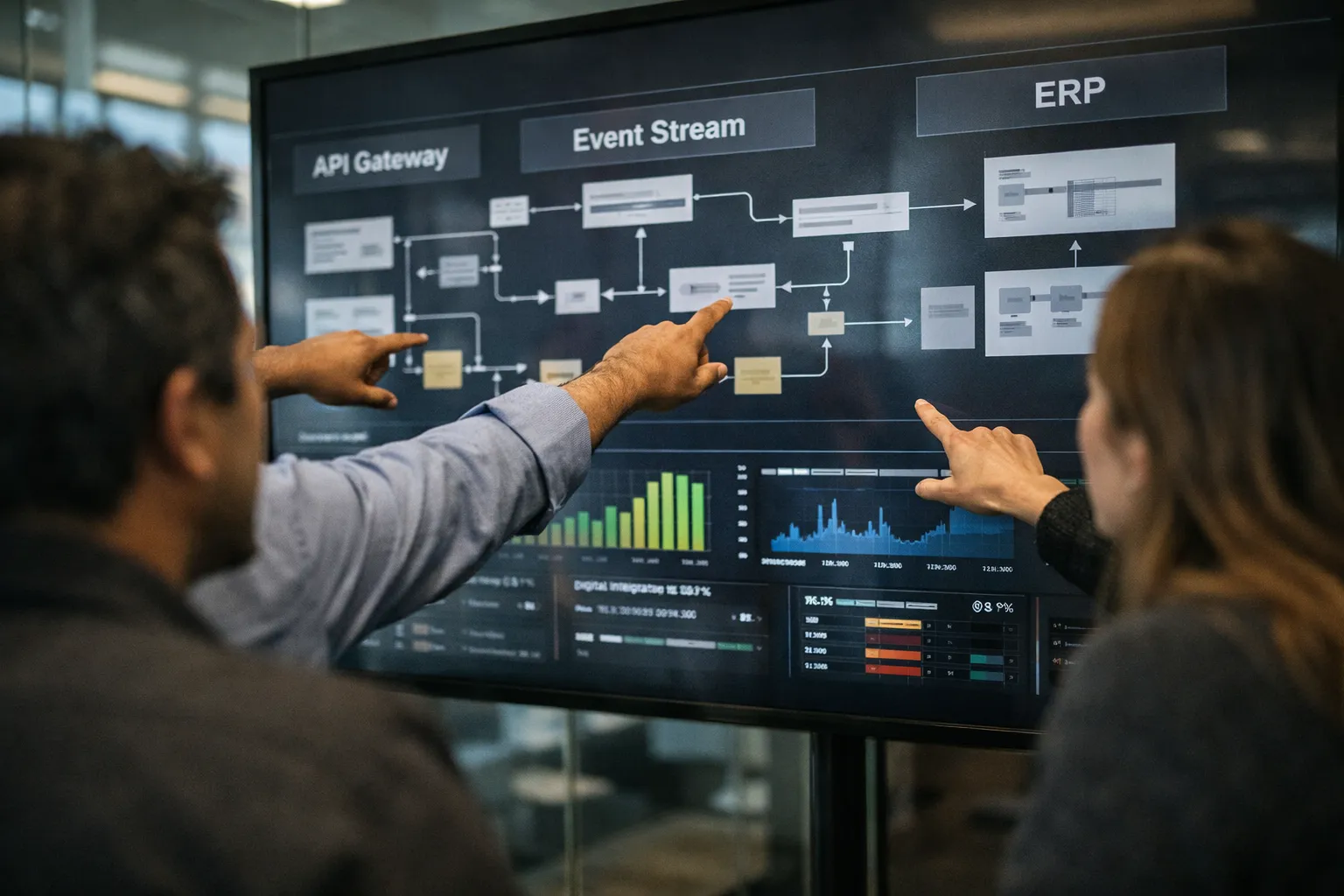
Enterprises that began digital transformation a decade ago are now confronting the next, harder phase: modernizing integrations around core ERPs such as SAP S/4HANA, Oracle Fusion, and Microsoft Dynamics 365. The choices made at the integration layer determine whether an ERP modernization yields scalable, composable enterprise solutions or a brittle, costly tangle of point-to-point connections. This analysis compares three dominant integration approaches—API facades, event-driven adapters, and integration gateways (iPaaS/ESB-lite)—and evaluates them across scalability, integration effort, ROI, and implementation risk.
Why integration architecture matters now
ERP modernization projects increasingly aim to unlock faster time-to-market for line-of-business applications, improve data accessibility for analytics, and enable composable application architectures. Yet ERPs are often monolithic, stateful systems with complex authorization, transactional semantics, and data models. The integration strategy shapes:
- Scalability — ability to handle seasonal or business-driven spikes without rearchitecting.
- Integration complexity — how many middleware components and custom connectors are required.
- ROI — total cost of ownership, developer productivity, and time to value.
- Implementation risk — disruption to operations, rollback complexity, and vendor lock-in.
The three integration patterns
1) API facades (synchronous, canonical APIs)
Description: API facades expose a canonical, purpose-built API surface in front of the ERP. They translate ERP-specific protocols and payloads into stable REST/gRPC/GraphQL contracts for downstream services.
- Strengths:
- Clear contracts reduce coupling between ERP internals and consumers.
- Fast for request/response workflows: UI-driven transactions, B2B APIs.
- Easier to secure and version; fits existing API management ecosystems.
- Limitations:
- Synchronous semantics can create tight latency and availability dependencies on the ERP.
- Scaling requires extensive caching, circuit breakers, and replication strategies.
- Complex transactions spanning multiple services demand compensating logic.
- Best fit: Front-end integrations, partner APIs, and bounded transactional contexts where immediate consistency is required.
2) Event-driven adapters (asynchronous, streaming/CDC)
Description: Event adapters capture changes from the ERP (change-data-capture, event logs, or application events) and publish them into an event mesh or stream for downstream consumers to subscribe to.
- Strengths:
- High scalability: decouples producers and consumers and scales horizontally.
- Better resilience: consumers can process at their own pace and replay streams for recovery.
- Enables near-real-time analytics, CQRS patterns, and materialized views.
- Limitations:
- Operational complexity: stream infrastructure, schema management, and ordering guarantees add operational burden.
- Eventual consistency model requires application changes and careful data-modeling.
- Integration work: mapping ERP transactions into meaningful domain events often requires business semantics that don't exist in the ERP.
- Best fit: Analytics, sync to data warehouses, materialized read models, and event-driven microservices.
3) Integration gateways / iPaaS (hybrid, orchestrated)
Description: Gateways and iPaaS platforms mediate integration through configurable connectors, transformation pipelines, and orchestration capabilities—positioned between ERPs and consumers.
- Strengths:
- Low-code connectors can deliver rapid integration with standardized adapters for common ERPs and SaaS.
- Hybrid support: can mediate both synchronous APIs and asynchronous messaging.
- Operational visibility and tooling are often built-in, reducing implementation friction.
- Limitations:
- Scalability depends on the chosen platform; some iPaaS solutions struggle with high-throughput enterprise workloads.
- Hidden costs and contract lock-in can erode ROI over time.
- Orchestration at scale can become a single point of complexity if used as an “integration monolith.”
- Best fit: Rapid integration requirements, heterogeneous SaaS landscapes, and organizations prioritizing time-to-value over custom infrastructure.
Comparative analysis: scalability, integration effort, ROI, implementation
Scalability
Event-driven adapters provide the best long-term scalability because they decouple producers and consumers and can be scaled independently. Properly designed stream infrastructures handle bursty workloads and allow multiple consumers to replicate state. API facades can scale horizontally but require caching layers, request throttling, and sometimes read-replicas of ERP data to avoid overwhelming transactional systems. Integration gateways scale variably—cloud-native iPaaS offerings can scale elastically, but older ESB-style gateways can become bottlenecks.
Integration effort
iPaaS wins on short-term integration effort: pre-built connectors and low-code pipelines reduce initial implementation time. API facades require careful contract design and often bespoke adapters for each ERP module. Event adapters require the largest upfront investment in modeling events, building adapters, and deploying streaming infrastructure, but that effort pays off as integration footprint grows.
ROI
ROI is multidimensional: cost of infrastructure, developer productivity, maintenance, and business value delivered. If the project prioritizes rapid enablement (e.g., B2B partners, mobile apps), API facades on an iPaaS yield faster ROI. For strategic initiatives—analytics modernization, composability, or reuse across dozens of downstream systems—event-driven approaches deliver higher long-term ROI through reuse and reduced incremental integration cost.
Implementation risk
API facades reduce immediate risk by limiting scope and keeping semantics synchronous and familiar. Event-driven architectures carry higher initial risk due to cultural and architectural change (eventual consistency, retries, idempotency). Gateways reduce implementation risk for organizations lacking in-house middleware expertise, but create supplier risk and potential cost overruns if functions exceed platform capabilities.
Decision framework: how to choose
Use this pragmatic checklist to select the right approach for a given ERP modernization initiative:
- Business urgency: If speed-to-market for front-end apps or partner integrations is the driver, start with API facades mediated by an iPaaS.
- Throughput and scale needs: If you expect high event volume, analytics ingestion, or many downstream consumers, prioritize event-driven adapters and stream infrastructure.
- Consistency requirements: Strong, synchronous transactional semantics point to API facades; eventual consistency allows an event-first design.
- Operational maturity: If your org lacks SRE capability for streaming platforms, weigh the costs of managed services or choose hybrid gateways.
- Long-term composability: For enterprises moving toward a composable portfolio of services, invest early in an event layer to capture reusable domain events.
Practical recommendations for 2026 ERP modernization projects
- Adopt a hybrid strategy: Most large enterprises benefit from combining patterns. Use API facades for transactional paths and developer-facing contracts, and publish domain events for cross-cutting concerns and analytics.
- Define canonical domain events early: Capture business semantics close to the domain to prevent downstream consumers from reimplementing transformation logic.
- Invest in observability: Distributed tracing, event lineage, and schema registries are essential—treat observability as a first-class implementation deliverable.
- Measure ROI beyond delivery speed: Track metrics such as reduced integration rework, time to onboard new consumers, and cost per integration transaction.
- Plan for migrations: If lifting ERPs to cloud-native instances, design adapters that can be reconfigured rather than rewritten—use middleware that separates configuration from code.
Case vignettes (anonymized)
A global manufacturer implemented API facades to expose order-entry APIs for dealer portals and achieved a 60% reduction in developer onboarding time. Separately, a financial services firm built a streaming layer to feed real-time risk models and cut nightly batch windows to near-real-time; the upfront investment in event modeling paid off as new consumers reused event topics without new ERP connectors.
Conclusion
There is no one-size-fits-all answer for ERP integration. API facades, event-driven adapters, and integration gateways each address different slices of the integration problem. The enterprise-grade approach in 2026 is hybrid: align integration patterns to specific business capabilities, invest in domain-driven event models for long-lived reuse, and use gateways or iPaaS where speed and heterogeneity demand it. Prioritize scalability, secure and versioned integration contracts, and instrumented implementations to maximize ROI and minimize operational risk during ERP modernization.