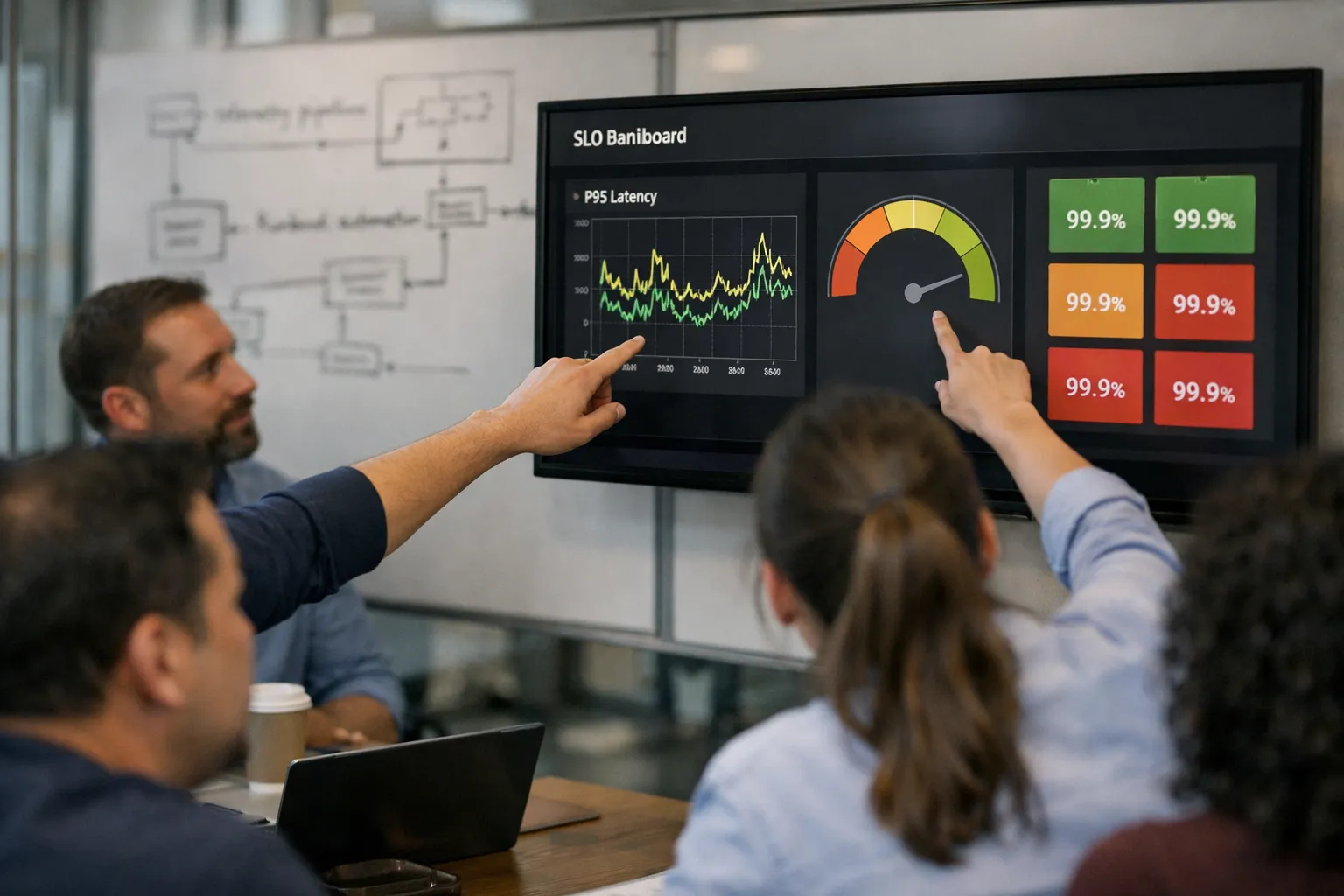
Enterprises delivering software at scale increasingly replace static, contract-only SLAs with observability-driven service-level objectives (SLOs) and automated responses. Done well, this approach aligns engineering decisions with business outcomes, reduces mean time to repair (MTTR), and improves customer trust. This guide walks platform engineers, SREs, and architects through a practical implementation path—covering definition, instrumentation, computation, automation, multi-tenant concerns, compliance mapping, and ROI calculation—so you can operationalize observability-driven SLAs for enterprise solutions.
Why observability-driven SLAs matter now
Traditional SLAs are often legal artifacts that promise availability percentages without operational mechanisms. Observability-driven SLAs turn contractual promises into measurable, automated practices by combining:
- Clear SLIs (service-level indicators) derived from telemetry
- Business-aligned SLO targets and error budgets
- Automated responses—alerts, scaling, throttling, or rollback—based on burn rates
In 2026, enterprises face more complex integration surfaces—hybrid cloud, multi-region deployments, and high-cardinality multi-tenancy—so observability-driven SLAs are essential to maintain scalability, integration fidelity, and predictable ROI during implementation.
Core concepts (brief)
- SLI: a quantitative measure (e.g., P95 latency, request success rate)
- SLO: a target for an SLI over a time window (e.g., 99.95% monthly availability)
- Error budget: allowable SLO violation budget (1 - SLO) used to judge risk-taking
- SLA: contractual agreement with customers; may map to one or more SLOs
Step-by-step implementation
1. Define business-aligned SLOs
Start with the business value. Work with product, sales, and legal to translate customer expectations into measurable objectives.
- List critical customer journeys (e.g., login, checkout, data sync).
- Choose SLIs tied to business outcomes—availability, latency, correctness (e.g., successful payment confirmations), and throughput.
- Set SLO targets by impact tier: enterprise-paid customers might have 99.99% for core transactions, while freemium tiers use 99.5%.
Example: For a payments API, define SLI = percent of successful signed transactions within 300ms. SLO = 99.95% over a 30-day rolling window.
2. Instrumentation and telemetry standards
Reliable SLI calculation depends on consistent telemetry. Implement an instrumentation plan that spans metrics, traces, and logs:
- Standardize metric names and labels (namespace.service.operation, status, region, tenant_id)
- Propagate context in distributed traces (trace-id, span-id, tenant context)
- Choose sample rates that preserve accuracy for P95/P99 latency while controlling data volumes
- Use open protocols where possible (OTLP, Prometheus exposition, OpenMetrics) to simplify integration
Policy: require every production API to emit a “request_latency_ms” histogram and “request_success” counter with tenant and region labels.
3. SLI collection and SLO computation
Decide where you compute SLIs—at-edge, metrics pipeline, or downstream analytics. Consider trade-offs:
- Edge computation (e.g., API gateway) reduces upstream telemetry load but requires robust tagging.
- Centralized computation (metrics DB like Prometheus Mimir, Cortex, Thanos, or commercial systems such as Datadog/ New Relic) simplifies historical cross-service queries.
Important implementation details:
- Use rolling windows (30d, 7d, 1d) and document the computation formula precisely.
- Account for measurement bias (e.g., sampling, aggregation intervals).
- Validate computed SLIs against raw logs for the first 90 days.
4. Set SLOs and error budgets, including per-tenant plans
Adopt a layered approach:
- Global SLOs for platform-wide guarantees
- Service-level SLOs for critical components
- Tenant-aware SLOs for enterprise customers with dedicated contracts
For multi-tenant SaaS, decide which SLOs are tenant-scoped (per-tenant availability) and which are global (control plane performance). Per-tenant SLOs increase cardinality and cost—balance precision with scalability by using sampling or aggregated tiers (e.g., "top 20 enterprise tenants get per-tenant SLOs").
5. Automate responses and integrate with operations
Automation is where observability-driven SLAs deliver ROI. Link SLO states and error-budget burn rates to concrete runbooks:
- Alerting: threshold-based and burn-rate alerts (e.g., 3x burn rate sustained for 1 hour)
- Auto-remediation: scale-out, circuit-breaker activation, or feature-flag rollback
- Escalation: route to on-call via PagerDuty or Opsgenie with SLO context in incident payload
- Customer-facing: automated status page messages and legal SLA triggers when contractual thresholds are crossed
Integration points: monitoring -> alerting -> orchestration (Terraform, Argo, or CI/CD pipelines) -> CRM/billing for SLA credits. Use webhooks and API contracts between these systems for reliable automation.
6. Multi-region, multi-cloud, and scalability considerations
For enterprise solutions running across regions and clouds:
- Define region-aware SLIs (e.g., per-region availability) and global aggregations.
- Account for eventual consistency (data replication lag) when choosing SLIs.
- Design telemetry pipelines for high throughput—use long-term storage like object-backed metrics stores and query layers tuned for high-cardinality queries.
- Cost management: high-cardinality labels (tenant_id, user_id) multiply series—apply label cardinality limits and aggregation strategies.
7. Compliance, reporting and SLA mapping
Map operational SLOs back to contractual SLAs:
- Document exact SLO definition in legal terms and build automated reporting that can generate forensic data supporting SLA calculations.
- Keep immutable audit trails of SLI calculations for dispute resolution.
- Provide transparent reports to customers: SLO status dashboards and monthly SLA compliance reports.
8. Measure ROI and build the business case
Quantify the benefits to justify investment:
- Reduced downtime: estimate avoided revenue loss = average revenue per minute × reduced downtime minutes
- Reduced MTTR: translate reduction in incident handling hours to labor cost savings
- Customer retention: estimate churn reduction from improved reliability and map to lifetime value (LTV)
Example ROI model (annualized): assume platform handles $50M ARR, average revenue per minute $95. If observability-driven SLAs reduce downtime by 30 minutes/year, that's $2,850 in avoided direct revenue loss, plus operational savings from faster MTTR; add churn reduction savings for enterprise contracts to reach full ROI. Tailor the math to your business lines and include integration/implementation costs for instrumentation and automation.
9. Operationalize governance and continuous improvement
Put processes in place:
- SLO review cadence (quarterly): update SLOs as features or customer expectations change
- Runbook maintenance: ensure automated playbooks are versioned and tested
- Telemetry SLAs: treat observability pipelines like first-class services with their own SLOs
Practical tooling patterns (2026)
Tool selection depends on scale and existing stack. Common patterns in 2026:
- Metrics: Prometheus + long-term storage (Thanos, Cortex, Mimir) or commercial providers (Datadog Metrics, New Relic Metrics) for enterprise-scale retention
- Tracing: OpenTelemetry collection to vendor or self-hosted backends; ensure tenant context propagation
- SLO management: SLO engines (Brigade, SLO-specific platforms, or built-in features in observability vendors)
- Automation: Incident platforms (PagerDuty) + orchestration (Argo Rollouts, Terraform Cloud) + feature flags (LaunchDarkly)
Choose systems that offer robust APIs for integration; avoid vendor lock-in by standardizing telemetry formats.
Common pitfalls and how to avoid them
- No business alignment: SLOs that don’t map to revenue or customer experience fail to prioritize engineering work. Fix: tie SLOs to customer journeys and financially quantify impact.
- Poor instrumentation: missing labels or inconsistent metrics leads to inaccurate SLIs. Fix: enforce instrumentation standards via code reviews and centralized libraries.
- Alert fatigue: alerting on raw thresholds instead of burn rates creates noise. Fix: leverage burn-rate alerts and escalation curves.
- Cardinality cost shock: per-tenant metrics can explode storage costs. Fix: use sampled per-tenant SLOs and aggregate tiers for lower-value tenants.
Short case vignette: payments platform
A mid-sized enterprise payments provider implemented observability-driven SLAs in 2025 to support a new enterprise tier. Steps they took:
- Defined SLO: 99.95% success rate for signed transactions within 300ms (30-day window).
- Instrumented: gateway emitted histograms and tenant_id labels; traces included payment-context.
- Computed SLIs in a centralized Prometheus/Cortex cluster with a daily reconciliation job against raw logs.
- Automated: built burn-rate alerts—at 2× burn rate, auto-scale payment-processing clusters; at 4×, disable non-critical features via feature flags and notify customers.
- Result: MTTR dropped from 90 to 25 minutes for payment incidents, delivering measurable ROI through reduced incident labor and improved churn among enterprise customers.
Checklist for your first 90 days
- Workshop with stakeholders to pick 3 initial business-critical SLOs
- Standardize telemetry names and labels across services
- Implement SLI collection for the 3 SLOs and validate against logs
- Define error-budget policies and write automated runbooks for burn-rate thresholds
- Integrate with incident management and test an automated response in staging
- Publish SLO definitions and reporting cadence to customers and legal
Conclusion
Observability-driven SLAs let enterprise teams transform abstract contractual promises into operational systems that support scalability, tighter integration across services, and demonstrable ROI. Start small, align SLOs to business outcomes, invest in consistent telemetry, and automate based on error budgets. Over time, this approach reduces downtime costs, speeds incident response, and strengthens customer relationships—making the implementation investment a strategic lever for enterprise software providers.