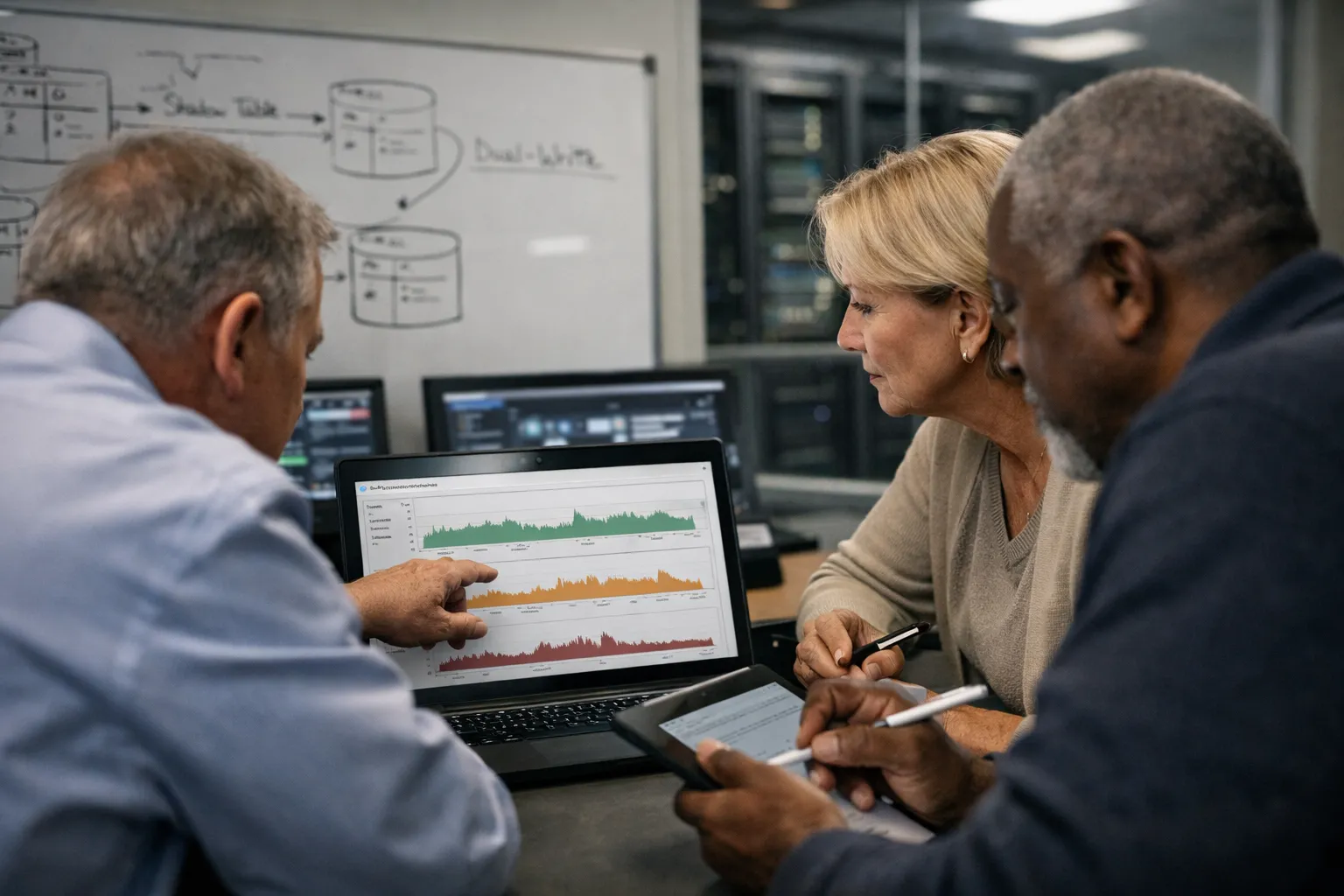
What you'll learn: This updated August 2026 guide shows enterprise software teams how to plan and execute online schema migrations with minimal customer impact, preserve data integrity, and demonstrate ROI. It's written for engineering leads, DBAs, SREs and platform teams responsible for production databases in high-throughput environments.
Prerequisites & context: why this matters now (Aug 2026)
Schema changes are no longer a one-off operational headache — they are continuous business requirements driven by feature velocity, analytics quality, cost optimization and tighter regulatory controls (data residency, consent management). Since 2022 the industry has moved decisively toward managed cloud databases, wider adoption of change-data-capture (CDC) pipelines, and integration of migration orchestration into CI/CD. Those trends mean teams can and should treat schema evolution as part of normal delivery rather than an emergency maintenance window.
Practical implications for 2026:
- Managed DBs (cloud and distributed SQL) increasingly expose non-blocking DDL primitives — but behavior varies by engine and version; test before trusting production.
- CDC tooling (Debezium, managed connectors in Confluent, cloud provider CDC) is now a mainstream mechanism for safe copy-and-cutover migrations.
- Teams are using automation and AI-assisted analysis to estimate backfill cost and detect downstream schema consumers.
High-level migration patterns (when to use which)
There is still no universal technique. Choose based on table size, write throughput, consistency requirements and downstream coupling.
1. Expand‑Contract (safe & broadly applicable)
- Expand: add nullable columns, new tables, or indices without blocking writes.
- Integrate: update application to write both old and new shapes (dual-write) behind feature flags.
- Backfill: perform asynchronous, rate-limited backfills using batched jobs or serverless workers.
- Contract: switch reads, validate, then remove legacy artifacts after observation.
Why: Minimal DB assumptions; works with Postgres, MySQL, and managed offerings. In 2026, teams commonly pair expand-contract with automated parity checks and CI-based gating.
2. Shadow table + cutover (low risk, higher storage cost)
Create a complete copy with the target schema, use CDC or bulk copy to populate, validate parity, then perform an atomic cutover (name swap or traffic routing). Best when table size or transformation complexity justifies a separate copy and when you can tolerate the extra storage and copy time.
3. Engine-native online DDL / index rebuilds
Use engine-specific non-blocking operations:
- MySQL family: gh-ost, pt-online-schema-change, Vitess online DDL remain staples for complex ALTERs.
- PostgreSQL: CREATE INDEX CONCURRENTLY, logical replication workflows and tools like pg_repack are standard; Postgres 14–16 improvements reduced many blockers, but some ALTERs still require careful orchestration.
- Distributed SQL & managed DBs: Spanner, CockroachDB, Yugabyte and other cloud providers offer online primitives for common schema changes — behavior and guarantees differ, test cutover semantics.
Why: When your DB supports it, online DDL avoids application-level dual-write complexity; still validate latency and locks under peak load.
4. API/service-level transformation (when DB change is risky)
Introduce a versioned service layer or adapter that maps new shapes to the current schema. Useful in multi-tenant or third-party dependency scenarios where direct DB change is constrained by contracts or compliance. This buys time for a phased migration.
Updated tooling and integration choices (2026)
Two integration layers matter: migration orchestration and runtime integration. Since 2024–26, several practical shifts have solidified:
- CDC-as-a-service: Many organizations use managed CDC connectors (Confluent, cloud providers) or Debezium-based platforms for reliable change-stream copies.
- Migration pipelines in GitOps: Migrations live in code repositories, run through CI with approvals and automated smoke tests; GitOps tooling now often includes migration dry-run and impact assessment steps.
- Feature-flag + DAL patterns: Feature flags remain essential; teams combine them with abstraction layers so data access code can switch shapes dynamically.
- AI-assisted analysis: Emerging tools analyze query shapes, foreign-key usage and downstream consumers to estimate backfill cost and highlight risky paths — useful as a planning input, not a substitute for staging tests.
Step-by-step implementation (phased plan + practical timings)
Timelines depend on table size and SLA. Use these phases and corresponding checklist items:
Phase 0 — Assessment (1–3 weeks)
- Inventory impacted schemas: row counts, index cardinality, avg/peak write QPS, and hot partitions.
- Map downstream consumers: ETL jobs, materialized views, caches, third-party integrations.
- Estimate backfill compute and I/O: run a sample scan to extrapolate rows/sec and network cost.
- Define rollback criteria (latency thresholds, parity failures) and SLOs (RTO/RPO).
Phase 1 — Design (1–4 weeks)
- Select migration pattern and pick tooling (CDC, online DDL, shadow table).
- Define data contracts and schedule communication windows with downstream owners.
- Design rate-limiting, batching, and retry/backoff for backfill jobs; plan monitoring dashboards.
- Create a runbook with clear abort and rollback steps.
Phase 2 — Build & Test (2–8 weeks)
- Implement migrations in a migrations repo, run through CI pipelines with automated linting and dry-runs.
- Test on production-sized staging or by replaying traffic to a sandbox; measure time-to-backfill and replication impact.
- Wrap dual-write behind feature flags and simulate partial failures to exercise idempotency.
- Automate parity checks (checksums, row counts, sample queries) and integrate alerts when drift exceeds thresholds.
Phase 3 — Pilot & Rollout (variable)
- Canary on a low-traffic shard, tenant, or region. Gradually increase backfill rate while monitoring replication lag and tail latencies.
- Use traffic-splitting to steer a subset of reads to the new path and validate results against the legacy path.
Phase 4 — Cutover & Contract (days–weeks)
- Switch reads after meeting parity and performance criteria; observe KPIs for a defined window.
- When stable, remove legacy columns and indexes; prefer staged deletions to avoid long-locking ALTERs.
Testing & validation (what to verify)
- Data parity: row counts, checksums, sampled record equality for critical attributes.
- Performance baselines: p50/p95 latency, CPU, I/O, and read/write throughput under representative loads.
- Replication & failover: simulate replica lag, promote failover and confirm migration continuity.
- Downstream correctness: run ETL and BI jobs against migrated shape and validate results.
- Disaster recovery: test restore and point-in-time recovery steps against the post-migration layout.
Monitoring, observability and rollback
Instrumentation is critical. Track:
- Migration throughput (rows/sec), processed bytes, and progress percent.
- Replication lag and replication backlog.
- Error counts and failure rate per batch.
- Application KPIs: error rate, request latency p50/p95, and any increased retries.
Alert on thresholds that map to rollback criteria (example: replication lag > X ms for Y minutes). Maintain prebuilt rollback scripts to abort copy jobs, freeze writes to new fields, and route traffic back to legacy code. Regularly test rollback in staging.
Measuring ROI (practical, updated approach)
Translate outcomes into financial and operational measures. In 2026, teams should present ROI as three linked metrics:
- Operational savings: reduced planned downtime and fewer ad-hoc migrations.
- Developer velocity: shortened lead time for data-model changes (measure in sprint or days saved).
- Risk reduction: fewer incidents and lower MTTI/MTTR costs.
Example calculation (illustrative assumptions — replace with your org metrics):
- Planned migration windows prior: 8 hours/month
- Revenue at risk during downtime: $15,000/hour
- Engineer ops time for migrations and incidents: 150 hours/month @ $160/hr
- Initial program cost (tools, infra, 6 months engineering): $350,000
Annualized benefit estimate:
- Downtime cost saved: 8 × 12 × $15,000 = $1,440,000
- Engineer time saved: 150 × 12 × $160 = $288,000
- Total annual benefit: ≈ $1,728,000
- Payback period: $350,000 / $1,728,000 ≈ 0.20 years (≈2.5 months)
Run sensitivity analyses with conservative adoption or partial automation to produce believable timelines for stakeholders.
Operational pitfalls and how to avoid them (2026 edition)
- Underestimate cloud egress, compute and storage costs for shadow copies — budget those explicitly.
- Failing to detect downstream consumers — use automated dependency discovery (query logs, data catalogs) to map consumers.
- Relying solely on AI analysis — use it for discovery but validate in staging with real data.
- One-off scripts in production — enforce migrations via version-controlled pipelines and peer review.
- Insufficient rollback rehearsals — practice rollback procedures as part of your runbook cadence.
Concrete example (updated for 2026): migrating a 1.5B-row orders table
Scenario: A global SaaS product with a 1.5 billion-row orders table on managed MySQL-compatible cluster, peak writes ≈ 3,200/sec. Goal: add a compressed JSONB payload and new analytical indices while avoiding any customer-visible downtime and controlling cloud egress costs.
Chosen approach:
- Expand: add new nullable JSON column with an engine-supported non-blocking ADD operation.
- Dual-write: application writes both normalized columns and JSON payload behind a feature flag; writes are idempotent.
- Backfill: serverless workers (cloud functions) read ranges and populate JSON payload; batching tuned to stay below replication-lag threshold; use a compute spot pool for cost control.
- Parity: daily checksums across hash partitions; alerts for drift > 0.01%.
- Cutover: route reporting cluster reads to JSON payload for a canary tenant, then incrementally roll out; after 45 days remove legacy columns.
Outcome: No customer-facing downtime, replication lag stayed within SLA, and analytical query costs dropped ~40% after consolidation and new indices.
Checklist before your first production online migration
- Inventory and production baselines recorded
- Runbook with explicit rollback criteria written and rehearsed
- CI/CD pipeline for schema changes with approvals, dry-runs and audit trails
- Feature flags and data-access abstraction implemented and tested
- Backfill automation with rate-limiting and cost controls
- Parity/validation tools scheduled and integrated into observability
- Stakeholders informed: SRE, DBAs, downstream owners, legal/compliance if needed
Pro tips
- Use ephemeral read replicas to perform heavy analytical validation without impacting production replicas.
- Throttle based on replication lag, not absolute rows/sec — lag reflects your system's tolerance.
- Prefer schema additions without defaults; defaults can trigger table rewrites in many engines.
- Automate sanity checks: smoke test a sampled subset of tenant traffic to validate behavior before broad cutover.
- Instrument cost meters for backfill (compute, network, storage) and include them in runbook decisions.
FAQ
How do I decide between expand-contract and a shadow-table approach?
Choose expand-contract when you can tolerate asynchronous backfill and want minimal copy/storage cost. Choose a shadow-table when transformations are complex, when you need a different physical layout, or when backfill will take days and you prefer to validate on a separate object. Use storage, I/O budget and time-to-cutover as primary decision factors.
Can I rely on engine-native online DDL for all schema changes?
No. While engine improvements and managed DB features have reduced blocking ALTERs, many changes (column type changes, collation changes, or operations that require table rewrite) still need careful planning. Always test the exact ALTER on a production-sized clone or via a traffic-replay sandbox to confirm behavior under load.
How should I monitor parity during backfill?
Run deterministic checks: partitioned checksums, row counts by shard/partition, and sample record equality on critical keys. Automate daily comparisons and alert on divergence beyond a small threshold. Keep audit logs of validation runs for compliance.
What are realistic cost controls for large-scale backfills in cloud environments?
Budget for compute (workers), network (egress for copies), and temporary storage (shadow tables or snapshots). Use spot or preemptible compute where acceptable, throttle to avoid excessive egress spikes, and consider in-region replicas to control transfer costs. Include cost thresholds as abort conditions in the runbook.
How frequently should teams rehearse rollback procedures?
At least quarterly for teams performing frequent schema changes, and after any change to tooling or topology. Rehearsals should be run against a staging environment that resembles production in size and topology; validate both aborting an in-flight migration and recovering from an improper cutover.
Conclusion: By August 2026 the tooling and practices for online schema migrations have matured: managed DBs and CDC are mainstream, automation is expected, and organizations that treat schema evolution as a routine CI/CD concern realize measurable ROI. The right pattern depends on your engine, scale, downstream coupling and risk tolerance. Use the phased plan above, invest in observability and rehearsal, and present ROI in operational and development terms to secure stakeholder support.