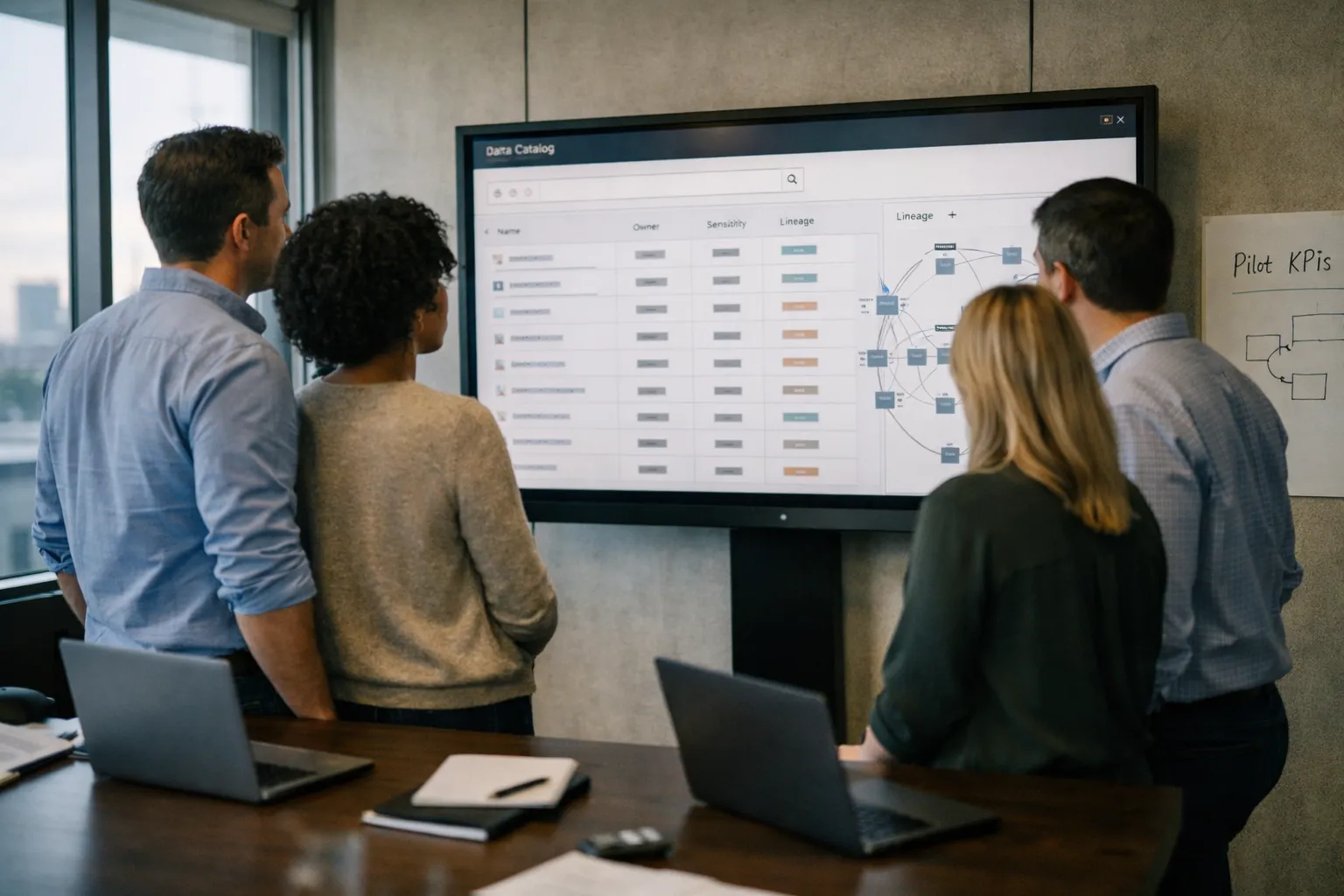
Enterprise teams selecting a data catalog and governance platform in August 2026 face a market where AI-first data practices, real-time streaming and tighter regulatory expectations have made metadata strategy central to both risk management and business velocity. Alation, Collibra and Microsoft Purview remain the three most frequently shortlisted enterprise solutions. This updated guide compares them on the operational criteria enterprise buyers care about today—scalability, integration, ROI and implementation—and adds new guidance on AI/ML lineage, data observability and pilot KPIs you should require in 2026.
Why this comparison matters in 2026
Between 2024 and 2026, two shifts have changed the stakes for metadata platforms:
- AI/ML provenance is now a board-level requirement: Enterprises must track training data lineage, model input provenance and feature-store lineage to manage bias, reproducibility and regulatory obligations for AI systems.
- Operational metadata and observability are critical for reliability: Continuous ingestion of operational events (pipeline runs, schema drift, quality alerts) is needed to support real-time analytics and SLAs.
Buyers no longer evaluate catalogs only for search—they need platforms that handle billions of assets and continuous event streams, integrate deeply with model and feature stores, deliver measurable ROI tied to analytics or compliance outcomes, and fit realistic implementation calendars that align with data platform modernization programs.
Vendors at a glance (2026 perspective)
- Alation — Continues to position itself as a behavioral, search-first catalog that emphasizes adoption, collaborative stewardship and productivity gains for analysts. In 2025–26 Alation expanded capabilities around automated tagging and LLM-assisted metadata curation; it focuses on SQL analytics lineage and query-aware search.
- Collibra — Remains a governance and policy orchestration leader. Collibra’s canvass for stewardship workflows, certification, and audit trails is often chosen where compliance, risk management and cross-functional policy automation are priority projects.
- Microsoft Purview — Offers the tightest native integration for Azure- and M365-centric estates. Purview’s cloud-native architecture and continuous investments in connectors and identity integration mean fast first-value for organizations standardizing on Microsoft cloud services.
Selection criteria and scoring methodology
This analysis uses four criteria enterprise buyers consistently report as decisive in 2026:
- Scalability — ability to handle large catalogs (hundreds of millions to billions of assets), sustained events/sec, multi-region deployment and acceptable query latency under heavy concurrency.
- Integration — breadth and depth of connectors (data lakehouses, warehouses, BI, ETL, MLOps, feature stores), API maturity and support for streaming/real-time metadata ingestion.
- ROI — measurable benefits across analytics velocity (time-to-insight), compliance cost reduction, steward productivity and total cost of ownership (TCO) over 3–5 years.
- Implementation — realistic deployment timelines, required engineering effort, professional services and operationalization complexity (inc. identity/IAM integration).
Scalability (what to expect in 2026)
Alation: Architected around fast search and behavioral metadata; production customers report reliable performance for tens to hundreds of millions of catalog objects when paired with recommended infra. For truly massive multi-region active-active estates (multi-billion assets, cross-region failover), expect design and capacity planning work—particularly for the query-logging and behavioral layers which can generate high event volumes.
Collibra: Built to support large governance workloads with complex workflows and audit histories. Collibra scales for enterprises with high policy-event volumes, but governance orchestration (approvals, certifications, automated remediations) introduces operational throughput considerations—plan CPU and workflow queue capacity accordingly.
Microsoft Purview: Uses Azure managed services to scale horizontally and absorb spikes in metadata ingestion. For Azure-heavy estates Purview reduces infrastructure management, but hybrid and multi-cloud estates still require careful architecture to avoid cross-cloud egress charges and to ensure acceptable latency in cross-region scenarios.
Integration (connectors, ML/feature store, streaming)
Three integration capabilities are decisive in 2026: MLOps/feature store connectors, streaming metadata (Kafka/Kinesis), and fine-grained cataloging of data contracts and APIs.
Alation: Strong connectors for BI, data warehouses and query-level lineage. In 2025–26 Alation expanded LLM-assisted automated tagging and basic connectors to model registries and feature stores, but deep two-way integrations with MLOps pipelines often still require engineering work or third-party adapters.
Collibra: Emphasizes integration with data quality, MDM and policy engines and has invested in APIs for registering ML assets and policy attachments. Collibra is commonly used to formalize and enforce data contracts across pipelines, though feature-store-native integrations vary by deployment and often leverage partners.
Microsoft Purview: Best-in-class for Azure-native services (Synapse, Azure Data Lake, Databricks on Azure, SQL) with improving connectors to Snowflake, AWS S3 and other non-Azure assets. Purview’s native auth (Azure AD) and automatic harvesting reduce friction for Microsoft-standardized firms; recently Purview added capabilities around model cataloging and lineage within the Azure ML ecosystem.
ROI (how to measure and where gains appear)
Track ROI with 3–5 KPIs during a pilot: time-to-insight, steward-hours per dataset, number of certified datasets, mean time to remediate data incidents, and compliance remediation costs avoided.
- Alation: Delivers tangible analyst productivity and self-service adoption gains fastest—visible in reduced tickets to central data teams and faster onboarding. Expect measurable improvements in SQL reuse and fewer duplicated datasets within 3–6 months of an active pilot.
- Collibra: ROI manifests as governance risk reduction—shorter audit cycles, documented policy enforcement and fewer manual compliance tasks. In regulated industries this ROI can be direct and quantifiable in avoided remediation costs and faster regulatory reporting.
- Microsoft Purview: Best ROI for Azure-standardized estates through lower operational overhead, faster ingestion and consolidated billing. Purview reduces integration and identity-management friction—benefits that compound when many Azure services are already in use.
Implementation (realistic timelines and resource needs in 2026)
Implementation speed is often the deciding factor in procurement. Updated typical timelines:
- Alation: Pilot: 6–12 weeks for a minimally viable catalog and search layer; enterprise rollout: 4–9 months depending on behavioral integrations and query logging. Success depends on enabling query capture, stewardship programs and BI integrations.
- Collibra: Pilot: 2–4 months for a governance-focused proof-of-concept; enterprise rollout: 6–15 months depending on policy modeling, identity integration and the breadth of automated workflows. Expect close involvement from governance SMEs and professional services.
- Microsoft Purview: Pilot: often a few days to a few weeks for Azure-only ingestion; enterprise rollout: 2–6 months for broad estates when non-Azure connectors are modest. Hybrid/multi-cloud estates can extend timelines due to custom connector work and network integrations.
Side-by-side summary
- Strengths: Alation—analytic adoption and search; Collibra—policy orchestration and auditability; Purview—Azure-native scale and lowest-friction integration for Microsoft stacks.
- Best integrations: Alation—BI/SQL lineage; Collibra—MDM, data quality, governance workflows; Purview—Azure services, M365, Azure AD.
- AI/ML readiness: All three now offer ML/AI metadata capabilities; Collibra emphasizes policy attachments for models, Alation emphasizes data usage and provenance, Purview integrates model lineage within Azure ML.
- Typical pilot timeline: Alation 6–12 weeks, Collibra 8–16 weeks, Purview 1–6 weeks (Azure-first).
Which platform suits which enterprise profile?
- Choose Alation if your priority is analyst productivity, query-aware search and rapid self-service adoption across SQL and BI ecosystems—especially in mixed cloud/on-prem estates that need strong discovery and collaboration.
- Choose Collibra if governance, auditability and formal policy enforcement drive procurement—typical for finance, healthcare and highly regulated public-sector deployments.
- Choose Microsoft Purview if your estate is largely Azure- or Microsoft-centric and you want a cloud-native catalog that minimizes integration friction and provides quick time-to-value for Azure workloads.
Deployment checklist: questions to validate before shortlisting
- How many metadata assets and events per day must the platform handle? Ask vendors for reference customers of comparable scale and request architecture notes for multi-region deployments.
- Which systems must be ingested natively, and which require custom connectors (Databricks, Snowflake, S3, on-premise stores, Kafka, feature stores)? Map critical connectors early.
- What level of lineage fidelity do you need—dataset-level, column-level, SQL/query-level, or model/feature-store lineage? Require sample lineage outputs in the pilot.
- Which identity and IAM systems will enforce policies (Azure AD, Okta, LDAP)? Validate role mappings and SSO flows in a sandbox.
- How will you quantify ROI—define 3–5 KPIs (time-to-insight, steward hours saved, compliance remediation time) and instrument them before vendor onboarding.
- Does the vendor or partner ecosystem provide MLOps and data-observability integrations you need, or will you invest in custom adapters?
Final recommendations (August 2026)
There is no single “best” catalog—each platform maps to different priorities. In 2026 buyers must explicitly map the catalog to AI/ML governance: track training data provenance, feature-store lineage and model registry relationships, because these are central to both risk and ROI calculations.
Procurement should follow a short, focused proof-of-value (3–6 months) that exercises critical connectors (including model/feature stores and streaming systems), validates lineage fidelity at the granularity you require, and measures analyst and steward productivity gains with pre-defined KPIs. Require vendors to produce example outputs from a dataset you control and insist on runbooks for common incidents (schema drift, failed ingestion, policy violation remediation).
Short guidance: if your primary objective is analytics velocity choose Alation; if governance rigor is paramount choose Collibra; if you are consolidating on Azure choose Microsoft Purview. In every case, insist on real-world scale proofs and measurable KPIs during the pilot to make a defensible enterprise selection.
Frequently asked questions
How important is ML/feature-store lineage when choosing a catalog?
Very important. If your organization trains production models or uses feature stores, the catalog must capture dataset-to-feature-to-model relationships and support provenance queries. Without this, you risk poor reproducibility, extended incident investigation times and regulatory gaps for AI systems.
Can a single platform handle both governance and analyst adoption goals?
Yes, but it depends on priorities and resourcing. Some enterprises adopt a hybrid strategy—use a governance-first platform (Collibra) for policy and audit functions and a search/adoption platform (Alation) for analyst productivity, with integration between the two. Conversely, Microsoft Purview aims to cover both in Azure-centric estates. Evaluate overlap, duplication and integration cost before committing.
What pilot KPIs should I require from vendors?
Require at minimum: (1) time-to-insight for a defined use case, (2) steward-hours saved per dataset or per week, (3) number of certified datasets produced, (4) mean time to detect and remediate a data incident, and (5) qualitative adoption metrics (search success rate, user satisfaction). Measure baseline metrics before the pilot.
How do I budget for ongoing costs beyond licensing?
Account for integration and connector maintenance, storage and ingestion costs for harvested metadata/events, personnel (stewards and platform engineers), and professional services for complex governance workflows. For cloud-native deployments, include potential cross-cloud egress and managed-service costs in TCO estimates.
Should I prefer a cloud-native vendor for hybrid estates?
Cloud-native vendors (like Purview) offer operational advantages in their native cloud but hybrid estates often need custom connectors, network design (e.g., private endpoints) and extra egress budgeting. If hybrid/multi-cloud is strategic, insist on reference implementations and test connectors for your critical systems during the pilot.