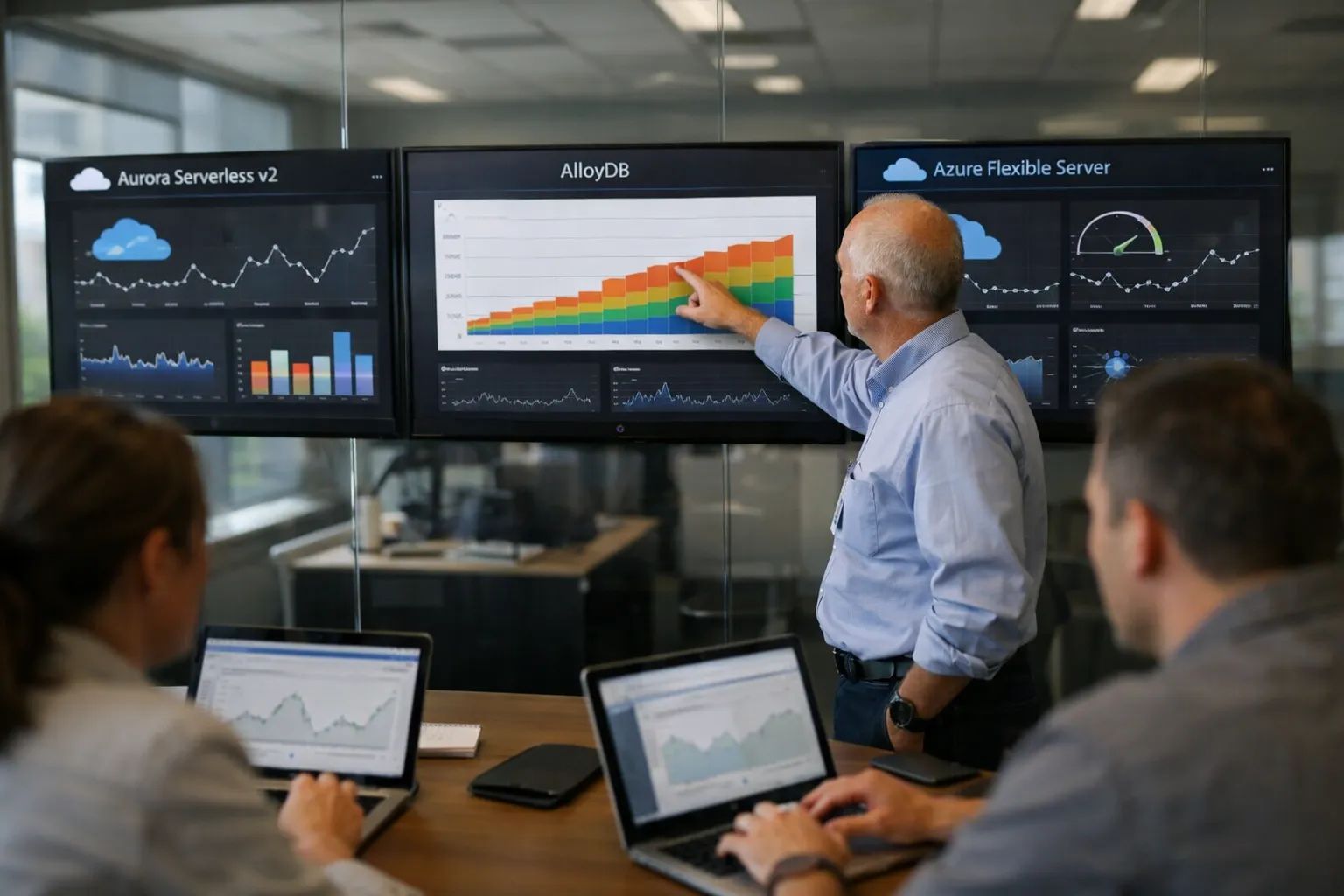
Managed PostgreSQL-class services remain the foundation for transactional systems, analytics-backed apps and modern SaaS platforms. Since our April 2026 brief, two major shifts have reshaped enterprise choices: (1) Postgres as a platform for AI/embedding workloads (pgvector and similar extensions are now routine requirements) and (2) rising emphasis on cost predictability and observability as scale and cross-cloud data movement increased costs in production. This update compares Amazon Aurora Serverless v2, Google AlloyDB, and Azure Database for PostgreSQL — Flexible Server with July 2026 context and practical guidance for enterprise architects and platform engineers.
What we compare and why it matters
We continue to evaluate three managed Postgres-class offerings that enterprises commonly consider as their transactional backbone:
- Amazon Aurora Serverless v2 (Postgres-compatible)
- Google AlloyDB (Postgres-compatible)
- Azure Database for PostgreSQL — Flexible Server
This update focuses on the same decision dimensions that matter in 2026: scalability (including AI/embedding workload patterns), ecosystem integration, spend predictability and TCO, extension and compatibility support (pgvector, PostGIS, pgaudit), and implementation realities—migration approach, high availability (HA), compliance and ongoing operations.
Comparison criteria — what matters now
We use consistent, enterprise-oriented criteria:
- Scalability & elasticity: vertical and horizontal scaling, autoscaling behavior, multi-region options.
- Integration & ecosystem: analytics pipelines, identity and governance, hybrid/multi-cloud tools.
- Extension & AI support: native/managed support for pgvector, embeddings pipelines, and analytical extensions.
- Cost & TCO: billing model (serverless vs provisioned), egress, reserved options, and hidden costs (observability, backups, cross-region replication).
- Implementation & operations: migration path, HA, RPO/RTO, observability, operational runbooks, and compliance.
At-a-glance feature snapshot (2026)
- Aurora Serverless v2: fine-grained compute autoscaling, deep AWS integration (S3, Redshift, Lambda, Glue), mature multi-AZ HA, strong operational tooling via CloudWatch and RDS observability. Cost model favors variable-load SaaS when autoscaling is tuned.
- AlloyDB: positioned for mixed OLTP+analytics and tighter integration with Google analytics stack; appeals when BigQuery or Dataproc offload is central. Enterprises increasingly evaluate AlloyDB for workloads that combine transactional operations with vector/ML embeddings pipelines.
- Azure Flexible Server: emphasis on governance and predictable maintenance (Azure AD, Arc integration), Zone-redundant HA, and straightforward lift-and-shift from Azure IaaS/Postgres. Favored when Microsoft identity and compliance are primary constraints.
Scalability: how each platform grows with demand in 2026
Scalability now must account for two workload axes: transactional peak TPS and AI/embedding inference/query throughput. Many enterprises run small vector indexes alongside OLTP; that affects memory and CPU patterns.
- Aurora Serverless v2: continues to be strongest for unpredictable, spiky multi-tenant SaaS because compute scales in fine-grained units. It decouples storage and compute which simplifies scaling storage-heavy workloads. Key enterprise caveat in 2026: autoscaling behavior should be verified under steady high-concurrency embedding lookups—some teams add warming strategies or reserve baseline capacity for low-latency AI lookups.
- AlloyDB: designed to sustain heavier mixed workloads where complex analytical queries or embedding joins run alongside OLTP. In 2026 many teams report lower tail latency for analytical queries when they use AlloyDB with BigQuery offload patterns. For pure transactional scale-out, evaluate read-replica lag under high write rates.
- Azure Flexible Server: provides predictable vertical scaling and read replicas; scaling operations are often scheduled. This predictability helps enterprises with strict maintenance windows but requires more capacity planning for sudden AI inference spikes unless you architect a hybrid design (e.g., dedicated inference tier).
Integration: ecosystem, tooling and data movement
Integration remains decisive: where your data pipelines, identity, analytics, and governance live will usually determine the best fit.
- Aurora Serverless v2: unsurpassed if your stack uses S3-based data lakes, Lambda functions, Kinesis/Glue ETL flows, and Redshift. In 2026, observability integrations (CloudWatch, X-Ray, third-party APMs) and native IAM policies simplify operations and compliance audits.
- AlloyDB: attractive when BigQuery, Dataflow, Vertex AI and Anthos are core. Enterprises that push analytics-heavy workloads into BigQuery and run embedding training in Vertex AI benefit from lower cross-service friction. Anthos remains a differentiator for firms pursuing hybrid Kubernetes control planes.
- Azure Flexible Server: tight Azure AD integration, Synapse connectivity and Azure Arc for hybrid governance are valuable for Microsoft-centric enterprises. In 2026, more customers integrate Flexible Server with Purview for data classification and Sentinel for centralized security monitoring.
Extension & AI support (pgvector, PostGIS, pgaudit)
Since early 2024, adoption of pgvector and Postgres-based embedding workflows accelerated. In 2026, extension support is a routine migration checklist item.
- Before committing, verify managed-service support for required extensions (pgvector, ivfflat/index types, PostGIS, pgaudit, citext). Many teams now use Postgres as a lightweight vector store to avoid separate vector DB costs, but this requires confirmation of managed extension versions and index type support.
- Operational implications: vector indexes are memory- and CPU-intensive at query time—ensure the provider supports appropriate instance sizes or baseline compute reservations for low-latency inference.
Cost & TCO: what changed in 2026
Direct pricing is still provider-specific and changes frequently. Key 2026 tendencies to incorporate into your TCO model:
- Serverless vs provisioned trade-off: Serverless (Aurora Serverless v2) reduces idle compute waste for spiky workloads but requires realistic load tests; cold or large-scale concurrent scale-ups can create latency spikes. Many teams combine a small baseline provisioned footprint with serverless bursts to balance latency and cost.
- AI/embedding cost drivers: embeddings and vector search increase memory pressure; they also increase egress when models or embeddings are processed outside the DB. Account for repeat inference traffic, storage for embeddings, and index maintenance costs.
- Hidden costs: cross-region replication, data egress, backup storage retention, and observability/third-party APM licensing often grow faster than compute costs—make these explicit in TCO models.
Implementation: migration paths, HA, compliance and operations
Implementation complexity and time-to-value continue to drive vendor choice.
- Aurora Serverless v2: migrations from Postgres are straightforward using logical replication, AWS DMS, or pg_dump/pg_restore. Focus post-migration effort on tuning autoscaling parameters and observability to detect scale-up bottlenecks. Aurora’s multi-AZ failover and automated PITR are mature; confirm RTO/RPO against your SLA (many enterprises aim for sub-minute failover for primary workloads).
- AlloyDB: supports standard Postgres migration paths. For analytics-forward migrations, staged approaches that migrate transactional workload first and offload reporting to BigQuery later are common. Validate extension compatibility and investigate how backup/restore SLAs map to your compliance needs.
- Azure Flexible Server: common path for enterprises on Azure because of simple lift-and-shift tooling and strong AD integration. Zone-redundant HA and maintenance windows make it easier to meet strict change-control policies; plan VNet and private endpoint configurations early to avoid cutover delays.
Practical migration scenario — updated considerations (500 GB OLTP, 2k TPS peak)
Same baseline scenario updated for 2026 operational realities:
- Aurora Serverless v2: If your environment is AWS-centric and traffic variance is high, Aurora remains a prime candidate. Add a small always-on capacity buffer for embedding-heavy query latency. Test autoscaling with synthetic vector lookup patterns that match production embedding sizes.
- AlloyDB: Best when analytics and ML pipelines are core and BigQuery/Vertex AI reduce pipeline friction. Consider staged cutovers: migrate OLTP first, then move analytics jobs and vector materialized views into BigQuery or an adjacent service to minimize interference.
- Azure Flexible Server: Choose when AD governance, reserved capacity and predictable maintenance windows are top priorities. For embedding workloads, couple Flexible Server with a dedicated inference tier or use Azure’s machine learning infra to avoid direct pressure on the DB host.
Side-by-side comparison — quick reference
- Autoscaling: Aurora Serverless v2 — strongest for fine-grained autoscale; AlloyDB — strong for mixed workloads with analytics offload; Azure Flexible — predictable scheduled scaling.
- Extensions & AI: All three can run modern Postgres workloads — but verify pgvector, index type support and versioning before migration.
- Observability: AWS/CloudWatch, Google Cloud Operations, and Azure Monitor integrations are mature—make sure your APM and tracing can ingest DB metrics and slow-query traces.
- Hybrid/multi-cloud: AlloyDB + Anthos or Azure Arc are options for multi-cloud governance; Aurora is best-in-class inside AWS but multi-cloud architectures will add complexity and egress costs.
Best for scenarios — updated guidance
- Choose Aurora Serverless v2 if: you run an AWS-native, multi-tenant SaaS with highly variable load and you can tolerate (or mitigate) transient scale-up latency for rare bursts. Add baseline capacity for embedding-driven low-latency work.
- Choose AlloyDB if: analytics and ML are central; your engineering teams are invested in BigQuery/Vertex AI and you want a simpler path to combine transactional and analytical workloads.
- Choose Azure Flexible Server if: your organization is Microsoft-centric, requires deep AD governance, or needs disciplined maintenance windows and predictable scaling operations.
Updated implementation checklist
- Map workload patterns including embedding query sizes, typical vector index memory footprint, peak TPS and idle periods. Run synthetic vector-query load tests.
- Inventory required Postgres extensions (pgvector, PostGIS, pgaudit, citext) and confirm provider support and version compatibility.
- Plan baseline capacity strategy for serverless options to meet tail-latency SLAs—don’t rely solely on reactive scaling for embedding-heavy queries.
- Model TCO including egress, cross-region replication, backup retention, and third-party observability licensing. Use provider pricing calculators and validate with small POCs.
- Design HA and RTO/RPO: test failover and PITR restore times with production-sized datasets.
- Define governance: IAM roles, encryption, audit logging, and compliance mappings (SOC2/ISO/GDPR). Ensure your SIEM and Data Loss Prevention policies integrate with provider-native tooling.
- Stage cutover using logical replication or DMS and validate rollback plans with a rehearsal run.
Recommendations — practical next steps for July 2026
1) Start with a focused POC that mirrors production workload including embedding lookup patterns, not just standard OLTP. 2) Run full-cost TCO scenarios that explicitly add egress and observability costs. 3) Use a hybrid baseline for serverless services (small provisioned footprint + autoscaling) where low-latency SLAs exist. 4) Treat pgvector/embedding support as a hard requirement, not optional—confirm index types and native performance. 5) Keep governance and identity integrations high in your selection criteria: identity-bound access and audit logs shorten compliance timelines.
Final recommendation
There is still no universal winner. In July 2026 the right choice flows from three factors: your cloud footprint, whether analytics/ML embedding workloads are central, and your tolerance for variable latency vs. need for predictable operations. Use Aurora Serverless v2 for AWS-first, variable-load SaaS with a warmed baseline; pick AlloyDB when Google Cloud analytics and Vertex AI materially reduce end-to-end latency and costs; choose Azure Flexible Server when AD governance, predictable maintenance and Azure-native services dominate. In every case validate with a realistic POC, model TCO for your full stack (including AI pipeline costs), and hard-test failover and extension compatibility before cutover.
FAQ
Does pgvector run well on managed Postgres services?
Yes—pgvector and similar embedding workflows are widely used, but performance depends on the provider’s support for index types, instance memory and CPU, and how they expose configuration. Before migrating, test realistic embedding sizes, index builds and query latency. If a managed service lacks required index support, consider a hybrid approach (DB for metadata and a specialized vector service for large-scale nearest-neighbor queries).
Should I always reserve capacity alongside serverless?
For low-latency SLAs, yes. Many teams now use a small reserved baseline to guarantee low-latency performance while allowing serverless to absorb spikes. This hybrid pattern reduces tail-latency risk while preserving most autoscaling cost benefits.
How much does AI/embedding change my TCO?
Embedding workloads increase memory and CPU requirements and can raise egress and storage costs (if embeddings are materialized or served externally). Quantify embedding storage, index maintenance frequency, and inference traffic when modeling TCO—these often become dominant cost drivers at scale.
Is multi-cloud replication practical for Postgres in 2026?
Multi-cloud replication is feasible but costly. Cross-cloud egress, higher latency and operational complexity make it suitable only when business requirements demand active-active or regionally distributed failover. For most enterprises, a primary-cloud strategy with a well-defined DR region or hybrid governance (Anthos/Arc) is more cost-effective.
What’s the quickest way to validate a provider for enterprise production?
Run a performance POC that mirrors production: full dataset subset, real query mix including embedding lookups, background maintenance tasks (vacuum, index rebuilds), and failover drills. Combine this with a TCO model that includes backups, egress and observability to make a data-driven choice.