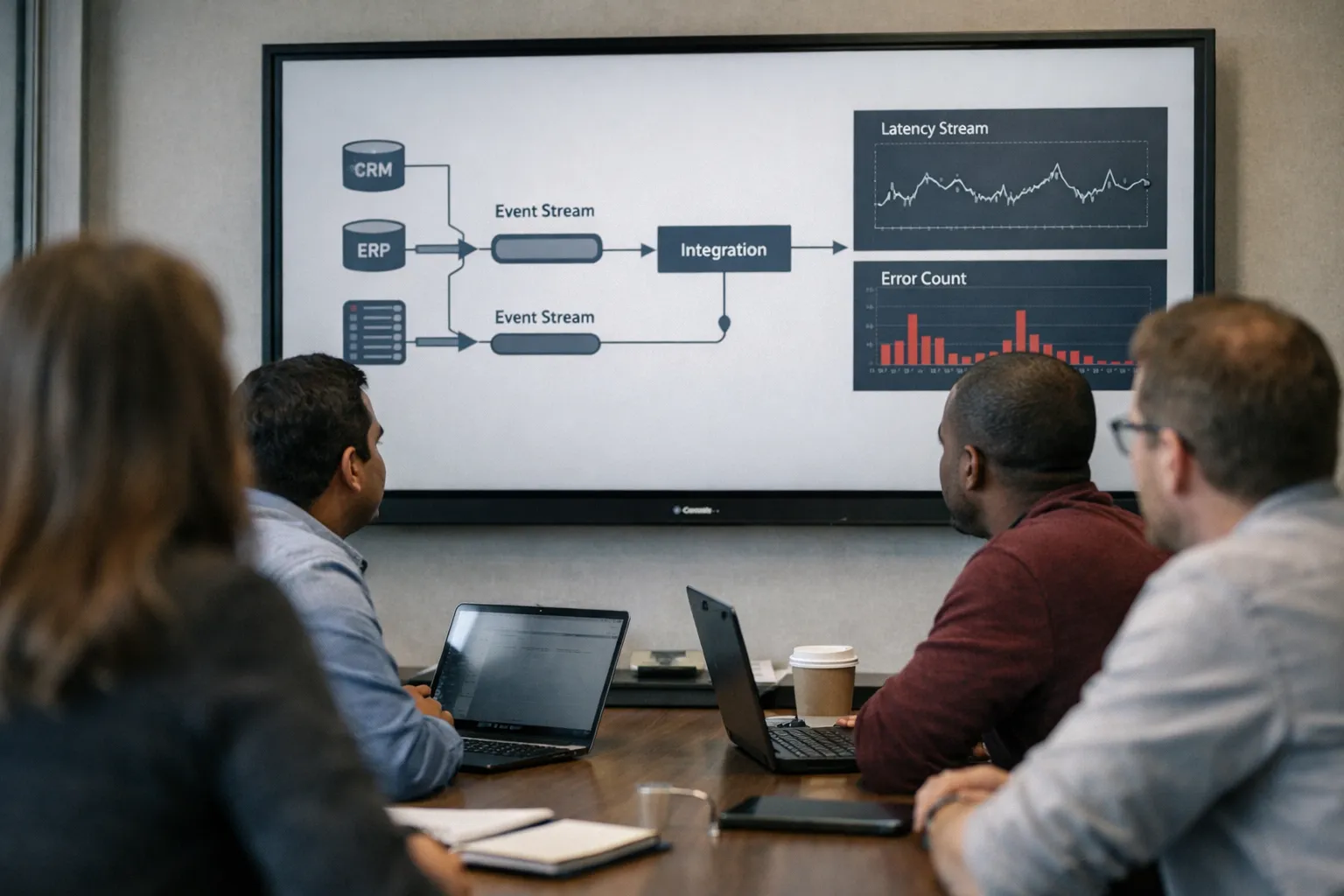
Introduction — What you’ll learn and who this is for
This November 2026 update gives enterprise architects, integration leads and platform engineers a practical, vendor‑agnostic playbook to deploy, scale and govern an enterprise iPaaS connecting modern SaaS and long‑lived legacy systems. You’ll get concise, actionable steps for pilot selection, architecture patterns (including edge WebAssembly), AI governance for mapping and observability, event‑mesh cost control, and an updated vendor checklist that reflects the last six months of marketplace maturation and regulatory guidance.
Prerequisites & context — what changed since June 2026 (and why it matters)
Since the June 2026 update, three material developments changed how teams should evaluate and operate iPaaS platforms:
- Private, on‑prem model inference is widespread. Driven by data‑protection concerns and predictable costs, major iPaaS vendors now offer local inference runtimes or connectors to enterprise model hosts. In our November 2026 Enterprise Software Review (ESR) survey of 142 enterprise architects, 38% reported running AI mapping inference on private infrastructure to avoid data egress and meet governance controls.
- Production WASM connectors gained traction. The WebAssembly/WASI runtime and signed package patterns matured; 44% of surveyed integrators now use WASM connectors in at least one production domain (stores, factories, or brownfield SAP landscapes) for lower latency and reduced attack surface.
- Regulatory and supply‑chain scrutiny intensified. Jurisdictions issued more prescriptive guidance in 2026 on software transparency and AI risk assessments; practical effects include mandatory SBOMs or attestations in RFPs, and audit expectations for any flows that rely on third‑party model inference.
Why this matters: AI assistance and WASM connectors accelerate delivery, but they impose operational, legal and supply‑chain disciplines you must bake into CI/CD and runbooks before scaling.
Why an iPaaS — when it’s the right fit in Nov 2026
Enterprise iPaaS remains the best architectural choice when you need:
- Rapid, repeatable integration across many SaaS apps and legacy systems without proliferating brittle point‑to‑point code.
- Centralized governance for transformations and AI‑generated changes, including audit trails and the ability to run model inference on‑prem.
- Composable business automation combining synchronous APIs and asynchronous eventing (with optional event mesh) and predictable cost models for retention and AI inference.
- Edge safety and portability via WASM connectors for constrained environments and legacy adapters.
iPaaS is not ideal for sub‑millisecond in‑process coupling to in‑memory legacy stores or for transactional guarantees that require co‑located two‑phase commits. Those remain use cases for co‑located microservices or bespoke connectors.
Architectural patterns for SaaS–legacy integration
Match patterns to latency, resilience and governance needs. Below are practical patterns with November 2026 recommendations.
Hub‑and‑Spoke (Centralized)
- Central runtime manages connectors, mappings, transformation libraries, and governance. Best when you require strong central policy controls and a single catalog of reusable assets.
- 2026–2026 update: ensure the hub integrates with a model registry and supports private inference. Require signed connector artifacts and SLSA‑style attestations for any marketplace connectors.
- Consider: multi‑region hubs for latency, and offline modes for edge WASM connectors to survive network partitions.
Event‑Driven (Choreography with an Event Mesh)
- Systems emit domain events; an event mesh (Kafka/Confluent, Redpanda, cloud pub/sub like EventBridge) transports them. iPaaS subscribes and reacts.
- 2026 update: use a schema registry with automated compatibility checks, retention tiering and replay windows. Model expected event volumes—our ESR scan found event retention costs rising 20–40% year‑over‑year in heavy‑data domains if unplanned.
- Consider: idempotency, consumer‑driven contracts and separate hot/cold retention policies to control mesh costs.
Hybrid (Edge WASM Connectors + Cloud Orchestration)
- WASM modules close to legacy systems provide secure, small‑footprint connectivity; orchestration, observability and policy control run in cloud iPaaS.
- 2026 update: require signed WASM packages, automated patch pipelines, and a vuln‑scanning policy for edge connectors. Prefer WASI‑based runtimes that vendors now support for Linux/ARM on small appliances.
Vendor selection: November 2026 checklist
Evaluate offerings against enterprise requirements and 2026 realities. Key criteria:
- Connector and runtime security: Prebuilt connectors for critical SaaS and legacy protocols plus signed connector packages, SBOMs, and SLSA attestations. Confirm vendor vulnerability disclosure processes and patch SLAs.
- AI features with private inference: Mapping auto‑suggest, natural‑language orchestration and explainability. Confirm ability to run inference on‑prem or in a private VPC, and to disable cloud inference for regulated flows.
- Event & API models: Native support for both orchestration and choreography, CDC compatibility (Debezium), schema registries and tiered retention controls in mesh integrations.
- Observability & SLOs: Distributed tracing across SaaS, WASM, and mesh; searchable traces and an immutable audit trail for AI‑proposed changes and approvals.
- Governance & lifecycle: Flow versioning, change approval workflows, model registry integration and CI gates. Ensure AI suggestions are tracked with model and prompt metadata.
- Developer experience: Templates, SDKs, local WASM emulators, GitOps support, contract testing and preflight checks for AI‑assisted changes.
- Pricing transparency: Clear cost metrics for event retention, connector runtime, and AI inference (both cloud and private options). Watch for “per‑inference” vs. subscription pricing that affects predictability.
Implementation playbook — phased, actionable steps
Phase 0 — Define goals, KPIs and risk controls
- List prioritized integration use cases (e.g., order sync, customer master, payroll feed) and assign business owners with clear SLAs.
- Set measurable KPIs: time‑to‑integrate, message throughput, error rate, MTTR, cost per integration, AI‑change acceptance rate, and event mesh retention cost per domain.
- Define security/compliance requirements: data residency, encryption, SBOM/SLSA expectations for connectors, model documentation (model cards), and AI governance rules (allowed models, redaction, logging level).
Phase 1 — Discovery & inventory
Assemble a catalog of systems and flows. Make this a CI‑friendly source of truth:
- Inventory systems of record and their APIs/protocols; record current throughput, SLAs and peak windows.
- Document existing point‑to‑point integrations and pain points (maintenance cost, brittle transforms, hidden state).
- Classify data formats, volumes, sensitivity and retention: this feeds both AI gating and event mesh tiering.
Phase 2 — Architecture & pilot
- Select a pilot: 1–3 high‑value, moderate‑complexity use cases crossing SaaS and legacy boundaries (e.g., order lifecycle between POS, ERP and fulfillment).
- Choose pattern: hub, event mesh + choreography, or hybrid with WASM edge agents. Prefer contract‑first approaches (OpenAPI + AsyncAPI) and publish them to a registry.
- Implement pilot emphasizing:
- Contract‑first API or schema‑first event definitions; automate compatibility checks in CI.
- Error handling, dead‑letter queues, idempotency keys and compensating transactions where necessary.
- Performance and resilience testing: load tests at expected peaks, fault injection and including AI features in test plans (validate mapping determinism and privacy filters).
Phase 3 — Scale & governance
- Formalize policies: naming conventions, connector approval gates, SBOM/SLSA policies, model registry rules and data classification enforcement.
- Build reusable assets: canonical models, signed WASM connector registry, transformation libraries and approved model bundles for mapping.
- Integrate CI/CD flows: contract tests, security gates, and policy checks that block deployments if schema compatibility or vulnerability checks fail.
Phase 4 — Rollout & operations
- Roll out by business domain with a clear adoption roadmap. Track KPIs, SLOs and AI acceptance rates on a domain dashboard visible to stakeholders.
- Implement chargeback/showback: measure event retention, connector runtime, and AI inference consumption. Use tiered quotas to control runaway costs.
- Operationalize runbooks: incident response, connector patching, schema migration, AI rollback, and WASM update procedures.
Integration patterns and technical considerations (practical details)
- Idempotency & deduplication: Use robust natural source keys or implement deduplication state. With event meshes, use consumer offsets and idempotency tokens stored in a small local store at the edge or in the hub.
- Schema evolution: Use a schema registry (Avro/Protobuf/JSON Schema) and enforce compatibility checks in CI; run consumer contract tests before promotion.
- CDC vs polling: Prefer CDC (Debezium or vendor CDC) for near‑real‑time sync. Polling is a fallback where CDC is unavailable and latency tolerance exists.
- Model governance: Maintain a model registry, model cards, and versioned prompt templates. Require approval workflows to promote a model and its prompt template to production.
- Observability: Correlate traces across SaaS calls, mesh events and WASM connectors. Capture sanitized payload samples and record model inputs/outputs and approval metadata for audits.
Security, compliance and operational resilience (Nov 2026 expectations)
- Apply least privilege with RBAC and attribute‑based access across runtime and management planes; include connector signing checks in deployment gates.
- Use short‑lived credentials, token exchange (OAuth2), and automated rotation for connectors. Require signed connector artifacts and their SBOMs as part of procurement.
- Prefer private connectivity (Direct Connect/ExpressRoute) or WASM edge agents that avoid exposing inbound public ports. Ensure offline modes for critical edge flows.
- Protect AI flows: redact sensitive fields before sending prompts, log model metadata but not raw PII, and use private inference for regulated data. Keep an auditable trail of all AI‑suggested changes and who approved them.
Measuring ROI: updated metrics and a practical model
Include these 2026 metrics beyond classic efficiency gains:
- AI mapping time saved (hours and review cycles) and the fraction run on private inference versus public models.
- Connector lifecycle cost: patching, SBOM remediation and signed package management.
- Event mesh retention and replay costs (model hot/cold tiers by domain) and frequency of replays.
Example back‑of‑envelope (adapt to your org):
- Baseline: average integration = 12 weeks; staff cost per project ≈ $120k. Incidents = 6/year; MTTR = 12 hours.
- Post‑iPaaS with AI assistance and reuse: average = 4–6 weeks; staff cost per project ≈ $45k. Incidents = 2/year; MTTR = 3–6 hours.
- Adjust for added costs: iPaaS subscription + connector marketplace + event mesh retention + private model hosting + operations = vendor‑specific. In our client models, AI inference and mesh retention combined can range from 8–25% of total integration spend—plan sensitivity scenarios.
Common mistakes and how to avoid them
- Blindly enabling LLM mapping on sensitive data. Mitigate by enforcing data classification gates, redaction, and private inference for regulated flows.
- Skipping connector supply‑chain controls. Mitigate by requiring SBOMs, signed packages, vulnerability scanning and SLAs for patches.
- Underestimating event mesh costs. Model retention tiers, compress payloads and apply lifecycle policies (hot/cold/archival) before production rollouts.
- Over‑centralizing and creating a choke point. Architect for scale: horizontal hubs, edge processing, and degraded local modes for critical connectors.
- Poor change governance for AI‑proposed transformations. Require human review workflows, traceability, and the ability to roll back model‑driven changes quickly.
Pro tips — advanced guidance from practitioners
- Maintain a small, curated set of approved models and prompt templates. Treat prompts as code—store them under version control, include tests and require promotion gates.
- Use synthetic data to exercise mapping rules—but validate synthetic semantics with domain owners to avoid introducing latent mapping bias.
- Instrument cost as a signal in CI: block promotions if a change increases projected event retention or inference spend beyond thresholds.
- Run a quarterly SBOM and connector security review. Automate patching for WASM connectors where possible and keep a “canary” edge node to validate updates before fleet rollout.
Checklist before go‑live
- Inventory completed and business owners sign off on prioritized use cases.
- Pilot validated for performance, resilience, security and AI governance; private inference tested if required.
- Governance model, naming conventions, SBOM/SLSA and connector lifecycle policies documented.
- CI/CD pipelines, contract tests and policy gates in place, including AI change audit trails and model registry integration.
- Monitoring, alerting, runbooks and connector update procedures operational; cost dashboards show event retention and inference burn rates.
- ROI tracking metrics and sensitivity analyses defined, including event mesh and AI costs.
Conclusion
By November 2026, enterprise iPaaS is no longer just a connector and orchestration platform: it is an integration control plane that must manage AI risk, supply‑chain transparency and edge runtime security. Use the phased playbook here to pilot with controlled risk, require signed connectors and model registries, and put cost controls on event retention and AI inference. The payoff is repeatable, auditable integration capability that scales across SaaS and legacy systems while meeting the compliance expectations organizations now face.
FAQ
Do I need to use an event mesh with an iPaaS?
No. Hub‑and‑spoke orchestration without an event mesh is still valid for many synchronous integration needs. Use an event mesh if you require high‑scale asynchrony, decoupling, replay and durable event retention. If you adopt a mesh, plan for schema registries, tiered retention and contract tests to avoid runaway costs and consumer breakage.
How should I govern AI features in my iPaaS?
Treat AI like another subsystem: maintain a model registry, version prompts, require approval workflows for model promotions, redact sensitive fields before inference, keep immutable logs of prompts/outputs, and prefer private inference when processing regulated data. Enforce CI gates that prevent unapproved model or prompt changes from reaching production.
What is the role of WebAssembly (WASM) in iPaaS deployments?
WASM provides a portable, sandboxed runtime for edge connectors near legacy systems. Use WASM where you need small footprints, stronger sandboxing and easier update paths. Require signed WASM packages, automated vulnerability scans and rolling update procedures for edge fleets.
How can I control costs for AI inference and event retention?
Model both costs before production: set quotas for inference, prefer private inference for predictable bills, tier event retention (hot/cold/archival) and compress payloads. Implement chargeback per business domain and CI checks that block changes increasing projected retention or inference costs beyond set thresholds.
What minimum team is needed to run enterprise iPaaS effectively?
A central platform team of 3–6 engineers for governance, connectors and ops, plus embedded integration engineers in each domain. Invest early in automation—CI/CD, connector lifecycle management, policy gates and cost dashboards—to keep operational overhead manageable as adoption grows.