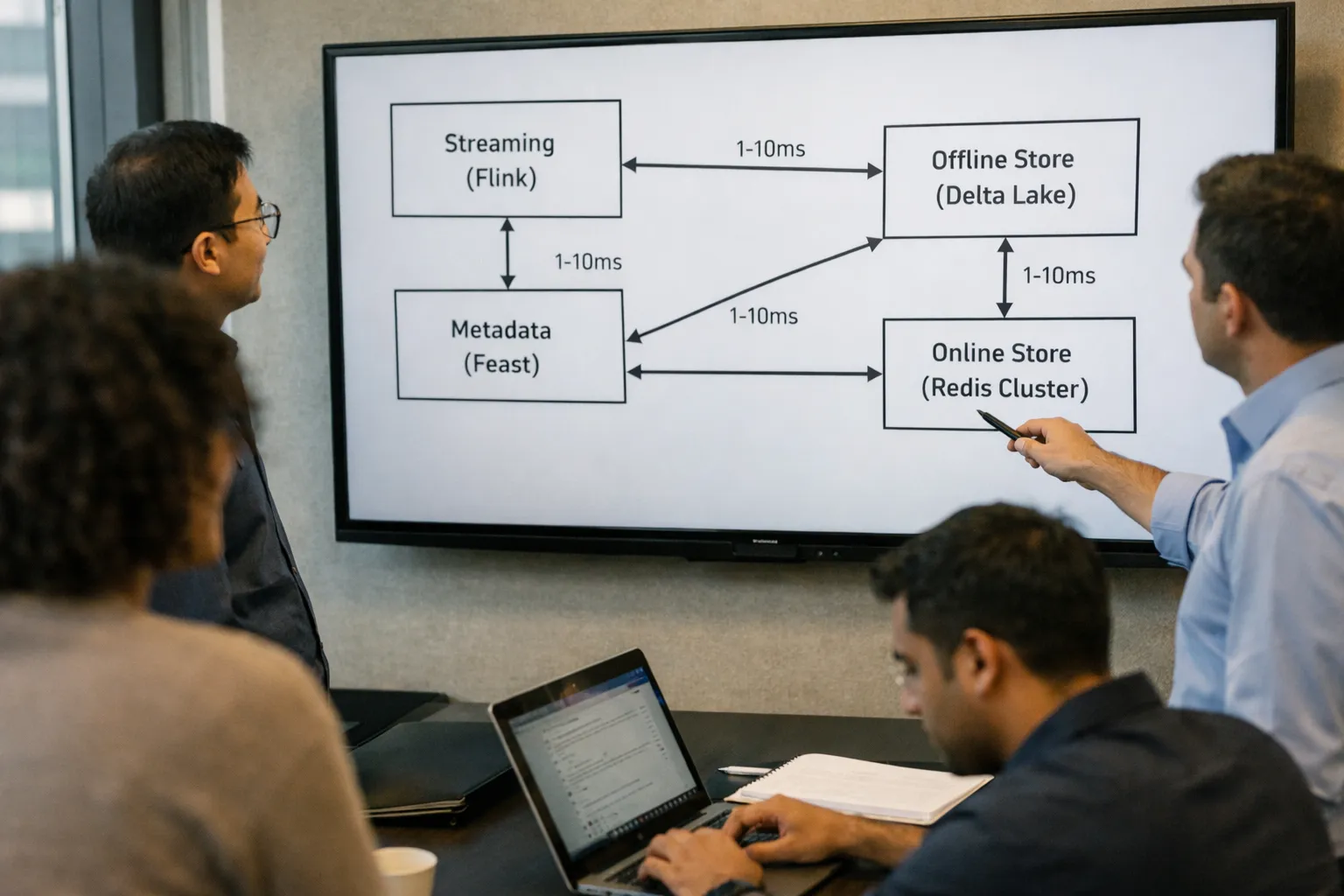
Enterprises are deploying machine learning across customer-facing, risk and automation systems that demand consistent, low-latency features across clouds and regions. Building a feature store that serves both offline training and online inference at low latency—while fitting enterprise requirements for governance, integration and ROI—has become a practical necessity in 2026. This guide walks through a concrete, step-by-step implementation of a multi-cloud, low-latency feature store for enterprise solutions, with trade-offs, recommended technologies, and measurable ROI levers.
Why a dedicated feature store matters for enterprise ML
- Consistency: Centralized feature definitions and materialization remove training/serving skew that causes model drift.
- Performance: Dedicated online stores enable sub-10ms lookups for real-time inference, versus seconds from ad-hoc queries.
- Scalability and multi-cloud operations: A properly designed store scales horizontally across regions and clouds to meet global SLAs.
- Governance and integration: Feature lineage, access control (RBAC), and integration with MLOps pipelines are essential for enterprise compliance.
- ROI: Reduced model rework, faster time-to-production, and lower operational costs from efficient serving and storage.
Scope and assumptions
This guide targets enterprise architects and platform engineers planning to implement or upgrade a feature store in 2026. It assumes:
- Workloads span two or more public clouds (AWS, GCP, Azure, or equivalents) and on-premise data centers.
- Real-time inference requires 1–20ms feature retrieval for high-throughput services and sub-50ms for latency-tolerant use cases.
- Existing core data sources include event streams (Kafka/Pulsar), a data warehouse (Snowflake/BigQuery/Redshift), and model serving infra.
High-level architecture
At a minimum, a production-grade, multi-cloud feature store has three logical layers:
- Ingestion & transformation – Streaming and batch pipelines that compute features from raw events and batch sources (Apache Flink, Spark Structured Streaming, Apache Beam).
- Offline store – Columnar storage for training datasets and historical backfills (data lake, warehouse: Snowflake, BigQuery, Delta Lake on Databricks).
- Online store / serving layer – Low-latency key-value store for inference lookups (Redis, KeyDB, Aerospike, managed caches).
Cross-cutting: metadata/registry (feature definitions, lineage, versioning) using Feast, Hopsworks, Tecton, or a managed provider (AWS SageMaker Feature Store, GCP Vertex Feature Store). For multi-cloud deployments, combine a centralized metadata service with region-local online stores to meet latency and availability SLAs.
Step-by-step implementation
1. Define requirements and SLAs
- List feature groups, cardinality, update patterns (append-only, incremental), TTL and required lookup latency (e.g., 1–10ms for fraud checks).
- Estimate QPS per feature key during peak (e.g., 10k QPS globally) and expected growth rate.
- Compliance: data residency, encryption-at-rest/in-transit, and access-control policies.
- ROI targets: reduce model downtime by X%, cut inference cost by Y%, speed up feature onboarding from N weeks to M days.
2. Choose your technology mix
Recommended 2026 config for enterprise solutions:
- Metadata & orchestration: Feast (open-source) or a managed feature store as control plane. Feast remains widely adopted for vendor-neutral registries in 2026.
- Streaming compute: Apache Flink or Beam (for exactly-once semantics and low-latency updates); use managed Flink where possible.
- Offline store: Delta Lake on Databricks or Snowflake for large-scale joins and backfills.
- Online store: Redis Cluster or Aerospike for sub-10ms reads; consider managed Redis (ElastiCache/MemoryDB, Memorystore) per-cloud region for operational simplicity.
- Transport: gRPC for high-performance serving APIs between model servers and the online store; protobuf schema for feature serialization.
Rationale: open metadata + managed per-cloud online stores gives best trade-off for integration and scalability while keeping vendor lock-in low.
3. Design data model and partitioning
- Feature keys: pick stable business keys (user_id, account_id) and avoid composite keys that cause hot partitions.
- Partitioning: shard keys across N partitions with consistent hashing; for Redis, design slot-aware keys and use cluster-aware clients.
- High-cardinality features: store them in a separate tier (e.g., SSD-backed KV like Aerospike) and apply caching for hot keys.
- Materialization cadence: stream materialization for near-real-time features; batch materialization for expensive features updated hourly/daily.
4. Build ingestion and transformation pipelines
- Source connectors: use CDC from transactional DBs (Debezium), event streams (Kafka / Pulsar), and batch extracts from warehouse.
- Stream compute: implement feature computation as idempotent operators with event-time processing, windowing and watermarking to ensure correctness.
- Exactly-once sinks: write to both offline store (for training) and online store atomically or with compensating transactions. Pattern: write-ahead log to durable append-only store, then materialize to online KV.
5. Implement the serving API and client patterns
- Model servers should call the feature store via a compact gRPC API that supports batch multi-key requests and multi-feature payloads.
- Use pinned connections and pooled clients to avoid TCP overhead at high QPS.
- Local caching: embed an LRU or tiered cache in model containers for microsecond reads; always fallback to online store on cache miss.
- Graceful degradation: if online store is unavailable, fall back to synchronous feature recomputation or a reduced feature set to preserve service availability.
6. Multi-cloud placement and data locality
To meet latency and availability SLAs:
- Deploy online store replicas in each cloud region where inference occurs. Keep metadata centralized or use geo-replicated metadata with strong leader election.
- Use asynchronous replication between online stores for eventual consistency across regions; accept slightly stale reads if business logic allows.
- For strict consistency, route reads to regional leader or use a globally distributed KV (with predictable latency costs).
7. Security, governance, and observability
- Encryption: enable TLS for in-transit and cloud provider-managed KMS for at-rest encryption.
- Access control: integrate with enterprise identity (OIDC/SAML) and enforce RBAC and attribute-based policies for feature access.
- Lineage and auditing: capture feature definitions, transformations, and materialization runs in the metadata service for model explainability and compliance audits.
- Monitoring: track feature freshness, miss rate, read latency P99/P95, write lag, cardinality growth and storage cost. Set SLOs for the critical metrics.
8. Deployment, testing and rollout
- Develop feature unit tests and integration tests that validate online/offline parity using synthetic and historical data.
- Shadow-run models against the new feature store for a few weeks and compare predictions and latencies.
- Progressively route traffic (canary) to the new online store, monitor SLOs, and rollback if necessary.
Performance and scalability patterns
- Throughput: Redis clusters with multi-node sharding routinely handle 100k+ simple GETs/sec per cluster; architect for linear horizontal scaling and capacity planning.
- Latency: in-memory online stores deliver sub-10ms end-to-end lookups; network topology and colocated model servers cut latency further.
- Cost control: tier cold features to cheaper SSD-backed stores and cache only hot items in-memory; use TTLs to limit storage growth.
Integration considerations
Enterprises require deep integration with existing systems:
- Data catalog and lineage: integrate the feature metadata with enterprise catalogs (e.g., Collibra, Alation) to maintain a single source of truth.
- MLOps pipelines: connect feature materialization to CI/CD for models and retraining triggers based on drift detection.
- SRE/Security: integrate feature store alerts into existing incident tooling and runbooks.
Measuring ROI
Concrete ROI metrics to track:
- Time-to-production for new features and models (target: reduce from weeks to days).
- Reduction in model production incidents due to training/serving skew (target: 50–90% fewer rollbacks).
- Inference cost savings by using efficient serving (cache hit rate improvements lower cloud provider egress and compute).
- Business KPIs: lift in conversion, fraud detection accuracy, or reduced churn attributable to improved feature freshness.
To estimate ROI, build a cost model including engineering time saved, cloud infra delta (online vs ad-hoc queries), and incremental business value from better models. Typical enterprise projects recoup platform costs within 6–18 months if adoption across multiple ML teams is achieved.
Operational checklist
- Define SLA and observability dashboards: feature freshness, P95/P99 latencies, error rates, cache hit ratios.
- Run capacity tests: simulate peak QPS per region and measure degradation modes.
- Automate backup and disaster recovery for online stores; practice cross-cloud failover.
- Enforce metadata hygiene: expand feature registry reviews and deprecation policies.
Common pitfalls and mitigations
- Hot keys: mitigate with key hashing, request batching, and hot-key caching layers.
- Stale features across regions: document acceptable staleness windows and provide versioned reads when strict freshness is needed.
- Excessive feature cardinality: avoid exploding storage by pruning unused features and applying TTLs.
- Vendor lock-in: separate metadata/control plane (Feast or open metadata) from cloud-managed online stores to preserve portability.
Example timeline for a phased implementation (6–12 months)
- Month 0–1: Requirements, SLAs, tool selection and PoC for a single critical feature.
- Month 2–4: Build pipelines, online store deployment in one region, integrate model servers, run shadow tests.
- Month 5–7: Expand to multi-feature sets, add metadata and lineage, implement governance.
- Month 8–12: Roll out multi-cloud replicas, automate DR, document ROI and onboard additional ML teams.
Conclusion
Implementing a multi-cloud, low-latency feature store is a strategic investment for enterprise solutions that want predictable, scalable ML in production. By choosing a decoupled architecture—open metadata/control plane, streaming compute, columnar offline stores, and per-region low-latency online stores—teams can achieve the scalability, integration and governance enterprises require while delivering measurable ROI through faster time-to-market and more reliable models. Start small with a critical use case, validate latency and consistency assumptions, and expand using the operational patterns described here.
Appendix: quick reference of vendor options (2026)
- Open-source metadata/control plane: Feast
- Commercial feature platforms: Tecton, Hopsworks
- Cloud-managed feature stores: AWS SageMaker Feature Store, GCP Vertex AI Feature Store
- Streaming compute: Apache Flink, Apache Beam
- Online stores: Redis Cluster (managed or self-hosted), Aerospike, KeyDB
- Offline storage: Snowflake, BigQuery, Delta Lake (Databricks)