Date: September 2026 — Enterprise software teams face a recurring architectural fork when replatforming legacy applications: move to a shared multi‑tenant model or preserve tenant isolation with single‑tenant deployments. Both approaches surface clear tradeoffs in scalability, integration, implementation effort and ROI. This analysis decodes those tradeoffs using operational, architectural and financial lenses to help enterprise architects and product leaders make a defensible decision for 2026 and beyond.
Why now: market forces that make tenancy a strategic choice
Three converging trends are driving replatforming decisions in 2026. First, systemic cost pressures force tighter scrutiny of cloud spend across compute, storage and networking. Second, regulatory and data‑sovereignty requirements remain prominent: sectors like healthcare, financial services and government impose strict isolation or residency constraints. Third, customers increasingly expect continuous feature delivery and lower latency across regions — requirements that favor architectures optimized for scalability and integration.
Strategic questions to answer
- Does the product need strong per‑tenant performance isolation or predictable billing granularity?
- How many concurrent tenants and peak load patterns must the platform support?
- What is the integration surface area — real‑time APIs, batch ETL, or event streaming — and how will tenancy affect it?
- What is the expected payback period for replatforming investment given customer churn and new sales velocity?
Architecture comparison: core differences
At a high level:
- Multi‑tenant (shared) model: One or a small number of shared application instances and databases host multiple tenants. It emphasizes resource pooling, higher statistical multiplexing, and simplified operational overhead for upgrades.
- Single‑tenant model: Each tenant receives an isolated application instance and/or dedicated database. It prioritizes isolation, customization and per‑tenant resource accounting at the cost of higher operational and cloud footprint.
Variants to consider
- Shared schema vs tenant‑isolated schema within a shared database (hybrid multi‑tenant).
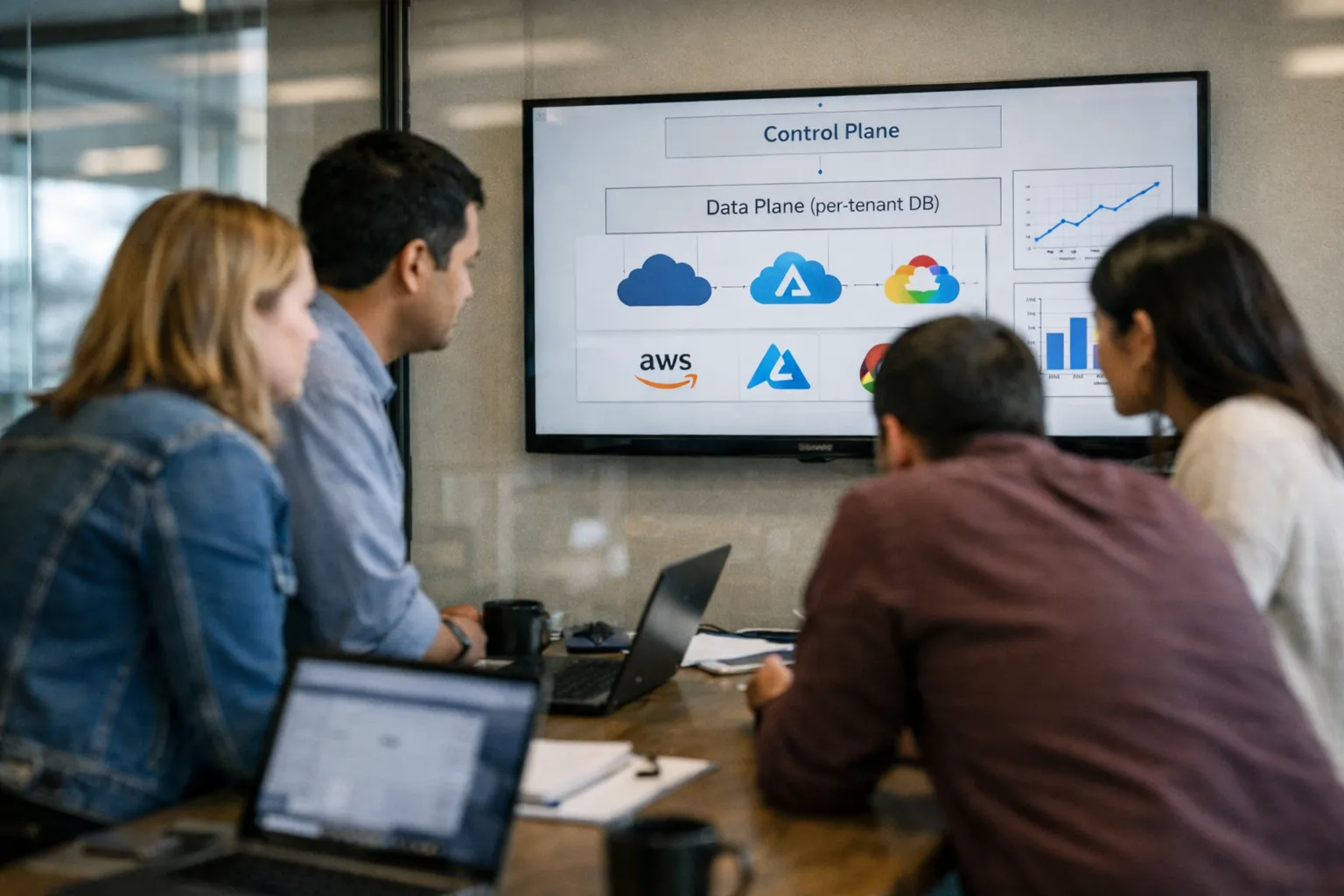
- Shared application but isolated data plane (shared control plane, tenant data islands).
- Containerized single‑tenant instances with orchestration and autoscaling (often used for large enterprise customers).
Scalability and operational behavior
Scalability is often the decisive technical criterion. Multi‑tenant systems shine at horizontal elasticity: a well‑designed stateless application layer plus pooled databases (or multi‑tenant-aware data stores) enables rapid capacity scaling and better utilization. This yields lower marginal cost per tenant as user volumes grow.
Single‑tenant deployments make it easier to provide linear performance guarantees because noisy‑neighbor effects are eliminated. However, scaling large fleets of tenant instances adds operational complexity: CI/CD for thousands of independent instances, rolling upgrades without cross‑tenant impact, and multi‑region replication become significant engineering workstreams.
Performance isolation strategies
- Multi‑tenant: per‑tenant throttling, query limits, resource governance and workload scheduling.
- Single‑tenant: resource capping per VM/Pod, dedicated DB sizing, and per‑tenant autoscaling policies.
Integration implications
Integration — the degree to which your platform connects to customer systems — interacts strongly with tenancy.
- Multi‑tenant platforms often centralize connectors and integration logic. This reduces duplication and speeds rollout, but complicates tenant‑specific connector configurations and may raise data routing concerns for on‑prem integrations.
- Single‑tenant deployments can host local adapters and custom integrations close to tenant systems (network‑proximal), simplifying firewall and compliance needs but requiring per‑tenant maintenance and versioning.
From an API design perspective, multi‑tenant systems must bake in robust authentication, scoping, and audit trails to ensure clear separation of data and integrations. Conversely, single‑tenant systems often reduce the complexity of identity federation but add cost when integrating at scale across many tenants.
Implementation complexity and migration pathways
Replatforming is an implementation‑heavy activity. Common paths include:
- Lift‑and‑shift to single‑tenant containers or VMs as an intermediate step to reduce customer disruption.
- Incremental refactor to a shared multi‑tenant control plane with tenant data isolation behind feature flags.
- Strangler pattern: replace modules one at a time, moving multi‑tenant friendly services first (auth, billing, analytics).
Key implementation risks are migration downtime, data transformation errors, and configuration drift. Teams should adopt a staged strategy with canary tenants and a rollback discipline. In practice, the most successful replatforms combine automated data migration tooling, exhaustive integration tests, and cross‑tenant observability.
ROI: narrowing the financial decision
ROI analysis must include both direct cloud costs and softer operational expenses. Consider these components:
- One‑time replatforming cost (engineering effort, migration tooling, testing).
- Ongoing cloud OPEX differences (multi‑tenant typically reduces duplicate resources).
- Revenue effects: faster feature delivery on multi‑tenant may accelerate new sales; single‑tenant may retain high‑value customers requiring isolation.
- Support and maintenance: single‑tenant increases per‑tenant support overhead and release complexity.
Example scenario (illustrative): a product with 500 medium‑sized tenants that can consolidate into a multi‑tenant platform might reduce annual infrastructure and ops costs from $5.5M to $3.2M — a $2.3M annual savings. If replatforming costs $6M upfront, payback ~2.6 years. For a small‑upfront, high‑value customer base (10 large enterprise customers), single‑tenant may retain $10M in revenue that would be lost if forced to multi‑tenant constraints; here ROI favors single‑tenant, despite higher OPEX.
These calculations must be tailored to real telemetry: per‑tenant active users, peak concurrency, data footprint and integration frequency.
Compliance, security and legal considerations
For regulated sectors, tenancy choices are often constrained:
- Data residency: single‑tenant deployments can be placed in specific regions or on‑premises to meet local laws.
- Certifications: SOC2, ISO27001 or FedRAMP can be achieved in multi‑tenant environments, but the evidence model and attestation scope must be carefully defined.
- Contracts: customers demanding contractual isolation and audit rights may necessitate single‑tenant or hybrid options.
Decision framework: when to choose which
Use a weighted decision framework across five axes: scalability need, integration complexity, compliance constraints, customer economics, and implementation risk.
- Choose multi‑tenant when: large tenant counts, variable peak loads, need for rapid feature rollout, and cost efficiency are priorities.
- Choose single‑tenant when: strict compliance/residency, high customization per customer, predictable large accounts with negotiable SLAs, or when integration requires network‑proximal adapters.
- Consider hybrid when: some customers require isolation while the majority benefit from multi‑tenant efficiency — run a shared control plane with isolated data planes or offer a tiered model.
Operational checklist before committing
- Benchmark current per‑tenant resource consumption and peak concurrency.
- Map integration points requiring on‑prem access, and evaluate connector portability.
- Run a cost model with sensitivity to number of tenants, average data growth, and expected peak factor.
- Prototype upgrade and rollback processes, including DB migration dry runs.
- Design observability that can attribute telemetry per tenant and surface noisy‑neighbor events.
Conclusion: tradeoffs, not absolutes
In 2026, the choice between multi‑tenant and single‑tenant replatforming remains contextual. Multi‑tenant architectures provide superior scalability and often better long‑term ROI for mass‑market enterprise solutions; single‑tenant deployments still make sense where compliance, deep customization or contract economics demand isolation.
Pragmatic enterprises increasingly adopt hybrid approaches: use a shared platform for the majority while offering isolated deployment options for strategic accounts. Whatever path you choose, quantify the tradeoffs with telemetry‑driven cost models, architect clear integration patterns, and invest in automation for implementation — only then will your replatforming decision translate into predictable scalability, secure integration and measurable ROI.