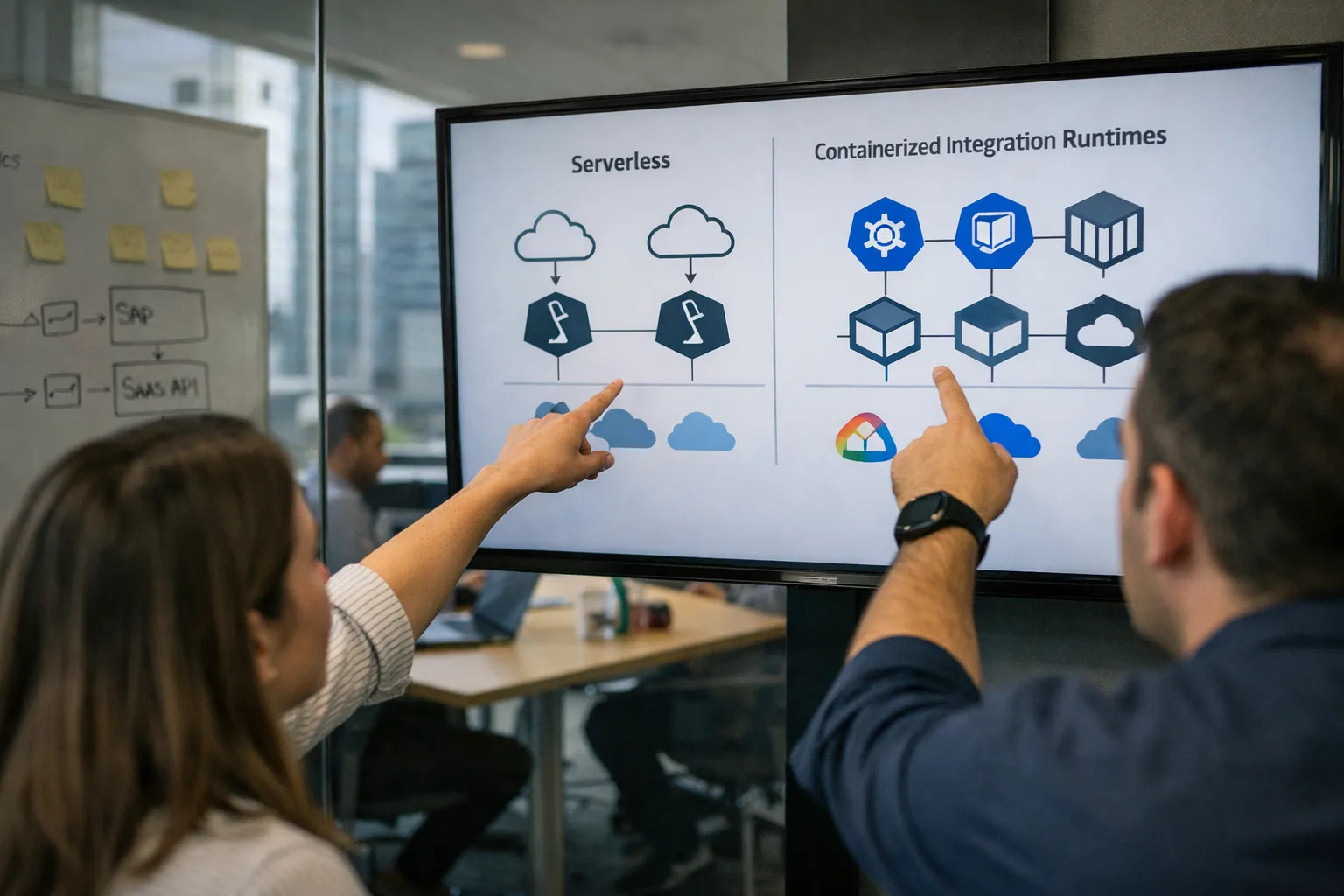
Enterprises in 2026 face a familiar integration problem with fresher constraints: more SaaS endpoints, stricter data residency rules, higher SLA expectations, and budget pressure to show measurable ROI. Two dominant architectural approaches—serverless connectors (managed, function-based integrations) and containerized integration runtimes (Kubernetes-hosted adapters and ESB-style runtimes)—are competing as the preferred patterns for modernization programs. This analysis dissects their trade-offs for enterprise solutions across scalability, integration surface, total cost and implementation complexity, and offers practical guidance for decision-makers.
What we mean by the two approaches
Definitions matter because vendors market hybrid options that blur lines. For this piece:
- Serverless connectors: Managed connectors or functions that run on cloud provider FaaS platforms or iPaaS-managed function runtimes (examples in market: cloud provider native connectors and iPaaS offerings from major vendors). They emphasize event-driven execution, pay-per-invocation billing and managed scaling.
- Containerized integration runtimes: Integration adapters, message brokers, or transformation engines packaged as containers and orchestrated on Kubernetes or managed container platforms. They include self-hosted ESB alternatives, Apache Camel/Spring-based runtimes, and purpose-built adapter fleets.
Scalability: elastic bursts vs predictable throughput
Scalability considerations determine whether integrations meet throughput, latency and availability targets.
- Serverless connectors scale fast for bursty workloads. Their autoscaling model handles sudden spikes (e.g., seasonal payroll runs, marketing event floods) without manual provisioning. This reduces operational overhead for unpredictable traffic patterns.
- Cold start and connection limits. Serverless functions can incur cold-start latency and face provider-side concurrency throttles or connection limits to legacy endpoints (e.g., SAP, mainframe gateways). Mitigations add complexity—warming strategies, connection pooling via companion services, or hybrid designs.
- Containerized runtimes excel for sustained high throughput and low latency. Stateful connectors and pooled adapters in containers maintain persistent connections, reduce per-request overhead and provide predictable latency for high-volume ETL, B2B EDI or real-time APIs.
- Operational scalability trades people for machines. Containers need capacity planning, autoscaling policies and cluster ops; serverless moves that burden to the provider but can push complexity into architecture when external systems require persistent sessions.
Integration surface: protocols, transformations and enterprise systems
Integration success depends on breadth and depth of protocol support, transformation capabilities, and how well an approach aligns with enterprise systems.
- Protocol breadth. Containerized runtimes are traditionally stronger at supporting complex protocols (JMS, MLLP for healthcare, EDI AS2) and providing deep adapters to ERP systems like SAP S/4HANA or legacy mainframes because they can host stateful libraries and drivers.
- Managed connector convenience. Serverless connectors speed up integrations against modern SaaS (Salesforce, Workday, ServiceNow, cloud storage) via pre-built connectors and managed auth flows (OAuth, API keys), improving developer velocity for SaaS-centric architectures.
- Transformation and testing. Enterprises needing heavy data transformations, complex enrichment or transaction orchestration often prefer containerized runtimes where advanced tooling, local testing and long-running transactions are simpler to implement and debug.
- Hybrid realities. Most large organizations are converging on hybrid topologies: serverless for cloud-to-cloud, containers for on-prem and stateful gateway roles.
ROI: licensing, run costs and engineering velocity
Return on investment requires more than license comparisons. Consider these levers:
- Upfront vs ongoing costs. Containerized runtimes typically have higher upfront engineering and ops cost (cluster setup, high-availability, monitoring). Serverless connectors shift cost to consumption, which can lower initial spend but lead to higher recurring bills if call volumes are steady and high.
- Developer productivity and time-to-value. Pre-built serverless connectors and iPaaS tooling can reduce implementation timelines—shorter time to integrate a SaaS app or expose a webhook. For greenfield projects with many SaaS integrations, this productivity often translates to concrete ROI.
- Hidden integration debt and governance costs. Containers centralize integration logic and can enforce consistent governance and testing practices. Serverless proliferation can create sprawl of tiny functions and ad-hoc connectors that increase long-term maintenance cost unless controlled by platform engineering and governance policies.
- Economic modelling. Use a three-year TCO analysis that includes: infrastructure (or provider consumption), licensing, engineering hours for initial implementation, ongoing maintenance, and a risk buffer for rework due to compliance or performance constraints.
Implementation: timeline, operational model and risk
Execution risk and time-to-production vary by approach.
- Serverless connectors enable rapid pilots. Proofs of concept connecting cloud apps to event buses or simple APIs can be done in days to weeks, making them attractive for lines of business and rapid MVPs.
- Containerized runtimes demand more upfront governance and testing. Implementations that touch regulated data, require on-prem presence, or rely on complex adapters (SAP IDocs, EDI) benefit from containerized runtimes despite longer initial delivery—because they allow predictable lifecycle management and deterministic failover strategies.
- Security and compliance. Data residency, encryption at rest, and audit requirements may mandate containerized runtimes inside corporate VPCs or private clouds. Serverless options are viable if providers support required compliance certifications and network controls (VPC connectors, private endpoints).
- Organizational alignment. Platform engineering teams are now the gatekeepers for integration patterns. Successful implementations pair platform resources (templates, CI/CD pipelines, observability) with product teams to avoid connector sprawl.
When to choose which—practical decision patterns
Below are pragmatic guidelines based on common enterprise scenarios:
- Choose serverless connectors when:
- Most endpoints are modern SaaS APIs with standard OAuth/REST.
- Workloads are bursty and unpredictable.
- Time-to-market and developer velocity are top priorities for pilots or new digital channels.
- Providers meet compliance and residency needs.
- Choose containerized runtimes when:
- Integrations require persistent sessions, heavy transformations, or support for legacy protocols (JMS, AS2, EDI).
- Traffic is steady and high-volume, making per-invocation costs inefficient.
- Strict governance, auditability and on-premise integration are non-negotiable.
- You need consolidated observability, testing and lifecycle control for complex workflows.
- Adopt a hybrid strategy when:
- You want cloud-native agility for SaaS while keeping on-prem adapters stateful and close to systems of record.
- Use serverless for orchestration and event handling, with containerized “gateways” for protocol translation and persistent connections.
Operational patterns and cost-control tactics
Enterprises that succeed at scale adopt these patterns:
- Platform templates: Provide pre-approved serverless connector patterns and container adapter images with CI/CD pipelines to enforce governance.
- Connection pooling proxies: Use small containerized proxies to maintain persistent connections for serverless functions that cannot hold state themselves.
- Observability-first deployments: Centralized tracing and SLA dashboards that span serverless invocations and container services; measure end-to-end latency, error rates, and cost per transaction.
- Cost guardrails: Implement usage budgets and autoscaling thresholds; apply tagging and chargeback to align lines of business to resource consumption.
Case patterns (anonymized)
Across banking, retail and manufacturing programs we analyzed in 2026, a few patterns recur:
- Retail firms used serverless connectors to rapidly integrate dozens of marketing and analytics SaaS products; cost rose with steady daily synchronization tasks, prompting refactoring to containerized batched connectors for high-volume syncs.
- Banks retained containerized runtimes for SAP and SWIFT adapters to preserve deterministic throughput and compliance, while exposing curated serverless APIs for customer-facing digital channels.
- Manufacturers adopted hybrid edge patterns: container adapters at plant gateways for OPC-UA and Modbus, and serverless connectors for cloud analytics pipelines.
Conclusion—match constraints, not trends
There is no universal winner. Serverless connectors and containerized integration runtimes both have places in contemporary enterprise architectures. The right choice aligns with the integration surface (protocols and state), traffic profile (bursty vs sustained), compliance constraints, and long-term cost models. Most enterprises in 2026 will adopt hybrid topologies, but the governance and platform engineering practices you put in place will determine whether that hybrid approach amplifies agility or creates debt.
Checklist for architects
- Map endpoints by protocol, SLA and data residency requirements.
- Estimate steady-state vs peak traffic to model serverless consumption versus container capacity cost.
- Prototype both patterns for a representative integration and measure end-to-end latency, reliability and operational effort.
- Establish platform templates, observability standards, and cost guardrails before scaling the pattern across teams.
Enterprises that apply disciplined evaluation—measuring integration TCO, implementation timelines and operational complexity—will be best positioned to extract ROI from their integration choices in 2026 and beyond.