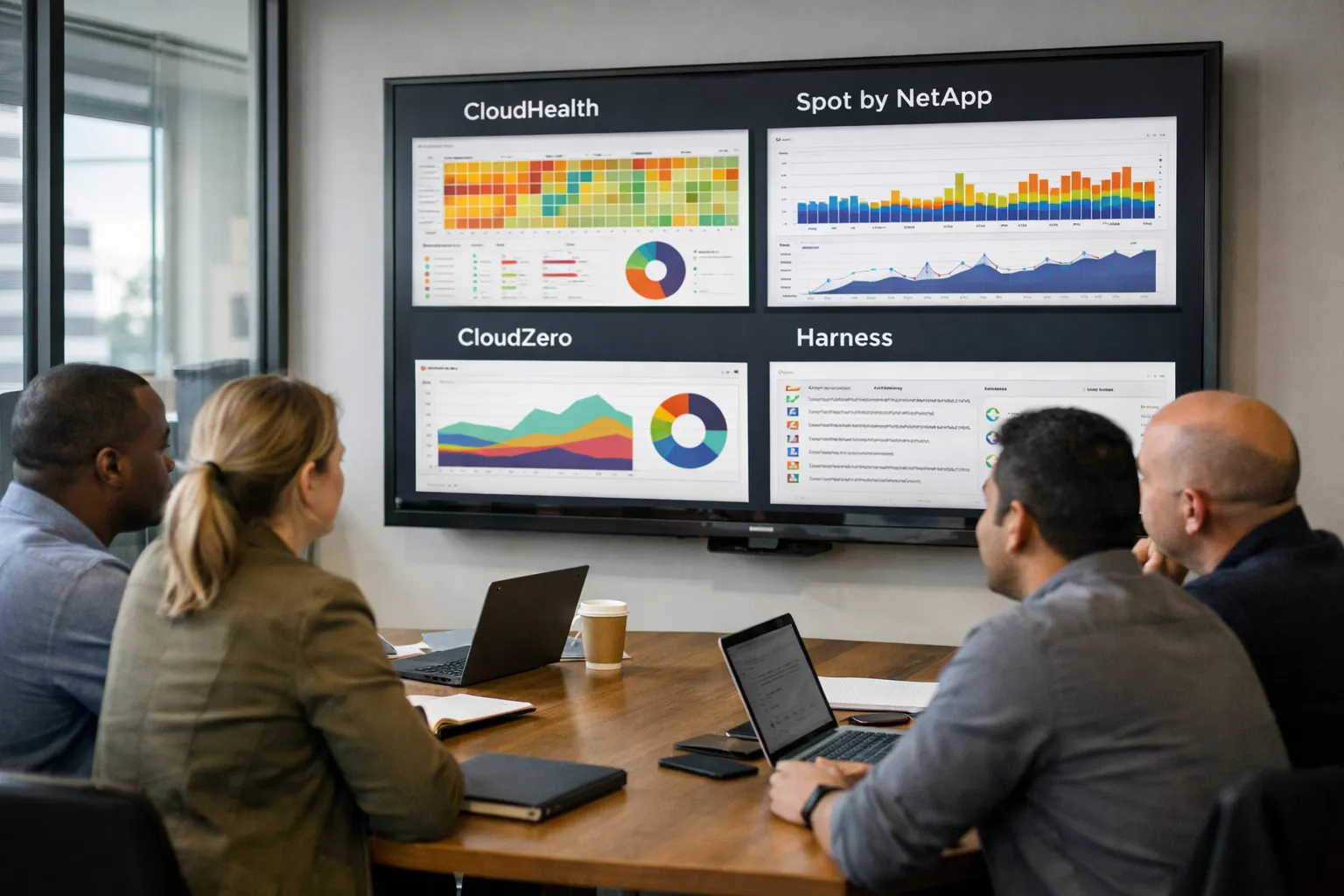
Enterprises grappling with multi-cloud bills, unpredictable GenAI workloads, and complex chargeback requirements need cost-management platforms that operate as full enterprise solutions. This comparison evaluates four leading cloud cost-management products—VMware CloudHealth, Spot by NetApp, CloudZero, and Harness Cloud Cost Management—side by side on the criteria that matter to IT and FinOps teams: scalability, integration, ROI, and implementation.
Why this comparison matters in 2026
By late 2026, enterprise cloud budgets have shifted: persistent multi-cloud deployments, bursty GenAI model training, and hybrid on-prem/cloud compute have widened the surface area for unexpected spend. Effective cost governance is no longer a narrow FinOps problem; it needs to be integrated with engineering workflows, observability, and chargeback processes. That makes distinctions in scalability, integration breadth, ROI model, and implementation effort decisive when choosing a platform.
How we compare
This article focuses on operationally relevant criteria for enterprise buyers:
- Scalability — ability to ingest and analyze high-cardinality tagging, petabyte-scale billing records and minute-level telemetry across hundreds of accounts or tenants.
- Integration — connectors and APIs for major cloud providers (AWS, Azure, GCP), private cloud/on-prem systems, Kubernetes, CI/CD, CMDB, and ERP/financial systems.
- ROI — how vendors model savings (licensed fee, percentage of savings, uplift on existing tooling), typical time-to-value and measurable outcomes.
- Implementation — deployment patterns (SaaS, managed, on-prem), data collection methods (agentless, agents, APIs), expected timeline and staff effort.
Quick vendor snapshot
- VMware CloudHealth — enterprise-grade cost governance with broad cloud-provider coverage and long-standing FinOps feature set, often chosen by regulated enterprises with heavy VMware investments.
- Spot by NetApp — specializes in compute optimization and workload scheduling (spot/interruptible capacity) with strong automation for cost reduction and workload resilience.
- CloudZero — engineering-centric cost attribution and product-aware cost modeling designed for granular showback and developer-owned cost insights.
- Harness Cloud Cost Management — integrates cost controls into CI/CD and platform workflows, emphasizing governance as code and automated policy enforcement.
Scalability: which platform handles enterprise scale best?
Scalability in cost platforms is two-fold: volume of telemetry and analytical granularity. Enterprises need both raw throughput (ingest of billing and telemetry) and high-cardinality analytics (per-product, per-feature, per-team allocation).
- CloudHealth — built for enterprise-scale billing reconciliation and long retention windows. Its architecture supports thousands of AWS/Azure/GCP accounts with established workflows for large tag dictionaries and cost allocation policies. Strong choice when retrospective analysis across years of billing is required.
- Spot — optimized for compute-scale actions more than historical analytics. It can operate at very large scale to orchestrate spot/interruptible instances across clusters and cloud accounts; its decision plane is designed for continuous optimization of thousands of workloads.
- CloudZero — optimized for high-cardinality attribution in near-real time. Handles large-scale event streams and allocates costs down to product/feature level; some customers run CloudZero against hundreds of accounts with minute-level resolution for engineering teams.
- Harness — scales well when embedded into DevOps pipelines and is effective where cost governance is a CI/CD first concern. Its scalability is tied to the platform team’s adoption of governance-as-code patterns.
Integration: connectors, APIs, and enterprise fit
Integration breadth determines how seamlessly a platform becomes part of your enterprise solutions stack. Key integrations to look for: native billing connectors, Kubernetes cluster adapters, CI/CD tooling, identity providers, CMDB/ERP, and data export capabilities.
- CloudHealth — extensive connectors to major cloud providers, native VMware stack integrations, and integrations with service catalogs and ITSM systems. Strong ERP/finance export options for chargeback and compliance reporting.
- Spot — integrates deeply with cloud provider APIs, container orchestrators (Kubernetes, EKS, AKS, GKE), and workload schedulers. Its strength is operational—automating instance life-cycle decisions and integrating with cluster autoscalers and scheduling systems.
- CloudZero — offers SDKs and event-driven integrations to map costs to product metrics (e.g., Datadog, New Relic, Snowflake, data pipelines), enabling product-aware allocation. Good APIs for custom integrations and dashboards used by engineering teams.
- Harness — built to integrate with CI/CD (Jenkins, GitLab, GitHub Actions), feature flags, and platform tooling. Strong governance hooks for policy-as-code and automated enforcement during deployments.
ROI: how each vendor delivers measurable return
Enterprises want predictable ROI: reduction in wasted spend, improved forecasting, and streamlined chargeback. ROI assessment should factor vendor pricing models and the change-management required.
- CloudHealth — ROI derives from improved visibility, centralized governance and reduced leakages via rightsizing and correct tagging. Typical public case studies show material savings over 6–12 months when deployed across large estate; finance teams benefit from robust reporting for showback/chargeback.
- Spot — ROI is execution-focused: direct compute cost reduction via spot instances, autoscaling, and rightsizing automations. For workload-dense environments, Spot often delivers fast, measurable reduction in compute bills (weeks to months), because it automates actual provisioning choices rather than only reporting.
- CloudZero — ROI is realized through product-level accountability and improved allocation accuracy, enabling product teams to optimize features that drive cost. Particularly valuable where engineering teams own cloud spend and need cost-per-feature metrics to make prioritization decisions.
- Harness — ROI combines automated enforcement (preventing runaway deployments), cost-aware pipelines, and improved developer behavior. Works best where cost controls are implemented upstream in the deployment process, reducing rework and surprise bills.
Implementation: time-to-value and operational effort
Implementation complexity ranges from a simple billing connector and dashboards to deep SDK instrumentation and policy rollout across teams. Below are typical enterprise experiences.
- CloudHealth — Common implementation path: connect billing accounts, configure tags/taxonomies, map to business units, and train FinOps teams. Time-to-value: 6–12 weeks for core reporting; longer if integrating with ERP/CMDB. Requires governance for tagging and data quality.
- Spot — Implementation often involves automated agents or controllers in clusters, integration with CI/CD or orchestration to control capacity, and policy definition for interruption handling. Time-to-value: 2–8 weeks for compute optimization benefits; needs operations alignment to accept automated instance lifecycle changes.
- CloudZero — Implementation requires event/telemetry routing (e.g., CloudWatch, billing exports, SDKs) and mapping costs to product identifiers. Time-to-value: 4–10 weeks to reach meaningful product-level metrics; close collaboration with engineering to tag and emit metadata is necessary.
- Harness — Implementation is developer-focused: embed cost checks into CI/CD pipelines and policy-as-code repositories. Time-to-value varies with DevOps maturity—can be as quick as a few weeks for pipeline checks, longer when governance is applied enterprise-wide.
Choosing by enterprise profile
Different enterprises will prioritize different capabilities:
- Large regulated enterprises with multi-year VMware footprints and heavy finance governance: CloudHealth — for mature reporting, compliance exports, and centralized financial reconciliation.
- Cloud-native, compute-heavy platforms with fluctuating batch or ML workloads: Spot — for automated spot/interruptible usage and real-time compute optimization.
- Product-led organizations where engineering owns spend and needs product-level attribution: CloudZero — for granular allocation and developer-facing cost transparency.
- Platform teams seeking cost controls embedded in the delivery pipeline: Harness — for governance-as-code and automated enforcement integrated with CI/CD.
Risk and governance considerations
When selecting a cost platform, consider:
- Data residency and export controls — critical for regulated industries when using SaaS platforms.
- Operational safety — platforms that automate instance lifecycle (Spot) require robust fallback and recovery plans to prevent outage risk from aggressive automation.
- Change management — enforcing consistent tagging and metadata emission is often the largest implementation task across vendors.
- Vendor lock-in — evaluate how easily you can export historical data and migrate models if you change vendors later.
Implementation checklist for enterprise buyers
- Inventory use-cases: reporting, automation, product attribution, governance-as-code.
- Map required integrations: cloud providers, K8s clusters, CI/CD, CMDB, ERP.
- Define success metrics: % cost reduction target, time-to-value window, SLA for reports.
- Run a proof-of-value on a representative subset (3–6 accounts or a production cluster).
- Plan governance: tag taxonomy, responsibility matrix (FinOps vs engineering), and escalation paths for automated actions.
Bottom line
There is no one-size-fits-all cloud cost platform. CloudHealth excels at enterprise-scale reporting and finance workflows; Spot delivers the most direct compute-cost reductions through automated optimization; CloudZero provides the most granular, product-focused attribution; Harness embeds governance earlier in the delivery lifecycle. Choose based on whether your priority is centralized finance governance (CloudHealth), immediate compute savings (Spot), developer/product cost ownership (CloudZero), or pipeline-integrated policy enforcement (Harness).
For enterprises evaluating these platforms in 2026, the practical path is to run short, representative proofs of value that measure both quantitative ROI (savings, forecast accuracy) and qualitative impact (team adoption, operational overhead). The right fit will align with your organizational model for cost ownership and your appetite for automation versus manual governance.