Introduction
This guide explains what enterprise teams need to build or centralize a Change‑Data‑Capture (CDC) platform in October 2026. It’s written for architects, platform engineers, SREs and engineering leaders who must deliver near‑real‑time operational data to analytics, event‑driven applications and AI features while controlling cost, risk and governance. You’ll get an updated implementation path, current design patterns, practical sizing and cost guidance, security controls that reflect 2026 tooling, and rollout and ROI measures that are actionable today.
Prerequisites / Context
Before you begin, have the following in place:
- Inventory of production systems and versions (relational, NoSQL, and SaaS).
- Prioritized downstream consumer list with latency, ordering and retention requirements.
- Stakeholder alignment on privacy, residency and compliance objectives.
- Network topology and egress cost estimates across regions and cloud accounts.
In 2026 enterprises commonly run mixed estates: legacy OLTP (Oracle, SQL Server), cloud‑native engines (Postgres derivatives, Aurora, Cloud SQL), document stores and SaaS platforms. Expect a hybrid reality: capture often remains on‑premises or in VPCs and streams into managed brokers or cloud change streams.
Why centralize CDC now?
- Higher demand for fresh data: Generative‑AI features, personalization and operational analytics increasingly require sub‑second to minute freshness.
- Consistency and reuse: A centralized capture layer avoids duplicate connectors and inconsistent semantics across teams.
- Regulatory expectations: Field‑level protections, lineage and residency controls are now standard requirements for many data products.
- Operational economics: Managed serverless brokers and connector services reduce staffing needs, but only when combined with cost controls for egress and tiered storage.
Notable 2026 developments to factor in
- Connector serverlessization: Several major connector frameworks and vendors now offer serverless connector options where you pay per‑connector throughput and compute, improving cost predictability for spiky sources.
- Multi‑format schema registries: Enterprises are standardizing on registries that support Avro, Protobuf and JSON Schema and expose compatibility APIs to CI pipelines and policy engines.
- Capture‑side protections: Field‑level tokenization and format‑preserving encryption at capture are increasingly implemented rather than deferred to downstream systems.
- Stronger lineage & observability integration: OpenLineage and OpenTelemetry are routinely embedded into CDC pipelines to measure freshness and trace change provenance end‑to‑end.
High‑level architecture patterns (Oct 2026)
Choose a pattern based on throughput, consumer count, operational model and compliance constraints.
- Log‑based CDC -> Managed streaming -> Consumers: The dominant pattern for high throughput and many consumers. Common stacks pair Debezium connectors with Confluent Cloud, Amazon MSK Serverless, Redpanda Cloud or managed Pulsar.
- CDC -> Cloud native change streams -> Warehouse/Analytics: When analytics/warehouse is the primary sink, native change streams (warehouse change tables or streams) reduce operational and egress overhead for analytics teams.
- CDC -> Event/Materialization engines: Combine CDC with Materialize, Rockset or ksqlDB for continuously maintained materialized views used by low‑latency services.
- SaaS CDC / Brokerless: SaaS CDC vendors (connector platforms) accelerate onboarding for many sources; they are useful for rapid pilots but must be evaluated for residency, locks on semantics and auditability.
- Edge/compute‑at‑source: For high egress cost or tight residency requirements, run transform/tokenization and even lightweight stream buffering in the same region or VPC as the source and send only sanitized events outward.
Step 1 — Assess sources and integration requirements
- Inventory engines and versions: Catalog exact DB versions and their supported CDC mechanisms (logical decoding, native streams, transaction logs). Some connectors depend on specific minor versions for correct transactional boundaries.
- Measure change volume and shape: Capture avg and peak writes/sec, average payload sizes and distribution of operation types (inserts vs updates). Run short sampling captures during business peaks rather than relying solely on historical ETL counts.
- Map downstream semantics: For each consumer record latency tolerance, need for transactional ordering, idempotency expectations and retention needs. Prioritize support for consumers that require strong ordering (billing, reconciliation) versus eventual consistency (analytics).
- Privacy and residency: Identify PII or regulated fields and determine masking/tokenization policies that must be applied at capture to meet legal or contractual obligations.
- Network and cost constraints: Estimate cross‑region egress and object storage costs under realistic change rates and retention windows. Model monthly costs for candidate architectures early.
Step 2 — Choose CDC technology (updated guidance)
Selection should balance operational burden, semantics and governance.
- Open source log‑based: Debezium and similar connectors continue to be the choice when you need maximum control and full transactional context. Favor when you must run capture adjacent to the source or need custom transforms.
- Managed streaming & connector services: Confluent Cloud, MSK Serverless, Redpanda Cloud and managed Pulsar are mature options for high throughput and multi‑consumer fan‑out. Evaluate pricing models for ingress, egress and storage.
- SaaS connector platforms: Fivetran, Airbyte Cloud and niche CDC vendors speed onboarding. Verify their support for transactional semantics, data residency and masking at capture.
- Cloud native streams: When warehouses or cloud data platforms are the primary sinks, prefer native change streams to reduce intermediary costs and simplify governance.
- Decision criteria checklist: source coverage, transactional semantics, schema evolution, field‑level protections, cross‑region replication, SLA and TCO (including staff).
Step 3 — Data modeling, event design and contracts
Schemas and contracts are now treated as code across the lifecycle.
- Adopt a standardized envelope: Use an envelope compatible with CloudEvents v1.0 or an equivalent that carries op, source, ts, txId, before and after payloads. This simplifies serverless and cloud integrations.
- Schema as code: Keep Avro/Protobuf/JSON Schema artifacts in VCS. Integrate registry APIs into CI to enforce compatibility rules before deployment.
- Contract testing: Implement consumer‑driven contract tests and mock harnesses. Run them in CI so consumers validate against schema changes before any change reaches production topics.
- Keying and partitioning: Use stable business keys for topic keys so joins and affinity work downstream and to limit hotspotting.
- Large objects: Emit references to object storage (signed URLs, content hashes) rather than inlining BLOBs to keep stream throughput efficient.
Step 4 — Delivery guarantees and consumer semantics
Align guarantees to correctness and cost.
- At‑least‑once: Easier to operate; design consumers for idempotency and include txId, before/after for deterministic reconciliation.
- Exactly‑once: Useful for billing and financial flows. Managed stacks have improved EOS support but require careful design and testing; limit EOS to flows that absolutely require it.
- Ordering & transaction boundaries: Preserve commit ordering for multi‑row transactions where consumers rely on it; when impossible, emit explicit commit markers so consumers can process batches cleanly.
Step 5 — Scalability, capacity planning and cloud economics
Model connector throughput, broker ingestion, retention cost and egress. In 2026, cloud egress and tiered storage are primary cost drivers.
- Record‑rate estimate: Base estimate on sampled writes/sec × amplification (1.1–1.5) to account for metadata and envelope overhead; validate with short production captures.
- Partitioning strategy: Determine partitions by expected peak MB/s and per‑partition throughput guidance from your broker vendor.
- Retention windows and archive: Keep 7–30 days hot retention for operational replay; offload older data to object storage with cataloged snapshots for audit needs.
- Regional placement: Reduce cross‑region egress by colocating capture or by running regional brokers and federating metadata rather than raw payloads.
- Use autoscaling wisely: Prefer managed/serverless brokers and connectors for elasticity where latency SLAs allow. For deterministic latency, implement autoscaling policies with warm‑up strategies and throttling controls.
Step 6 — Security, compliance and governance
- Encryption & access control: TLS in transit and encryption at rest for brokers and object stores. Centralize secrets in a vault and use IAM and RBAC for narrow access to topics and schemas.
- Field‑level protections: Tokenize or mask PII at capture using KMS‑backed tokenization and format‑preserving crypto where required by policy.
- Lineage and audit: Emit source offsets/LSNs, txIds and capture timestamps. Integrate with lineage tools to map upstream tables to downstream datasets and policies.
- Policy automation: Automate classification and enforcement in ingest pipelines so downstream consumers cannot accidentally exfiltrate sensitive fields.
Step 7 — Observability and SRE practices
Monitor capture, transport and consumption. In 2026, tracing and lineage are baseline capabilities for mature platforms.
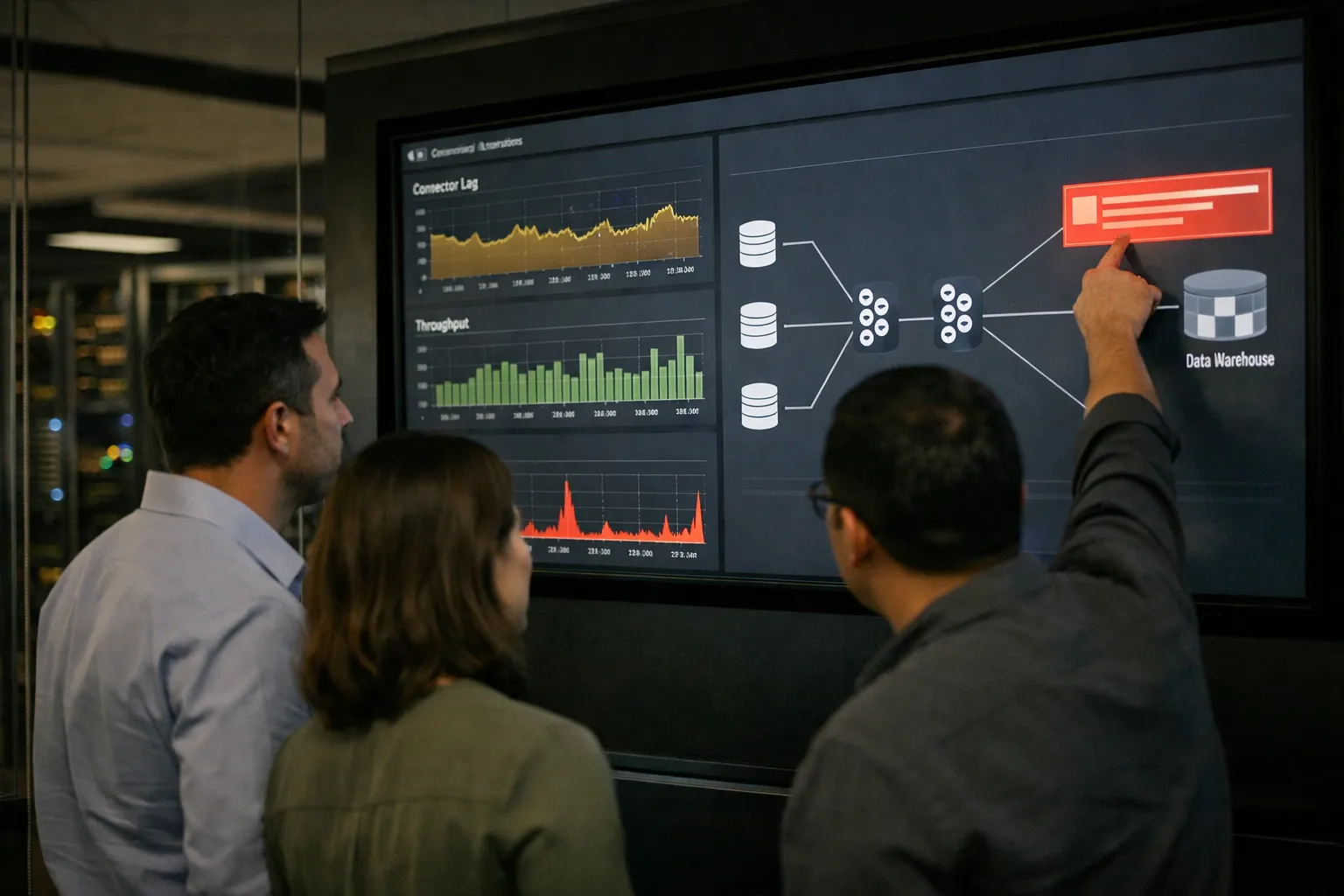
- Essential metrics: connector offset lag, per‑topic change rate, broker ingress/egress, consumer lag, schema registry errors and end‑to‑end commit latency.
- Distributed tracing: Propagate trace or request ids within change envelopes and use OpenTelemetry traces to measure latency from DB commit to consumer processing.
- Data observability: Run freshness, drift and schema checks continuously. Integrate alerts for sudden volume changes, schema breakage or tokenization failures.
- Playbooks: Maintain documented runbooks for offset resets, replays, snapshot reconciliation and schema rollback procedures.
Step 8 — Testing and validation
- End‑to‑end sanity tests: Verify single‑row insert/update/delete flows are visible across consumers.
- Snapshot and backfill validation: Automate diffs between snapshot data and streamed state to ensure idempotency and correctness.
- Schema evolution in CI: Run backward/forward compatibility tests and contract tests before schema changes land in production.
- Chaos and recovery drills: Regularly test connector and broker failures, network partitions and restore paths to measure MTTR and replay correctness.
Step 9 — Rollout strategy
- Pilot: Start with a low‑risk source and a single consumer (analytics team). Run for 4–8 weeks to validate semantics, transforms and playbooks.
- Wave rollout: Add sources and consumers in capability waves; require schema and masking policy compliance before onboarding.
- Platform adoption: Provide SDKs, onboarding templates, and a self‑service portal. Make the CDC platform the default integration path and retire bespoke polling ETL.
Measuring ROI (practical approach)
Translate technical outcomes into concrete business metrics:
- Latency improvement: Measure time‑to‑insight versus previous batch windows and quantify operational decisions enabled by fresher data.
- Operational cost savings: Compare consolidated connector maintenance and incident MTTR against legacy point‑to‑point ETL jobs.
- Developer velocity: Track number of integrations onboarded and average time to production using templates and SDKs.
- Risk mitigation: Quantify reduction in audit effort and compliance incidents due to centralized masking and lineage.
Example: a multinational retailer that centralized log‑based capture and standardized schema‑as‑code reported fewer bespoke ETL failures and faster incident resolution. Translate developer hours saved and fewer incidents into a realistic 6–18 month payback window depending on scale.
Common pitfalls and mitigations
- Underestimating schema drift: Prevent breakage with registry + CI gates and consumer contract tests.
- Neglecting idempotency: Include tx metadata and stable keys so downstream services can deduplicate reliably.
- Poor cost modeling for egress: Model cross‑region egress and tiered retention costs early and prefer regional brokering or compute‑at‑source if egress is material.
- Treating CDC as one‑off: Centralize operations, documentation and onboarding to ensure consistency and compliance.
Updated implementation checklist (Oct 2026)
- Inventory: source engines, versions, peak change rates and network constraints
- Chosen CDC engine and justification (open source, managed streaming, native change streams)
- Schema registry, schema‑as‑code, contract testing and CI gating
- Security: TLS, encryption at rest, KMS, RBAC, and field‑level tokenization/masking
- Observability: OpenTelemetry traces, OpenLineage integration, metrics, alerts and runbooks
- Testing: snapshot/backfill, schema evolution, chaos and recovery drills
- Onboarding: SDKs, self‑service templates, runbooks and SLAs for consumer teams
Case example (Oct 2026)
A global retail organization standardized on log‑based capture for critical OLTP using Debezium connectors deployed adjacent to primary DBs, streaming into a managed broker for multi‑tenant fan‑out. For analytical workloads they used the cloud warehouse’s native change streams to reduce egress costs. They adopted schema‑as‑code in Git with automated compatibility checks and implemented capture‑time tokenization for PII. Results: fewer bespoke nightly jobs, faster inventory decisions, measurable reduction in incident MTTR and clearer audit trails. Key to their success was modeling cross‑region egress and running tokenization near the source.
Pro tips
- Enforce schema checks in pipelines; fail fast and roll out changes only after contract tests pass.
- Prefer lightweight change events with references to large objects; fetch full payloads on demand.
- Use OpenLineage to connect change events to downstream datasets for governance and impact analysis.
- Where egress is significant, consider compute‑at‑source transforms and regional brokers to keep costs predictable.
Common Mistakes
- Deploying connectors without playbooks for offset recovery and replays.
- Failing to model egress and storage tiers before large‑scale rollouts.
- Assuming SaaS CDC vendors meet enterprise governance without additional capture‑time controls and audit capabilities.
FAQ
What envelope should we use for change events?
Use a change envelope that includes operation type (INSERT/UPDATE/DELETE), source id, capture timestamp, transaction id and before/after payloads. Align it to CloudEvents v1.0 if you require broader interoperability with serverless and cloud native consumers—this standardization simplifies tracing, idempotency and lineage integration.
When is native change streams (warehouse) the right choice?
Choose native change streams when the warehouse is the primary consumer and you want fewer moving parts, lower egress and simpler governance. If you have many heterogeneous real‑time consumers (services, caches, multiple warehouses), a managed streaming backbone gives better fan‑out and flexibility.
How do we manage schema evolution without breaking consumers?
Treat schemas as code: store artifacts in VCS, enforce compatibility via a schema registry, and run consumer contract tests in CI. For breaking changes, use versioned topics, transformation layers or a phased consumer migration with feature flags and contract‑based adapters.
Is exactly‑once necessary for most flows?
Not usually. At‑least‑once is simpler; design consumers to be idempotent using txId and before/after data. Reserve exactly‑once semantics for flows where duplicates cause unrecoverable errors (billing, financial transfers). The operational cost of EOS can be significant, so apply it selectively.
How should we handle large binary objects (images, documents)?
Do not stream large BLOBs inline. Emit a lightweight change event with an object‑store reference (signed URL) and content hash. Consumers fetch full objects on demand. This reduces stream throughput, storage costs and egress fees.
Bottom line: in Oct 2026 the question is less whether to adopt CDC and more how to do it safely, economically and governably. Start with a small pilot, enforce schema governance, instrument end‑to‑end observability, and treat capture‑time protections as a first‑class requirement.